Saturday, May 20, 2006

My second destination on my little travel excursion was the city of Norwich. I always wanted to see it, and I was not disappointed in my stay there. I got to see the coastline, which was a good thing, but I was rather tired of Great Yarmouth quickly, and I made my way to the train station (on a really bad side of town--worse than the rest of it) to try and catch an earlier train. Fortunately, there is consistant service from Norwich to Great Yarmouth and back all day long.

At first, I thought I was going to be disappointed by Norwich, too. The train station is outside of the city (in fact, it wasn't even on my town plan, which freaked me out at the beginning), and subsequently, not in the best of areas. When I arrived, it was just after school had ended and apparently a lot of students come from neighboring towns on the same line I was riding, which meant quite a hastle and the need to pull out my 'footballer'-like skills just to exit the train.

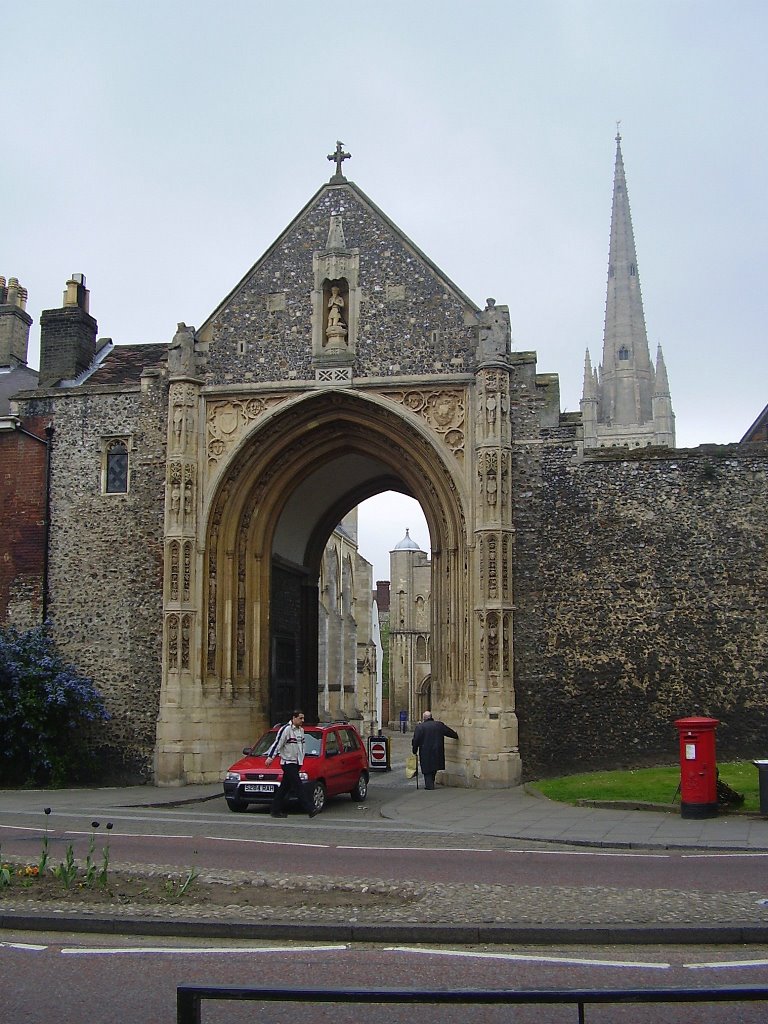
The hotel wasn't too far away, thankfully, and in a 'central' location--it isn't in the center of town, per say, but it is right by the Cathedral. The gateway with the tower behind it was right outside my hotel. Of course, those people had to park illegally in their Fawlty-Towers-style car before I took the picture, but so be it. The Cathedral was more of a complex--parts of the area within the gates had been updated, but you could distinguish between the buildings that were contemporary to it and those that had been added later or rebuilt. The area is called Tombland, apparently, and is one of the nicer, more historical, sides of town.


In addition to the Cathedral, there are 32 existing "parish" churches in Norwich. In their hayday, there used to be 61. Most of them are built in the usual "gravel" method, using smaller stones framed in something more substancial. All of them have some kind of bell tower on them. The tower you see here belongs to St. Andrew's which was nearby where I was staying in town. The reason I sought out this one in particular actually had to do with my previous job. The "congregation" of "pilgrims"--or the more religious sorts among them--were all minstered by one John Robinson. Robinson, before being ousted due to his "reformist" beliefs in the early 17th century, was a minister of the Church of England in Norwich, and this was his parish. The whole time I stayed in Norwich, this church was closed (hence the bright yellow sign on the doors). I returned several times there to no avail. However, I did explore the interiors of a number of other, similar parish churches nearby to get an idea of what it may look like inside. Behind it is the Bridewell museum, which is a smaller establishment that focuses on the manufacturing history of Norwich. It is very much like looking at the Lowell mills in Massachusetts, but with several types of exployments rather than just one. Regardless of some failed manufacturing trades, the city, unlike American cities on the east coast, is not dotted with large, hollow, empty brick mill buildings (New England could certainly take a hint).


One of the first things I did when I got to Norwich, regardless of my being exhausted having treked all around Great Yarmouth with my luggage before arriving, was take a walk around the city. There is a huge, mostly outdoor, shopping center there that is in the same place the markets were hundreds of years previously. In the middle of the market, going up a hill, is St. Peter Mancroft church--the outdoor archway is photographed here. According to information in the Bridewell Museum, the cattle market existed just outside of here at one point. In front of it is one of the BBC buildings and off to the right is the main courthouse. It really borders on the upper end of the center of town. Again, I was unable to go inside and take a look--this time due to a late afternoon arrival and the Sunday service on the following day. The original building was Norman, but it was rebuilt and reconsecrated in the 15th century, so that is the style you see here. It really is the largest of the "parish" churches in Norwich--built in the same syle, but approaching more "cathedral-like" architecture.

I saved my trip inside the Cathedral until last given it was on the way to the train station (at that point, I was hoping it was, and I turned out to be right--no thanks to the stupid map I was carrying. It is another Norman foundation--very Romanesque in style but moving in the Gothic direction.
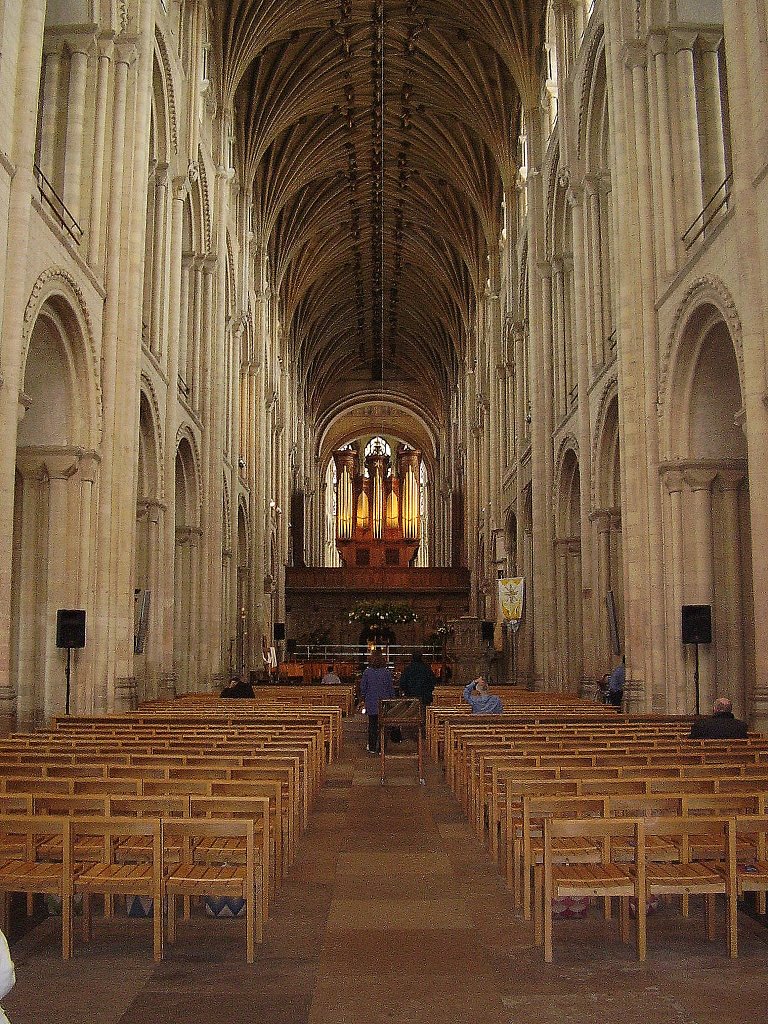

You can see the inside of it here. I got there right when they were about to begin Evensong services, so I didn't get to go around as much as I would have liked. It certainly looks Norman--round, decorated arches and heavy pillars, but you can see the more complicated ribbing on the ceiling, which is more Gothic in style. It is also much lighter--unlike Durham, which is Romanesque through and through, Norwich, with its incorporation of Gothic techniques, takes on a slightly lighter feel. At the back is the organ, which obscures the view all the way down the nave. There is a cloister attached, too, and a few ruins of other parts of the monastery as well as a hospital. The tower is rather distinctive at Norwich, which is probably an identification point for more experienced cathedral-goers than myself.

One thing that I was impressed by was how the Castle dominated the landscape. It is on top of a hill across from the market, so would have been right in the center of town. The Castle was my first stop when I did tour the museums, and I wasn't disappointed. It is an art/archaeologial museum as well as a historical building in its own right. The Castle on the hill gave a great view of the city. I was fortunate enough to choose to take a tour of the prison vaults, which are inside the hill more or less, and had a fabulous tour guide who knew a lot about the city as well as the Castle. She showed me the vaults, explained their use over time, she knew the practices and what the Castle represented in the city itself over time. I was

more than impressed, and was fortunate enough to be the only person on the tour with her. The inside of the building you see pictured was used to house the "common criminal"--debtors, thieves, and the like--and they had a sort of "community" inside the walls there. Before that, it had been a Norman palace, but over time, the Castle was turned over to the city and upon that change of hands, it became a prison. This view is from the bridge crossing over to the Castle, and apparently in the Early Modern period, on Saturdays at noon, there would be an execution--or more than one execution--there. Those that were executed didn't stay in the prison "community," but were instead relegated to the vaults underneath the Castle. Later on, the Castle's prisoners became the subjects of phrenologers who made their death masks and explored the bumps on their head to try and determine if any signalled they would become criminals. In the nineteenth century, it became a museum, as it is today.

Accomodations here very much outclassed those in Great Yarmouth. I stayed in the Maids Head Hotel, which is a 13th century establishment added to and built upon over time. It was a great place--very clean, very nice rooms, and fairly affordable. It was right by the gateway to the Cathedral and the market wasn't a long walk away. I greatly enjoyed my stay there.

So, Norwich earns itself an 8 and 1/2, putting it in the lead over Durham, York, and Great Yarmouth at present. Let's see if it maintains that lead...

Tuesday, May 16, 2006

I'm home again after a trip across southeast England. I started in Great Yarmouth.

Great Yarmouth certainly defies its adjective--lacking in "Greatness" in any capacity. It's not much of a place for history-oriented people, but even though the history isn't readily apparent, that doesn't mean that there isn't any at all.

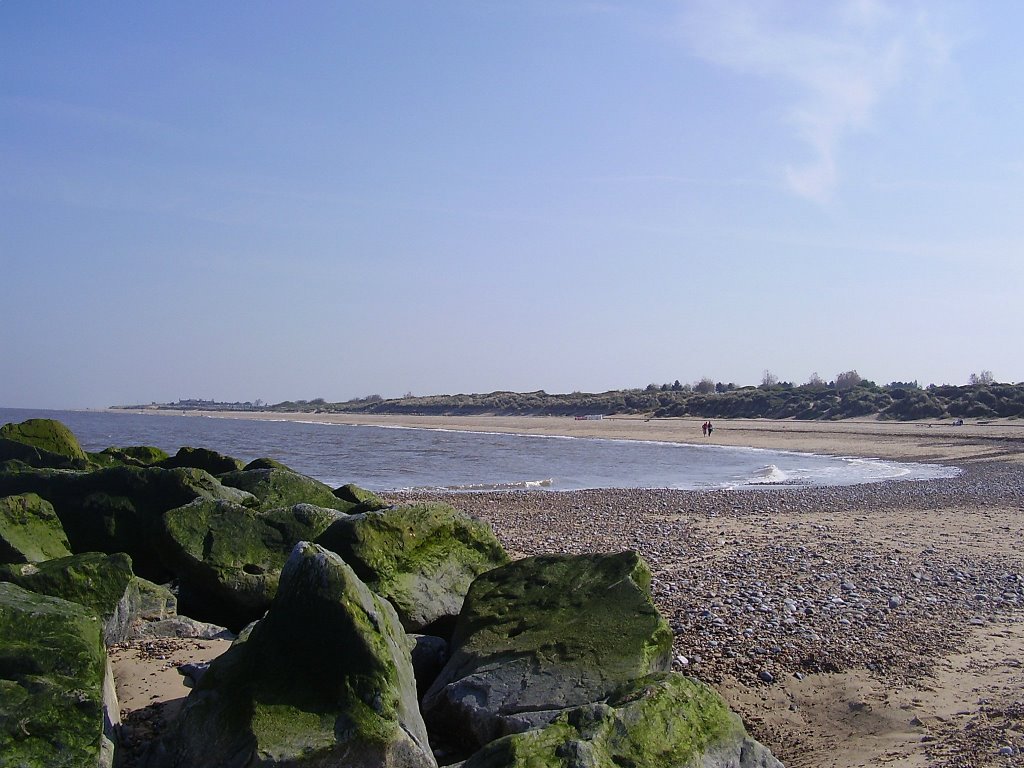
The shore itself is nice. Once you get past the tacky fun-parks and gambling establishments, you can walk for miles down the beach. I found that in comparison to New England beaches, the sand was far more glassy and there were an abundance of rocks smoothed over by the tide. It surprised me just how quiet the walk was--only a few other people, residents I suspect, were taking advantage of the nice weather and the beautiful scenery. Something I didn't know before arriving was the existence of a wind farm on the water. There is a controversy on Cape Cod over the installation of a similar wind farm off the coast in the Nantucket direction--apparently this will "wreck the view out there." Frankly, the wind farm was quiet and graceful--certainly the only power-generating system I have ever seen that is easy on the eyes.
On my second day, I took a walk around the town to get a look around. I came across the local parish church, St. Nicholas. It's kind of a Victorian "re-do" of the Norman Church. When you go inside, the arches are original, but the walls have clearly been rebuilt around them. It also "said something" that the nicest place in the whole town was the cemetery that spread out from the "nucleus" that is the churchyard. It was very quiet and well kept given that a huge town effort is focused on the maintenance of it. At least if you keel over while playing at a slot machine, you first, won't have far to go, and second, you'll be on a quality piece of real estate.

I was walking around on the "Quay"--and I have no idea what that means even though I am from a coastal area originally myself. I actually had stayed on the Quay, which is by the River Yare (on the other side of the town from the coast), but I didn't actually stroll down the street until after I made my seaside stop.
When I did, I came across a ruin of a Greyfriar's Abbey. It wasn't visible from the road at all. I turned down a side alley and literally walked into it while I was inevitably getting myself lost. Anyway, it would have been outside of the city proper in its time--about fourteenth century or so. The picture of the brick structure with what looks like a chimney protruding out of it is the ruin. On the other side you can see the arches a little better. It isn't very big, but you can still get a sense of the turns and almost tunnel-like network of rooms that would have existed there when it was a whole building.

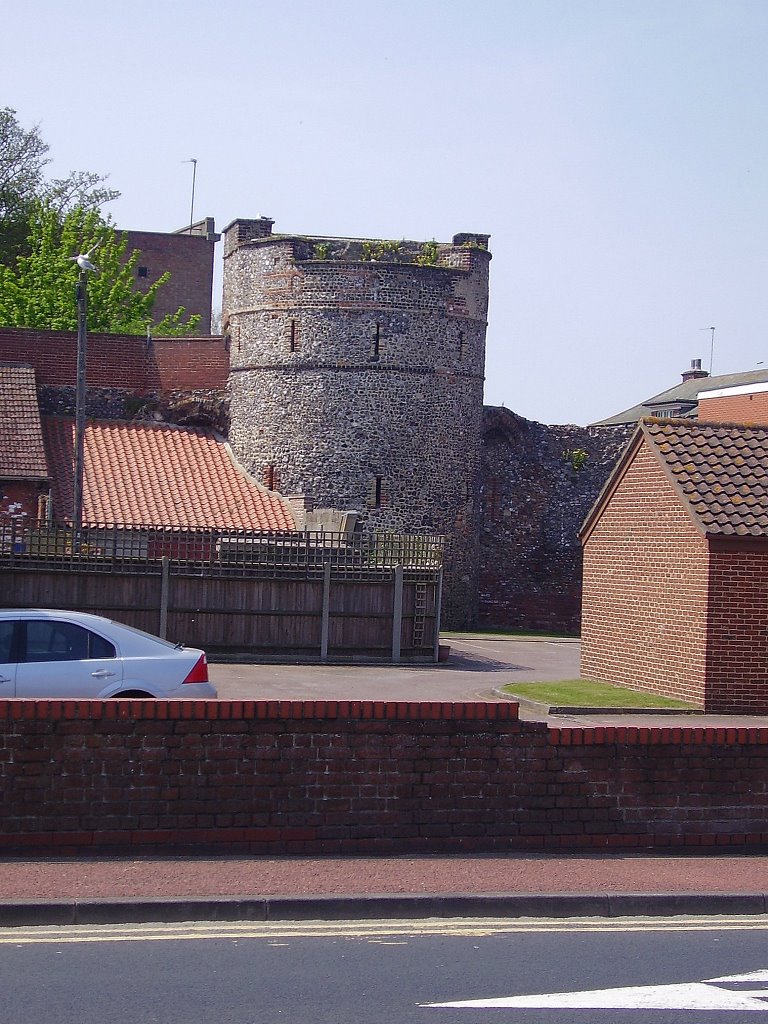
It may sound odd, but one of the most interesting features of the town was the remains of the town wall. There isn't much of it around, but every now and then, you'll look at a row of houses and spot the tell-tale arches or tower remains. Apparently most of it came down in the 1840s, but there are still sections around. There is a whole section still existing in the graveyard with a very cool tower at the end of it. I was walking down a street, desperate for the Sainsbury's nearby, when I turned and saw the tower you see in the picture sticking out from a bunch of commercial buildings across the street. The curious thing about it was the direction it faced in--it was facing to the water. Today, the majority of the town is apparently outside of where the original town would have been encompassed by the old wall.


Well, the trip was worth stopping there for a day, but I certainly wouldn't recommend actually travelling there for a prolonged period of time. The few things I managed to capture is the city's history--and that's all there is. The rest of the waterfront looks like a British version of Atlantic City that is even more tacky. I visited in the "off-season" so I can only imagine what it is like down there during the summer. It is windy down there--putting the wind farm to good use, of course, but that makes it hard to sit for a long time by the water. I noticed a lot of the "in the know" folks had these odd reems of tarp that they posted in the ground around where they intended to sit in the direction of the wind to block it.

One final note--I stayed in a place called the Star Hotel. It wasn't that far from the train station, which was an advantage for me. However, I was reminded of the "Royal Imperial Windsor Arms" from the movie "National Lampoon's European Vacation." If you don't know what I am talking about, the movie is well worth watching. At any rate, for those of you who do, I got two TV channels, one of which was a 24 hour run of news (the "Cheese Show"), I got no hot water from the shower head, but I got as much of it as I wanted to take a bath (sans whistling robed stranger), to make the toilet flush, I had to hold down the weight inside of the back of the bowl (that has no specific equivalent, but is just typical), and the bed, a "double" was actually two single beds put together.
Thus far, Durham will get 7 points out of ten, York gets 5, and Great Yarmouth will get 3 and a half.

On to the next location...

Sunday, May 07, 2006

Letter to my Former Self

Dear "Former" Self:

The unfortunate thing about this letter is that you won't get a chance to read it. However, that does not defeat the purpose of this, my "Present" Self, composing it.

I know school is a pain in the ass. All subjects like Math and math-related Sciences seem to do is bring your overall grade down. And I know you look at your friends who can perform just as well in those subjects as the liberal arts and ask why you can't do that, too. Well, I don't have an answer to that question, but I can tell you that your seeming "deficiency" in those subjects didn't hold you back in the long run. Even when you got older, you still wished you could work out an equation with some reasonable assurance that it was somewhat right, but other than the GRE exam, you won't need to see those odd symbols, parabolas, sines and cosines again. Your staying up late nights doing all of your homework, reading and studying for those AP exams will pay off--in the long run you will be able to do what you can only imagine "in theory" right now: you will be able to go to the school that you choose as the best option for you, if not quite for what you expect at first.

There will never be a time when your parents aren't looking over your shoulder. What you will learn is that it is better to make it easier for them to do that. They'll never admit to you that they were more strict with you than with your siblings, no matter what you do, so just keep that knowledge to yourself. It won't get better, either--you'll see what your siblings will be able to get away with, things you would have been grounded for ages for, and you'll immediately feel the injustice of that. You'll hide that well, though. The only thing I can say is that as you get older, you realize that your parents are human, too. They made mistakes and they had to learn how to be "parents" just like you learn how to do anything else in this life. You will have to admit, though, that their strict upbringing impressed upon you the ability to choose well between right and wrong. Had they been more lax, well, you probably wouldn't have turned out as well.

Your parents will never like any of the guys you bring home--you may as well know that right now. It's true, some of your choices won't be very good, but it is impossible not to throw into the mix the fact that you are the oldest and that it is harder for them to part with you in some ways, especially your father. However, on the other hand, they will always be accepting of your friends, no matter who they are. You are going to realize that you tend to stay in relationships too long, especially when you feel like you don't have any other dating options waiting for you if you were to end what you are a part of. As you move from place to place, school to school, and job to job, your experiences will impress upon you that there are two classifications of things in life: things that are meant to stay with you and things that aren't meant to last. Once you learn this, you will be more and more able to distinguish between them. You will go through a process where you will have to do what you know inside of you that you need to do--you need to go it alone to be able to learn what "you" is. When that happens, it won't matter if you're on your own or not anymore. And, it won't be as scarey as you think. In the end, you will be content with your own company and more comfortable with yourself. Both of these results will help you build better, longer-standing and more stable relationships of all kinds in the future.

Secrets you'll have to admit to yourself:

You're a romantic. Just live with it.

You can throw a ball as well as any guy--don't let them tell you otherwise.

You'll always be a "big sister" no matter where you are or how old your siblings get.

The Indigo Girls will save your life more than once.

Relationships aren't always what you think they are, and love is going to defy conventions for you.

You'll always want to do dozens of things with your life. Narrowing that down is not necessarily a good thing.

Above all, relax. When you do that, you will invite more people to you. You're going to have to learn openness, and thankfully you will, but not without a lot of help. That means not shutting anyone out who has something to offer--and that means everyone.

Until your "Future" self comes along,
Your "Present" Self

Wednesday, May 03, 2006

Visit to Durham

At the beginning of this week, I went to Durham. This is the first time I have ever been out there, regardless of having been accepted to the University there. I considered that offer first, actually, before I ended up at York. Therefore, I was all the more curious to see the place.

The "city" is built on a hill overlooking the River Wear, but unlike York and the Ouse, the surroundings have maintained a certain natural beauty, probably because of the high embankments as opposed to the low, flat lands that surround the river in York.

The first picture here is a view of the countryside from the top of Durham Cathedral. Lots and lots of narrow steps, twisting around in a circle, but once you get up there, as you can see for yourself it is certainly worth it. I liked this side because of the green fields you can see on the hill.

Here is the Castle, which is right next to the Cathedral on the top of the hill. Today, it is actually a part of the University, and there are students who get to live in the keep here. I went on a tour guided by a history student, and the University seems to be a lot more formal than the University of York--it's been around longer, so kind of maintains some old traditions, like formal meals and surprisingly to me, a lot of student religious services. The best part, which you can't see here, was this incredible old Normal Chapel that was walled up about fifty years into the life of the first castle, and then rediscovered in the 19th century as completely in tact as time would allow. It was made of sandstone, so the interor was brownish in color, almost marble-like. It was also very dark, and you could see just how thick the walls really were--about six feet. We didn't get to see the inside of the keep here because of the student accomodations, unfortunately. The main buildings of the castles are actually off to the left beyond a Victorian reconstruction of a medieval gate system.


This is a view of the Cathedral, but you can only see this side if you stand on the other side of the river, which puts you at a rather low angle. It is Romanesque, which makes its architecture rather large and clunky, but certainly Norman in style. The columns on the inside are huge and the archways are rounded. There are a lot of windows in the towers that you can see here, but not so many along the sides of the building--not like the large, spacious Gothic style windows that make Gothic cathedrals feel so much lighter. The key features of the Cathedral, however, are the tombs of St. Cuthbert and Bede. Bede gets a box to himself on this side of the building inside a chapel. Apparently, his bones were stolen from Jarrow by the monks at Durham in the 11th century. Go figure. Anyway, St. Cuthbert was also "moved" here, but his tomb is more like a shrine on the other side of the cathedral. He is buried on an upper "level" beneath the floor there. There is also an exhibit that they called "The Treasures of St. Cuthbert," which was rather misleading because I thought it meant that there was more from his burial that was going to be on display. Instead, most of it, although impressive, was just comprised of some of the Cathedral's artifacts, like seals, manuscripts, and vestments. However, there were a few things that were specifically Cuthbert-oriented, such as a cross with a garnet inlaid in the middle--found on his body even though the majority of his treasures had been pillaged years before. There were also fragments of some kind of Byzantine cloth that covered his remains and a once silver covered portable altar. Most impressive was his coffin, wooden, original, and carved by the Anglo-Saxons with pictures of the apostles. It was in fragments, but the museum had put it back together so you could see it as it would have looked in box-form. It was a great visit, and a very impressive place (and very tiring given the 250 stairs to the tower).

This is a view from one of the bridges over the River Wear. In the distance is another bridge--a footbridge--that allows you access to the level the Cathedral and Castle are on. It was the usual cloudy British day, but regardless, you really can see how beautiful it is there with all the trees--in fact, I think this is the largest concentration of trees I had seen to date in England. I took a walk on the right side of the river along a footpath there, and it was fantastic. I followed it past that bridge to another one around that corner of trees you see back there.

Although Durham is small--smaller than York, I really liked the city. If I had been a more efficient planner, I would have stopped in Newcastle first--only another 25 minutes up the road by train, and then stopped by Durham on the way home to York so I could have seen both places, but it gives me an excuse to hop off the train again and see this place under perhaps some more sunny skies. It was definitely worth seeing.

Well, thank you, Cuthbert and Bede, for showing me your final resting place. It may not have been your first, but hey, you could definitely find a worse one for your last.

Monday, May 01, 2006

Number Two: Emily

This is Emily.


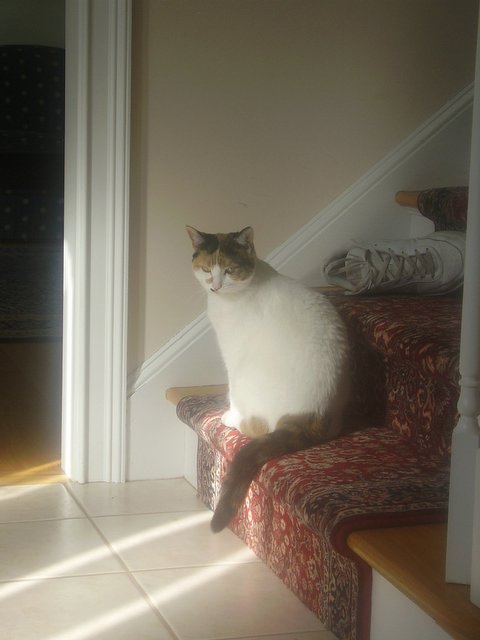
Emily is Anne's sister, and my sweetest baby. She is smaller than her sisters--they are both longer, especially their necks, while Emily is a rather compact little thing. She is also oddly colored, as you can see. My father refers to her as having "calico ends" in the fur on her head, tail and paws, but nowhere else.

At first, she got into everything. I think she believed her name was "No!" when she was little. However, she had such a way about her that under almost any circumstances, she was able to "make friends" (this discounts Phoebe). She did this first with my roommate's cat--a huge Maine Coon named Geronimo who had the brain of a rugby player. As soon as she saw him, she nuzzled right into the bib of long fur under his chin, and he was hooked.

Her favorite friend, however, is Harriet. Harriet, who is notoriously difficult to get along with, has taken to Emily, and tolerates her company in ways she does with no one else, feline or otherwise. Harriet suffered from a glucose crash a few years ago, and she couldn't see or move for about a week while she recovered. We kept her in a laundry basket, lying on a blanket, and always put that basket where there was plenty of human and cat company. One night, Harriet was sitting there, sprawled out, at least partially blind, and Emily, perked up with a tiny mew, jumped right into the basket and sat with her. This action met with mutual purrs from both of them.

Emily expresses joy by rolling all over the floor when you pass by her. She'll purr whenever she meets up with anyone who may offer her some attention, and she was the only of my cats to like my last boyfriend, Matt.

Perhaps her sisters could take a lesson from her kindness....

Perhaps we all could. Posted by Picasa

Saturday, April 29, 2006

"My Kitties" Number One: Anne

I was cleaning up my room, and I realized how much I missed my kitties.
I thought I might introduce them to you.

This is Anne

Anne
is one of three kittens I picked up in October 2003. Anne apparently looks the most like "mom" who was ferrul and living in Little Compton, RI. A curator at a historic home in that rather deserted part of the state found three of the four in the litter and took them into her own apartment, already inhabited by two older cats, one of which developed a "stress disorder" having to deal with the new "children."

Anne has two sisters, Charlotte and Emily. She tends to communicate her desires vocally, and she has a different tone for "I want this" and "No, mom, I didn't do anything wrong, really..." She frequently teases Phoebe, my mother's cat; however this recently resulted in several cuts on her nose and the subsequent decision to cool it for a little while or enlist her sisters as reinforcements. She usually figures out when I am about to go to bed and stakes her claim on the foot of it before anyone else can.

Here, she is in one of her more well-behaved states. I would like to mention that after she woke up from this particular nap, she cornered Phoebe under a wheeled footrest with Charlotte and then went outside and refused to come in until about 2 am. Lesson: Don't be fooled by the innocent "nap state." Posted by Picasa

Wednesday, April 19, 2006

My Love/Hate Relationship With England

Now that I am fresh--well, maybe not fresh given the time span between my last shower and the present time--off of the plane from Manchester, I was thinking about the good and the bad in England. It's funny how perspectives differ. I was sitting in an aisle seat (thank you, Dad) on one of those airbuses. Across the asile from me was this girl, probably about eighteen or so. Once we landed in Manchester, I am thinking "here we go again," and she says, "I am soooo glad to be back in England." Go figure.

So as to get the insulting part of this out of the way first, I present:

The Bad

Hot and Cold Taps: Why these can't be combined into one tap whereupon you can regulate the amalgamation of the hot and the cold water before it hits the sink basin, I will never know.

Weather: Now, New England is world renouned for being unpredictable. It could be seventy degrees in January and then you get a blizzard in April. But, here, albeit consistent, the weather is usually "rain expectant" no matter how nice it may be when you wake up in the morning. The dampness stays everywhere here. I remember mentioning the state of the ground--the wet, muddy mess that is anything with grass growing on it--to an English student, who said, "I didn't know the ground was suppposed to be dry in winter."

Vegetables: Sometimes, you just don't want tubors as a side dish to, say, everything.

Breakfast Food: To continue the food trend, I was recently reminded of British morning food options, including "pancakes," which are really crepes (but the British don't want us to think they have anything in common with the French), "golden syrup," which is essentially butter and sugar melted together (where is the maple, my friend?), and "bacon"--thankfully, my previous pilgrim practice of soaking bacon that has been salted has come in handy. Also, there is what they refer to here as a "full breakfast," which includes tomatos, mushrooms, and the ridiculous British version of baked beans.

Coffee: Alas, I must bid a temporary fare-well to my beloved iced coffees, given even the folks at Starbucks don't know what I am talking about when I order one here.

No Driving: Not to say that I would ever attempt to drive here, given I would probably turn out looking like Clark Griswold in his European Vacation movie (sans Eric Idle), but there is something to be said for being your own means of transportation. You can get where you want when you want to taking your own personal routes, etc. If I want to be my own means of transportation here, I have to don the comfy shoes and start walking--never forgetting an umbrella.

Money: Congrats, my English friends, your money is worth far more than my own. I put an exchange in and then, whoa, I have half as much. I also noticed that in the US, products I can get both here and there are priced the same given the scaling. For example, I can get an item for 200 dollars in the US, and here because people make more money, it costs 200 pounds, which is about 350-375 dollars.

The Internet: This only really applies to my living in campus housing, but the internet here is crap. I can't get on and depend upon it, and the proxies I have for features like AOL never seem to work for long. I also can't upload anything from here. I'm sure this is true of most Universities, but still, it is a pain in my ass.

Pharmacy System: In the US, if I need something, I can generally get it. However, if I want anything on the "adult" level of strength here, I have to have a discussion with a pharmacist. Let's just say I would prefer not to talk about menstrual problems with a complete stranger, albeit professional, in front of about seven other customers in line in the only Boots in the whole city.

My Hair: In the US, I have ever so many more options. Here, I couldn't figure out why so many people sport multi-colored dye jobs that were cut perfectly straight. The problem here goes back to the weather, I think. No matter what you do, no amount of ultra hold gel will keep curl in your hair. You hit the air outside and it is gone in thirty minutes, rain shower or perfectly clear day. At home, I can curl it once and it lasts until I wash it, giving me so many more stylining options--which is essential.

Job: Because I do not have a working Visa, I cannot work in the UK. I was thinking of doing some volunteering around since classes are over, but I really can't pick up any cash. I would like to do something other than sit and read in solitary confinement, but I can certainly rule out making some money on that deal.

The Good

Now that all of the British folks are groaning, growling, and scrolling down angrily to the "comments" section, I will present the other side of the line.

Sunlight Hours: New England was nice, and I thought it was light rather late, but when I got here I was completely surprised. The sun rises before six and sets at eight already--the longest day of the year in NE isn't even that long, and it's only April. I am really excited to see how long it stays light out when we do near June. The idea of a lot of daylight hours is very motivating to me, so, I can't wait.

Proximity to other Countries: Most people will say that the USA is like one huge country that incorporates other cultures in the same way that Europe incorporates other countries. However, everyone still speaks (some form of) English and there are a lot of cultural similaries throughout. England is really close to a lot of different places and it would cost me as much to get to them from here as it would to go from New England to Washington DC, which isn't far away. I hope to take advantage of it this time.

Bus/Train System: Although nothing beats being able to hop in your car, turn on your radio, buy a coffee, and drive yourself, the English transportation system is actually really, really good. I can get where I need to go by bus or train fairly easily as long as I plan ahead and am on time. It's much better than HAVING to drive, which is really what it is like in the US everywhere except for right in the middle of most major cities.

Hair: As much as I hate the fact that curl is a moot point, I can say that the dampness keeps my hair down when it is straight--no fly-aways, nothing.

No Snow: I may not be the biggest fan of this rainy country, but at least the concept of a Nor'easter is a foreign one.

Mail: I send away for something, and I have it within two days--a day in some cases. It pays to have a small country. In the US, I could send away and not get it for weeks. Then UPS will inevitably lose or damage it anyway.

Some Pharmacy Items: In some very rare cases, I can get things here without a prescription that I can't in the US. I remember having an infection once, and I ended up buying a pill for it that I couldn't get without a doctor's check at home. I took it and four hours later, I was fine. I would have had to wait to see the doctor, wait for the prescription, pay a ton for it, then take it and wait in the US. By then, the infection would have probably healed itself.

Bakeries: I can get quick food from someplace other than a McDonald's or a Burger King. Different may not equate to healthier, but at least it is something.

Nice People Give Directions: All bets are off in the US. You could ask an old lady for directions who will hit you with her purse or a cab driver who doesn't know the answer even if he has driven the same city for twenty years. In any case, you get an attitude. Here, they not only tell you where to go, they direct you, sometimes walk with you, and call you "luv."

Well, there you have it. I am back in the UK. At least I get a room away from cultural immersion, unless you count the Chinese students on the hallway--but that is a different culture all together. Ah, well, back to Monty-Pythonland.

Thursday, April 13, 2006

My Harbor by the Hearthside

Years ago, I had a cat we called "Barney." He was another abandonment case, and he was a "one and only" in terms of the "domesticus" species in our house. Then, one December night, Dara showed up at our back door. Barney wasn't thrilled with Dara at first, but she was more than happy to allow him to have his run of the house, so he quickly realized the benefits of remaining king of his domain and having a playmate. They used to play this game we termed "chase." They would run after each other all over the house, taking terms being the chase-er and the chase-ee until one of them reached the slate platform in front of the fireplace. Then, the running stopped. The chase-ee was on "base" and could not be touched. Eventually, so the game would continue, the chase-ee would leave this safe spot and the running would continue in this cyclical form until one of them got fed up and gave the disapproving "hiss and swipe" to get the point across as clearly as possible.

Regardless of our experience in this world and how it increases over time, we never seem to expect bad things to happen to us. They happen over and over again, and yet, they remain surprises, they take us off-guard. No matter how level headed you are, I honestly don't believe anyone is so well adjusted to the mysteries of what we call life to say "I just roll with the punches," implying that those things have no negative effects. Of course they do. We shouldn't be striving for the unattainable ideal that is not allowing any of life's ridiculousness to throw us for a loop, make us upset, make us take a long, hard look at ourselves. Instead, we should be ready for those things to happen--we should expect them in the unexpected, allow them to produce their effects upon us, and let them ultimately strengthen us so we learn something from them. Ignoring them, letting them slide off of us like "water on a duck's back" cheats us of too many valuable learning experiences.

Well, we admit something bad happened and we feel bad now because of it. Now what?

One thing I have discovered over time is the concept of that "base" as being the one thing that reminds us that everything can and will be OK. There are things within ourselves--qualities, interests, dreams--that existed before that happened, and will exist long after we have forgotten why we were so upset in the first place. It is too easy to let those events and how we feel about them subsequently narrow our vision and focus. That is what makes learning how to completely ignore them so attractive. We get so caught up in how we feel, how upset we are, that it can become literally consuming. However, that "base" can be the one thing that keeps us from sinking and gives us that all-too-necessary perspective.

What's your base? Is it what you want to be, who you want to be? Is it a happy memory, a kind person, a beautiful song, a quiet place? It is your interests, your thoughts, your faith?

Mine is usually what I want to do--projects I want to accomplish. I think about my writing, listening to certain music that has stayed with me over time through many similar situations, places I saw and enjoyed before it happened. Simple, yes, but they remind me that there was something before and will be something after that is positive. It confines that moment to what it is--a moment boxed in on either side by other moments and experiences much more well worth remembering.

I'm going to sit on my slate platform in front of the fireplace for a little while, because this next game of chase, well, I don't intent to lose ;-).

Harriet Update: Although we did think that her time was up a few weeks ago, she has subsequently recovered from her illness and is doing just fine. She is treated every three days with a hefty injection of antibiotics, to which you can assume she readily objects. Luckily no one has landed in the emergency room....yet....

Tuesday, March 21, 2006

Ode To A Cat

I am going to tell you the story of Harriet.

Harriet is my cat. We don't know how old she is, where she comes from. I picked her up from a local animal shelter--the kind that does not euthanize their residents--in 2002.

She was older, she ended up being diabetic. She wasn't the type to cuddle up to you, she didn't want to be or look cute. She just wanted to be herself. She felt like sitting at the top of the stairs, so she did so. She wanted me to feed her, she let me know. She didn't like my boyfriend, she made that highly evident by using my living room rug as a litter box.

Although declawed and aparently sporting only one fang, she was a proficient hunter. In order to "thank" me for giving her a secure home--something I think she lacked for quite some time--she would take care of the mouse problem in my apartment. The first time I realized she had this talent, and this gratitude, was when she, while I was at work, killed an unfortunate rodent in my kitchen, cleaned it off, and spread it out nicely in presentation form at the top of the stairs leading to my apartment. When I got home, reached the end of my ascent, I look down to see this precious possession given to please me, and I completely freaked out. Harriet, on the other hand, simply looked at me in a confused fashion, and then, assuming that it wasn't in good enough condition for me, proceded to clean it off more just in case that was the clincher she was missing.

She graduated from this to actually demonstrating to me how she would catch and kill the unfortunate creatures. I awoke once in the middle of the night because I heard a wail...thinking she was ill, I turned the light on. No, she was there, sitting proudly on her haunches, with another victim dangling out of her mouth. Upon acknowledging my now awake state, she dropped it to the ground. Yes, it was still alive. It immediately started to jump about to escape, but Harriet had other plans. She, with lightning fast action that I thought was impossible for a cat her size, immediately pawed it down. Unfortunately, it buried itself in a pile of my laundry, but she insisted upon watching that hill of dirty clothing until I ended up washing it a week later, just in case it came back.

Harriet was queen. She did not like her authority being challenged. Her first test was Geronimo, my new roommate's cat. He was your typical "dumb guy" in cat form. He just wanted to play, she wanted him to get lost. I brought her back from a short sojourn home and he excitedly greeted her at the door when she came in. This good-natured welcoming patrol was met with a swipe with her unclawed paw across his face, and a resulting "what did I do?" look in cat bewilderment from him.

When I got my little ones, she tolerated them. She seemed to be happier in the company of her own kind. As one of them, Charlotte, got a bit bigger, she thought she was in a position to challenge Harriet for power. Charlotte made the mistake of hissing at Harriet once, and she received the same buffet to the face that Geronimo did in response. To make her point all the more clear, when Harriet saw Charlotte again in passing, she wacked her again...this time sending her clear across the floor.

Harriet did "crash" in the diabetic sense once. Since cats can gradually recover from diabeties, her body started to make insulin and we didn't know. Suddenly, we found her on the floor, completely collapsed. We took her to the vet and had to painstakingly look after her for a few weeks while she recovered. For a while, she couldn't walk, and my mother tried to wash her with the cat equivalent of a baby wipe. My father described the sounds she made as "nothing he had ever heard any animal make before....but they didn't sound good." After my mother finished, Harriet grabbed the discarded wipe in her mouth and shook it back and forth as if to teach it a lesson for its impudence.

During this time, Emily, another of my little ones, who loved Harriet very much, would jump into the laundry basket we kept Harriet in and sit with her. Somehow, Harriet knew she was there, even though her crash rendered her temporarily blind. Harriet purred, and so did Emily. All of the other cats were too afraid to go near her, but Emily stuck by her.

Harriet may have hated car rides, she may have been rather unfriendly at times, but she was probably the smartest cat I have ever had. She always "knew" something was going on---like she was just one step, as opposed to many, from understanding. She always tolerated other cats, save the ones that challenged her authority. The best part was that she seemed happy--she had a home, a secure home, and that was something she never had before. Someone abandoned her, and that made an imprint on her mind. When I moved out of my last apartment, she crouched in a corner, desperately worried that we were going to leave her behind. Anyone that thinks that these kinds of things do not affect animals--that animals aren't "smart enough" to remember them or for them to make a permanent imprint on their minds just like us--has never seen a look on a pet's face like Harriet's that day.

Now, she has an infection, and one of those that may indicate the presence of something much more dangerous.

For nearly four years of her being my companion and reigning queen of my house, I want to thank her for being herself. She didn't offer any apologies for being herself--for wanting things her own way. She knew that if we, or anyone else, didn't like that, she could make it on her own because she had.

If a cat could show you how to be more secure and be comfortable with who you are, she did. And if this is her time, she will be missed. But somehow, I know that she will be more tranquil, more peaceful about her own passing than I will, and she will probably be the one to comfort me in the end.

Friday, March 17, 2006

Let's Play A Game....

Ok, I was surfing around other blogs, and I saw this idea come up--then I was inspired to go visit a tarot card reading site, and I thought, let's combine the two activities into one.

How to play the game:

Put your music list on "shuffle" (no cheating, damnit).

Read each premise below and think about the song that the computer selected in relationship to it.

Now, to make this more interesting (the blogger had picked out random questions about life--the kind of stuff you ask a Ouija Board), we're going to combine this with two traditional tarot spreads.

Spread One: Celtic Cross
How to use it: Any general life situation.


Directions: Think of something going on in your life. This spread will go through the steps of analyzing it for you; however instead of cards, you get to use your own music.

Here, I'll do my own as a demonstration....

My life situation: Wouldn't you like to know.

1. What best illustrates me? (your divination card)
"What's Up" by 4 Non-Blondes (well other than the 25 years thing...)

2. What is the atmosphere surrounding this issue?
"Just Push Play" by Aerosmith (hmmm....well, if they're going to bleep it anyway)

3. What is the main obstacle in the way in this situation?
"Trouble" by the Indigo Girls (given it's an obstacle, I can't think of anything more appropriate)

4. What is the goal I can hope for without changing my priorities?
"Get Back" by the Beatles (at least I am not a man who thinks I am a woman)

5. What is the foundation of the situation?
"Follow Through" by Gavin De Graw (excellent, spot on there)

6. What is a passing influence in this situation, something to be released?
"The Best Is Yet To Come" by Frank Sinatra (so, I have to give up my plumb?!)

7. What is an approaching influence in this situation, something to be embraced?
"To Be With You" by Mr. Big (he, he, if only....)

8. What is my role or attitude in this/to this situation?
"Bad Day" by Daniel Powter (that isn't so wrong, either, come to think of it...)

9. What is your environment in this situation, including the people you are interacting with?"Scenes from an Italian Restaurant" by Billy Joel (ok, getting creepy, sort of...)

10. What are your hopes or fears, or an unexpected element that will be thrown in the mix in this situation?"Nuthin' But a G Thang" by Dr. Dre and Snoop Dogg (well, this just broke the trend)

11. What is the ultimate outcome of this situation?
"A Message" by Coldplay (no comment....no)


Ok, now that I am sufficiently freaked out, here is spread two for you to try.

Spread Two: Relationship Spread
How to use it: Any relationship with anyone and your interaction thereof.


For me, I'll just go with something from a long time ago and see if this interprets it right.

1. Your song (your divination card again)
"The Summer Wind" by Frank Sinatra (hmmm...Frank, where is this going?)

2. How you see yourself in this relationship?
"Tabhair dom do Lamh (trans.: Give Me Your Hand)" by the Chieftains (not bad...)

3. How you see the other person/people involved?
"Daylight" by Coldplay (Ok, that may make a little sense there)

4. How you feel about the other person/people involved?
"Love Rollercoaster" by the Red Hot Chilli Peppers (I think that classifies anything along these lines anyway)

5. What stands between you and the other person/people?
"Bigger Than My Body" by John Mayer (ambition? Hmmm...maybe in that situation)

6. How the other person/people see you?
"The Fool on the Hill" by Paul McCartney (oh, gee, thanks a lot--dumbass)

7. What the other person/people feel about you?
"Wedding Bell Blues" by the Fifth Dimension (!!!!)

8. What is the challenge of the relationship?
"Breathe (2 AM)" by Anna Nalick (perhaps not so far off...)

So, people, give it a try--let me know how it turns out...

Wednesday, March 15, 2006

Tribute

I was walking tonight--I just decided to walk and see where I ended up going. I didn't want to go to the library and do any work and I didn't feel like calling anyone up. I just put on a sweater, took out my music, and started walking.

I realized that I probably could tell the story of the last eight or so years of my life just through Indigo Girls songs. You know when you associate a song of some kind with a time or a place or a person--and whenever you hear it, if you're really paying attention, you can go back there in your head to a moment that would otherwise have been quickly forgotten.

I remember when I was first really introduced to them. I was a freshman in college at Holy Cross. This one guy, Brett, was a big fan, and he used to play their music on his stereo system as well as on his guitar. The first album he brought out to me was Swamp Ophelia.

The songs I liked the best on it were "Least Complicated" and "The Wood Song," but like in most other cases concerning their music, I quickly saw the CD as a whole and ended up enjoying it from beginning to end.

"Least Complicated:" On top of Mount Saint James in Worcester, MA in December--dark, cold, night out, emotionally wrecked by another one of John's mood swings and looking for freedom from that horrible feeling.

"The Wood Song:" New situations, new people, lots of adjustment and wanting things to settle down. Wanting the needless drama to end in favor of more stable relationships with people, in favor of creating a real community.

"Shame On You:" In a car, on a main road, in Connecticut. Person singing in the back seat. Then again, in another car in Boston with John telling me about all of his other relationships.

"Mystery:" Singing in front of the mirror in my bathroom. Liking the unique connection with someone else, but secretly craving that it was more grounded.

"Galileo:" Brian sitting at his computer in his room with that look of cartoonlike anticipatory delight on his face.

"River:" When John went away to Iowa--sitting in my room at home in RI writing in the summer. Wished he was there, knowing it wasn't going to last much longer--directions diverging.

Few years hiatus....

"Get Out the Map:" Any trip on the road, especially in Kingston, MA on the backroads around Route 3--usually winter or early spring, always sunny. My apartment in Plymouth, dressing to work on the Mayflower. New people at work--an overused mix tape in the deck, taking the long way to get coffee on a day off, repeating the best songs.

"Land of Canaan:" Kyle Parrish (unknown reason on this one), living in downtown Plymouth, the party that happened when I moved in there.

"Walk Away:" Finally deciding it was over with John, but with the complete awareness that I didn't want it to be over and would keep looking back anyway.

"Perfect World:" Working out in RI over the winter because I had gained about ten extra pounds--very dry and cold for a long time. Trip to the gym then to get a smoothie, walking around my neighborhood in the cold with a book on tape in the deck, counting the days to resuming work.

"Watershed:" Sitting in my car after finishing the Interpreter's Test talking it out with Chris. Very nervous, very tired, not certain how well I did on it.

"World Falls:" Myself, my philosophy, what grounds me. Seeing the simplicity, seeing the complexity and how beautiful those things in life are.

"Chickenman:" Sara Mahoney (again, unknown reason on this one, too), driving down Route 44 to Plymouth in the morning, few cars out, sunny, road stretches out interrupted ahead of me.

"Kid Fears:" In the office in my apartment in Bridgewater--horrible feeling of nervousness. Knowing what was eventually coming, knowing what I was going to eventually lose--or maybe never actually had.

"Hey Jesus:" Finally losing it--or giving it back perhaps. Alone in my apartment in the living room wrapped in a blanket with my cats, the music on the TV on, needing to sleep, bottle of chardonnay.

"Rise Up:" Walking back from class, needing to be picked up by something--long walk, played it several times. Coming back after my loss--talking to myself in the rear view mirror of my car on a break in the library parking lot. Putting a list of quotes up on the wall at the Mayflower.

"Let Me Go Easy:" Hearing the words you know you need to say, being too weak to say them. Wanting it close and pushing it away by necessity. Anticipating the pain when you cut it from you, and it's so much worse when you're in control because you rip yourself away and create it.

Thank you, ladies, it has be a fantastic ride so far, and I hope you'll continue to be there as it goes on. Couldn't have done it without you.

Songs for anyone else? Any similar phenomena for you? Please feel free to share.

Sunday, March 12, 2006

Sailing Off, Hoping For A Good Sunset

Classes for this program just officially finished up this past week, and now we embark on the open, unpredictable seas of working on your own project...well, on your own. It's like taking a sailing course with a bunch of other people. You each get a small, individual basic sailing vessel. At first, you're all reasonably close together in the water. Someone on a larger, easy to see boat is yelling orders to you from a central vantage point and you are taught to raise the sail, haul the right lines, and not crash into each other while at the mercy of the elements on the ocean. Then, eventually, it becomes a "free sail;" they let you go, and you start moving in whatever direction is appealing to you (or maybe whatever direction the wind happens to be taking you).

So, what happens now? Well, you've got to take what you know now and go for it. This is what you showed up to do ultimately anyway, isn't it? You're going to go off in your own direction. Some people you'll never meet up with--they were more attracted to the harbor in the other direction. Some won't go very far at all, and if you're intent upon really going on out there, you're going to leave them behind. Then again, there are going to be a couple of people who you may lose sight of at first, and then later on, you find again a little farther along in the journey--perhaps people you didn't expect to be there. And then, of course, there are the people who want to go to the same place you do. Some of them are aware of it and stay fairly close by, others are also aware and make an attempt to sail a different route on purpose. Regardless of who or what is around you, one thing remains the same--it really is you in that boat on the water, and you're going to have to expect to find yourself alone out there a good portion of the time.

One of the biggest contradictions is the idea of a "community." When you're thrown somewhere with a bunch of other people, you inevitably create a community through that shared experience. What happens when those common elements disappear? Maybe the point is effort-based--this means that you're going to have to take common bonds, common experiences, and then create opportunities to sail side by side for a little while. Someone may turn off on the way to explore something that doesn't appeal to you at the moment, but that doesn't mean that when you spot them on the horizon again, you won't point your boat in that direction and sail on over. You aren't side by side anymore desperately trying to distinguish between the tiller and the rudder. You know what those are, and you're off to discover other things in other places with new knowledge of the trade. However, in the end, you are all doing the same thing, albeit in different places and by different rules--you're all going off to find something. Maybe it's worth remembering that no matter what the differences are, that common basis remains the same.

So, as we all sail off....let's hope for a good sunset.

Wednesday, March 08, 2006

Elusive Silver Lining

It's always hard when you have to admit to yourself that you're not happy. I don't see that so much as giving up as really just coming to terms with what is your reality. The most difficult thing is knowing that the environment that you're in isn't going to present you with what you're looking for--and maybe being in a place where that isn't present actually enlightens you to what that thing or those things are.

It's not that you aren't willing to do what it takes to find it--it's just that regardless of the leads you have followed and the efforts you have made, nothing has really materialized. And, I think the toughest thing is not really being able to talk about it either because no one is going to have a clue what you are trying to express, you just don't have that kind of relationship with anyone, or you just don't know what to say in the first place--or all of those, or maybe none of them.

I wish I had something enlightening to say. Unfortunately, I don't.

Sunday, March 05, 2006

Stuck in the Middle

Have you ever felt like you don't have a place? That you fall in between two or more "realities" or "conceptions" of something, and as a result, you try to fit into one or the other, but neither really feels right?

Maybe times like these force you not to pick a "one" or the "other." Maybe they make you think about the similarities and differences that you share or don't have in common with those other realities.

And, in the end, there is always a choice. You can either choose whatever is readily available--choose between what is around you even though you know that those options aren't quite right or you can choose to exist outside of them. The harder choice, of course, is choosing to stay true to yourself. Here you are, you've got nothing but you, and that has to be enough--it may have to be enough for a long time or tomorrrow may change everything. It's always the most difficult to stay true to something when you're not quite sure what that is.

Or, the one good thing is that these kinds of experiences force you to take one more hesitant step in the direction of knowing yourself. But, let's be honest, they're not enjoyable to go through.

Up on the watershed,
Standing at the fork in the road,
You can stand there and agonize till your agony's your heaviest load,
I'm going to fly as the crow flies,
Get used to a country mile,
When you're learning to face your path at your pace,
Every choice is worth your while.

But ending up where I started again makes me want to stand still.

Wednesday, March 01, 2006

Sometimes, You Just Don't Know What to Ask For...

...so, you don't ask for very much at all. Or maybe, you're asking for everything.

The thin horizon of a plan is almost clear,
My friends and I have had a tough time,
Bruising our brains hard up against change,
All the old dogs and the magician,
Now I see we're in the boat in two by twos,
Only the heart that we have for a tool we could use,
And the very close quarters are hard to get used to,
Love weighs the hull down with its weight.

But the wood is tired, and the wood is old,
And we'll make it fine if the weather holds.
But if the weather holds, will I miss the point?
That's where I need to go.

No way construction of this tricky plan,
Was built by other than a greater hand,
And with the love that passes, will I understand it,
Watching closely over the journey?
Yeah, but what it takes to cross the great divide,
Seems more than all the courage I can muster up inside,
But will we get to have some answers when we reach the other side?
The prize is always worth the rocky ride.

But the wood is tired, and the wood is old,
And we'll make it fine if the weather holds.
But if the weather holds, will I miss the point?
That's where I need to go.

Sometimes I ask to sneek a closer look,
Skip to the final chapter of the book,
And maybe steer us clear of some of the pain it took,
To get us where we are this far,
But the question drowns in its futility,
And even I have got to laugh at me,
No one gets to miss the start of what will be,
Just holding on for the ride.

But the wood is tired, and the wood is old,
And we'll make it fine if the weather holds.
But if the weather holds, will I miss the point?
That's where I need to go.

It's funny how a whole decade later, the meaning still applies.

Tuesday, February 28, 2006

The Universal Self and The Laws of Misinterpretation

One day, years ago, I was having an awful time of it with little, petty things that today, I completely have forgotten. However, we all get wrapped up in the small stuff sometimes. My friend, Pat, was sympathetic, but not foolish enough to humor me, so he took me to the top of the hill that Holy Cross is situated on and told me to look out over the city of Worcester. Suddenly, my life, my problems--it all seemed so small, and more importantly, confined to myself alone (thank you, Jimbalaya--he gets credit for reminding me of this).

Several times, I remember when M and I used to walk by the ocean. Sometimes, it was dark, and you couldn't see the water, but you could hear it moving in and out with perfect natural rhythm--the kind we like to structure and make into meter and music. He used to remark about how that same pattern of motion and sound pre-existed us for thousands of uncountable years and would outlive us by countless more. All at once, it makes you feel connected to an inner unity that can only be experienced rather than seen or heard. And, subsequently, it makes all of those little things that weigh you down seem like impediments to our ability to perceive this unity of which we are a part.

The problem lies in how we see ourselves. All too often, we are too microcosmic in our views.

The one thing that causes this to happen most often is the act of thinking too much about yourself and how everything around you relates to you. If it is constantly a secondary, or not even a thought at all, to you that something that happens or something someone does may have nothing to do with you at all, then, if you don't mind my putting it bluntly, you need to stop seeing the people, events, and things around you as in your own personal orbit.

How often have you or your actions been misinterpreted by others? Oh, and how often does that piss you off to no end? I hope that both numbers, if you bother to come up with any, correspond. Sometimes, we make mistakes--but most of the time, if we misunderstand someone, it's our own fault. Why? Well, true misunderstanding usually is the result of us looking too closely at ourselves and how we think and feel rather than trying to put yourself in someone else's place for a few minutes. However, there is a second side to look at here--the one of the person who is misinterpreted.

Let's face it--it's a pain in the ass when you know somone thinks something of you that's wrongly assumed. And honestly, no matter how hard you try to understand the other person in question and give him or her the benefit of the doubt, the situation remains the same--it's not your fault this time, that falls on someone else's sholders and that someone else may be so engrossed in that preformed interpretation or opinion that no matter what you do, you can't change it. Even if you address the situation--you may chat or write or even change how you act--how can you know that it is going to matter? No matter what you say or how you say it, the 'misinterpreter' is going to see your actions from that preconceived stance--completely re-interpret them, if you will, to make them fit into their original ideas, margin of error not withstanding. Why? Well, because if you do regularly interpret things as they relate to you--guess what? You're the classic case of 'self-centered,' and the last thing you want proven to you is that you're wrong.

What is being ignored is all of the evidence that person does not have because it exists outside of his or her orbit and has nothing to do with him or her. And, given the people to whom this applies, well, let's say that kind of evidence either doesn't exist to them or is just ignored because, hey, it doesn't apply. Ultimate connundrum.

So, what is the bottom line? I don't think there is one. Other than: grow up, look past the end of your nose for once, and get over yourself. Harsh words, yes, but the reality is harsher. It's the idea that not everyone is always thinking about you, that you may have nothing to do with what that person just said or did, and that although people listen to what you have to say, you can't assume they care about your opinions.

The bottom line is that no matter how well you do something or how well you think of yourself, someone else probably knows more or does it better than you do--and those people don't need your sanction or acknowledgement to make that true.

Or, maybe if you learned the two hardest of life's lessons--that you are not the center of anyone's universe other than your own, and that you have to laugh at yourself, no matter how ridiculous you look TO YOURSELF or to others, then, you wouldn't be so afraid of how others see you. Tired point? Well, maybe not if you haven't mastered it. Why is this important? Because that is the root of the problem--if you close yourself within yourself, you won't get criticized and everything can be as rosy as you like it to be. It's the ultimate insecurity--no matter how you appear on the outside, this behavior sets a red flag up in the minds of every single person who has any insight and observes you for more than two seconds.

As the Indigo Girls said:

What makes me think I can start clean slated?
The hardest to learn was the least complicated.

Open your eyes, my friend, and see what's really out there--not what you want to see or what you want other people to see in terms of yourself. You may be surprised--for once in your life, you may breathe a sigh, relax, and have a good laugh. That's when you can climb the hill and see what's really there as well as your place within that spectrum. That's when you can hear and see the tide on the shore and feel that inner connection between you and the rest of what's out there. It's not about you--it's not about you being different or proving your uniqueness.

Ultimate life's challenge? Probably, but it is worth it to be able to say to yourself as you progress along life's path--look at what I was and look at what I am trying to be. At least I admitted to myself that I'm not perfect, and I didn't continue to delude myself into thinking that I made other people see me that way.

Wednesday, February 22, 2006

Coulds, Woulds, and Shoulds

A friend of mine called the other day, and she asked if she should pursue a guy at work that she really connected with and had "gotten to know" over a fairly considerable course of time.

What are the "rules" for "getting involved," if you are doing it for more than superficial reasons?

Have you ever met anyone that you somehow knew that you could develop strong feelings for? Yes, that's an odd concept--the idea of being able to do so, and yet, having some form of "control" over your emotions, as if will mattered. In fact, we usually assume that we don't have any control over who we care about--or at least, we have minimal control. The whole "will" issue is directly related to the mystery of romance--the idea that we don't understand why we care about someone, but that we just do and therefore, it was "meant to be." Of course, this is usually wrapped up in the idea of the "soul mate" or the "one" concept. We fall in love with someone because, well, that's what we've always been looking for, right? A concrete absolute that is "out of our hands" in one way or another, meant to sustain us until the end of time or some other such nonsense.

I remember watching a "Behind the Music" episode on the American TV channel, VH1 about Bette Midler. She ended up marrying a guy she hadn't known for a very long time, and there was this implication that she was "just meant to marry him" and asking why was a moot point. Instead of this guy being her mystical soul mate, I think he was just one of those people she "knew" she could develop a lasting relationship with.

It's more like taking a survey than it is making some amazing discovery. You come to realize that you "could" care about someone after you talk to them a few times and find connections between the two of you even in those short encounters and chats. When you talk to someone, what you are indeed doing is evaluating that person--this doesn't mean that you pass judgement so much as you ask them questions, learn something about them to see what they are all about. Short discussions here and there are like test pits for an archaeologist--you're putting your hand in the pond and picking up a handful of what's on the floor from completely unrelated places in the water just to get a clearer picture of what's under there that you can't see yet. Realistically, you won't be able to form connections between what's in your hand after one short dig and what you found last week in a similarly small hole. That's for the excavation to decide--and that is indeed what taking a survey of the ground is for. After a few dry runs, you have to ask yourself whether or not doing an excavation is worth it. If enough test pits have brought up evidence of what you're looking for, then, you get out the shovels and call in the interns.

So, the "could" is determined by a testing phase, which goes on whether you recognize it or not.

The "would" happens when you start actively making an attempt to excavate. I mean, if enough of your test pits are good, the chances are that there is more good stuff under there you just haven't accessed yet. That's when you can make your connections between what you found and what is really there. So, you start asking questions, seeking out that person's company, actively making conversation, and all usually starting from one of those points you discovered when testing. It's like taking one of your particularly good test pits and enlarging it--making it wider and deeper so you can see what else is there. Eventually, you start to see connections and new ideas. However, every day is different. One day, you may pull something up that deserves to be vaulted in a museum somewhere. The next day, you may find something you thought was equally priceless, but turned out to be a dirty rock. Other times, you bring out your manual labor, your whole host of technology, and your best tools only to find that it's raining, and you have to go home. All the while, the end is the same--you would develop those feelings because the basis, what you were looking for, is there--and now you know it is.

Now, comes the hard part, the "should." Here's a beautifully picturesque landscape, complete with flowers and trees and grass, even your contentely munching little rabbit hopping by. You know that monastery was there 1200 years ago on that spot--all you have to do is get out the shovel and you'll make history. So you do, and you find it--a fantastic ruin of a place. However, after you're done, you look around you--the tree is lopsided, the grass is wholly gone and so are the flowers, and the rabbit just took residence in another glen. Then, you ask yourself whether it was worth it in the first place.

"Should" is about assessement of what you've found and what you want to do with it. If you've done a careful job excavating, generally, there is some kind of stable relationship there. You've found and strengthened a connection you recognized. Now, you have to ask yourself whether you "should" move that to another level, and if you tell me "feelings" play a part, I'm sending you to the nearest therapist. "Should" is about knowing what you've got and what you're willing to risk--knowing what you may lose. I think that this is more of an important point than you may realize because it takes into account someone else other than yourself. You have to ask yourself whether that other person is either ready or willing, or both, to change your relationship. I am going to propose that usually, unless completely dense, people can tell if a connection is there, and probably ask themselves the same questions. It's about being considerate and aware of others--you knowing your "feelings" and what they "tell you to do" is inherently selfish.

If you "could" and you "would," it doesn't mean you "should"--and if you don't, you may not be missing out on an opportunity. You may be creating one, a stronger one in the form of a good friendship.

Sunday, February 19, 2006

Don't Call Me Beautiful

Everyone, whether you admit it to yourself or not, has picked up something s/he considered "romantic" in his/her life. This could be anything from a picture to a poem to a song to a moment in time encased and locked away in one's memory. I'd like to propose the heinous idea that although that may have been romantic, none of it is love--at all.

Ok, let's go through the "what's not love", shall we?

Now, when it comes to romance, cliche is necessary, so let's start with Shakespeare. We all know him either because we really do like his writing or we were at least forced to read it at some point, so it is good common ground to go from. We all know his sonnets--we had to read them, maybe even memorize them for needless classroom public display, and perhaps compose papers on them, expounding on their meaning. It is useless to go through all of them for any purpose, let alone this one. However, there are a few important points to be made. First, he expounds on the usual, Renaissance lover-esque forms of passionate, possibly unrequited, love in most of his poems. I'd suggest numbers 58 and 148 as particularly good examples--with their laments about "slavery" to love and blindness to the faults in one's lover. Yeah, whatever. Well, wait a minute, there are some signs--maybe even many signs--that he got it right.

Take Sonnet 130 (which we all probably know, too):

My mistress' eyes are nothing like the sun;
Coral is far more red than her lips' red;
If snow be white, why then her breasts are dun;
If hairs be wires, black wires grow on her head.
I have seen roses damask'd, red and white,
But no such roses see I in her cheeks;
And in some perfumes is there more delight
Than in the breath that from my mistress reeks.
I love to hear her speak, yet well I know
That music hath a far more pleasing sound;
I grant I never saw a goddess go;
My mistress, when she walks, treads on the ground:
And yet, by heaven, I think my love as rare
As any she belied with false compare.

So, why is that important? Because love isn't mythical. Romance is the myth, not love. We try to make love "mythical" by adding in the spice that is mystery, mystique, destiny, fleeting moments in time. However, we do that more often because that is what we think we're supposed to do. We think we are supposed to find the people we love faultless and beautiful in all ways. The truth of the matter is that love erases that mystery--it encourages you to get to know someone else so instead of hiding faults, they become realities, part of the completeness that is the other person. The first step in love is learning what those faults are and a willingness to be aware of them rather than dousing them in some high-flying, flowery language that is both transparent and useless.

This one is even better, Sonnet 116:

Let me not to the marriage of true minds
Admit impediments. Love is not love
Which alters when it alteration finds,
Or bends with the remover to remove:
O no! it is an ever-fixed mark
That looks on tempests and is never shaken;
It is the star to every wandering bark,
Whose worth's unknown, although his height be taken.
Love's not Time's fool, though rosy lips and cheeks
Within his bending sickle's compass come:
Love alters not with his brief hours and weeks,
But bears it out even to the edge of doom.
If this be error and upon me proved,
I never writ, nor no man ever loved.

Ok, now we have another piece in the puzzle that tends to elude us--the idea that love lasts a while, a long while. So, what exactly does this mean? It's not just about weathering the "tempests of life." We can do those on our own; we have friends and family that stand by us in those cases. Instead, the toughest trial a real relationship confronts has more to do with what happens when you start to learn more about the other person. Since love is about taking away rather then indulging in the mystery, you've got to weather that process. This means taking in things that you may not like--traits or past experiences--and learning to accept them as a part of the whole of the other person. This also means dealing with the "opening up" process that will inevitably reveal these things to you. No one likes to be vulnerable, and few of us are enamoured of the idea of someone else knowing about that part of ourselves we want to change. That means dealing with running into a lot of closed doors, but being determined to open them with as much understanding, patience, and care as is necessary. Oh, and that's a two way street, my friend--that's going to happen to you, too.

Thank you, Mr. Shakespeare.

Now, onto something else.

Let's choose another author we all know, either from personal interest or forced literary instruction: Jane Austen. The novel that gets the most booking is, of course, Pride and Prejudice, but although we all like the evenly-packaged, happy-ending inspired story, it is more than a little unrealistic. Pride and Prejudice is about the romance and love we all seem to want--the close moments, the tall, dark stranger that falls madly in love with us against his/her will, the secret ways that lover desperately subverts his/her values to save us. In the real world, that's crap.

Instead, I would like to propose Emma as more realistic.

Emma, as a character, is fairly complete--she is flawed, and that is made plain in what she does. She insults her friends, she thinks a little too highly of herself in general, but all along, only one person sees her for what she is: her friend, Mr. Knightley. Mr. Knightley has faults of his own, which he is aware of and mentions clearly. However, it is his self-awareness that allows him to be insightful into Emma's character. He knows more about her than she does about herself, and the novel is essentially her process of realizing who she is and what she needs. In the third Volume of the novel, after all manner of blunders and assumptions, Emma sees one thing clearly--that 'Mr. Knightley must marry no one but herself.' In this moment, she sees her own flaws for the first time for what they are--she reassesses her behavior and assumes that because of these faults in person and action that Mr. Knightley could never love her.

But what does this guy do for Emma? I mean, he badgers her about her faults, corrects her constantly. Why?

It's because he does so not to subject her to constant criticism. It's because he has taken that awareness of her flaws to the next stage--he accepted them as they are, loved her for who she is, and then, tried to assist her to grow past them. This, of course, met with a lot of scorn, a lot of jokes, but in the end, the realization that was what she needed came through. She needed someone to help her grow. She needed someone to see her for what she was and help her be what she could become, regardless of the "tempests" that course of action would, and do present.

So, what's the big idea? Love is about seeing more clearly than in any other context, and yet, seeing one thing in your life probably more clearly than at first, you want to see. After that, it is about taking that vision, that reality, that vulnerability, and assisting in that growth process--that life process. It's not about seeing someone and falling in love with radiant beauty. It's about seeing someone gradually for who they are and helping them become more beautiful on their own terms, no matter how hard it is.

It isn't going to hit you like all those fireworks/Cupid's arrows analogies. It's going to start with you wanting to ask questions that reveal who that person is, maybe noticing once or twice how pretty/handsome s/he looks under that light. You aren't going to run valiantly off to war to avenge honor, you aren't going to shut yourself up in unproductive anguish at one negative word. Then, one day, you may ask yourself: "Is this love?" If, after a process of getting to know that person, if you know those flaws and you still want to know more, if you'd be there if that person needed you, and, most of all, if you wouldn't take advantage of that person's vulnerability, the answer is: "Yes."

For you, M. Because that is what you are, and you are the only one that has been that.

Romance is blind, not love.

Wednesday, February 15, 2006

When Bachelor Number Three Doesn't Choose You

I was talking to my friend the other day. It was an amusing conversation about rejection. Yes, we all hate it, yes, we have to go out with our buddies, commisserate, complain, probably get inhebriated to get over it depending upon the situation, but it really is one of the experiences in life through which all of us can relate to each other. One rejection story usually brings out another from someone else, and before you know it, five or six of you are all standing around laughing because talking about it reminded you that first, it happens to even the best of us, and second, hey--the "rejector" missed out, didn't s/he?

So, I present to you: The Various Levels of Rejection.

Level One: Radio Silence

Come on, now, my friends. Is this not on the level of "I'm avoiding passing you in the hall" high-school style? I think this registers on the lowest level of them all. Do you honestly think that we can't take it? You're certainly not going to be the first, the worst, or the last. To define this category, for those of you who are confused, this is when the person in question just doesn't get in touch with you, period, regardless of how many non-confrontational methods of communication exist out there.

About a year ago, I, in an outburst of "no one is interested in me" frusteration, I joined the EHarmony service. I was pleasantly surprised when the system quickly matched me to someone in the nearby area, Eric. We exchanged questions, went through the whole step by step communcation process, and then, we decided to meet. I met him once and only once for a short date in Boston. Honestly, I think if the guy smiled once, I was going to have a heart attack in shock. Anyway, afterwards, I was thinking--well, he's a complicated person; it will probably take more than one meeting to get to know him better. Then, I heard nothing more from him--no e-mail at all, and when he came on the IM system and saw my name up there, he immediately signed off.

I thought this was rather juvenile, but hey, I'm not the one who missed out in the end.

What you can learn from this: Just say "no," be honest, open, and direct, and you won't turn into a story told at collective dinners for a laugh from better friends.

Level Two: The E-Mail/IM

Ok, we're getting better because actual communication is involved here, and some effort is required. One of these two is non-confrontational, the other is but without the face to face action a meeting one on one demands.

An e-mail at least closes things off if that is indeed your intention. You can type out your thoughts, edit them so misinterpretation is unlikely, even write something, save it, and come back to it later when the spirit moves you if inspiration is not forthcoming. E-mails are just a quicker version of the original post, so at least you know that the person you're trying to let down easy is going to get the message relatively quickly, which is good for both of you. All it takes is a few minutes here and there with your hands on a keyboard.

The IM, although a simulated conversation, is still rather unconfrontational so it doesn't get many more points than the e-mail. You could literally lie in wait for the other person to sign on, type out a blurb in the little white screen, send it, then immediately sign off. Or, you could actually have a conversation, although it won't be a long one more than likely. Again, you get the option to edit what you have to say because you can see it before you send it.

I broke things off with my last formal boyfriend almost a year ago and a big part of the problem lie in the fact that we didn't have a very close emotional connection, and I generally felt dismissed by him. Two or three days after I sent him away from the house we coinhabited, I got an e-mail from him detailing how much he really cared about me. Everything he should have said to me while we were together was there. However, given the number of opportunities he had to say them to me during our two year relationship, and even though I never doubted his sincerity, it did not ultimately change my decision. Yes, this is probably not the story you expected on this topic, but the point is the same--I appreciated the gesture, but the medium left much to be desired.

What you can learn from this: Well, if this is your weapon of choice, you at least chose something that could be considered a weapon. However, from a table of maces and swords, you picked up the three foot stick that used to have an axe head on it.

Level Three: The Phone Call

Well, you win for having the balls to confront someone directly. Unlike with writing, you run the risk of saying something stupid or at least having your words come out wrong, but the fact is that you're taking that risk. You have enough respect for the other person in question to talk directly, be honest, and what's worse, feel the sting you know you're handing over to your potential/former partner. You'll probably take a deep breath, pick up the receiver, put it down again, think too much about it, change what you were going to say, think again about actually doing it, but in the end, you put the digits in, waited for the "hello" on the other line, and said your piece. The hardest thing is knowing that you aren't going to feel much better when it's over--instead of abject fear of what you are about to do, you are left with the empty feeling of having let someone down directly and having caused and experienced that let down with that person. However, you know that the real onslaught of emotion come after the click, so although you're confronting to a degree, you are only opening a window through which what needs to be said is done so in a limited amount of time, and putting down the receiver frees you from the situation.

Years and years ago, I went out a few times with an older guy, Peter. During one of our dates, I found a folder in his car with some commentary written on it about how he couldn't find a prom date, so he was taking me out a few times in order to ask me to ensure a lack of bachelor status at this pivotal high school moment. Eventually, a few weeks later, he did call, to break off his prom date with me for someone else he prefered to take. Yes, he was a classic asshole, which was further demonstrated when he became a substitute teacher in our town school system and then decided to manifest his newly-found power by picking on my younger sister who ended up in some of his classes--very mature. However, he picked up the phone and was brutally honest--probably because he didn't care at all--but hey, he said his piece directly to me.

What you can learn from this: Phone calls are hard--it can be hard even to call someone you're interested in. However, you do earn some respect for actually doing it--none of us like hearing "you're just not into me" over the phone, but if you confront that head on and are honest, well, you get a few points for that.

Level Four: The One on One Conversation

It may not seem as if this applies to every kind of relationship. If you've only gone out with someone once or twice, you may think it's not worth the hell and high water of the one on one conversation. Usually, people tend to place this in the "breaking off a long-term relationship" category. However, respecting people is more general than that--it doesn't only apply to those whom you have shared a lot of time and energy with--in theory, it should apply to everyone with whom you had even a hint of involvment.

This is especially hard. You've got to tell someone, to his or her face, that you just aren't interested in continuing/pursuing something with him or her. And, after you say what is so hard to put into soft terms, you have to sit there and watch the rejection set in. If you talk one on one with someone, you are putting yourself in the middle of the rejection experience. As if it isn't enough to tell someone what is so hard to say, you get to see it and hear it, and the other person may go quietly or pour the contents of a glass in your lap. Congrats--well done on this for having the gusto to put yourself in a particularly bad situation in relation to someone else and subjecting yourself to whatever may ensue afterward.

I spent a very long time with one guy, John, in college. It came to a point when the relationship had to end--and it was all about me cutting it off. However, I waited until I could see him, and we talked not once, but several times on the matter. It was very hard to talk to him about it, and he was very upset--as was I--but he deserved to know from me directly regardless. Then, he ran off with the next adoring, two-dimensional chick he found at a party two weeks later, but that's beside the point.

What you can learn from this: It doesn't feel good, you'll think about it before you do it, you'll think about it after you do it, but the point is you do it. Why? Because you wouldn't want sudden "radio silence" to determine the end of anything, you wouldn't want an e-mail cutting you off without a word, and you probably wouldn't want a phone call that you'll need to recover from afterward. You believe you deserve respect? So does everyone else.

And, the added bonus is if you're one of these, after we get over you, you're the type of person that we would consider remaining friends with, and even introducing you to one of our friends in the future--maybe that good looking one you had your eye on in the first place...

The Moral of the Story: No one likes to be rejected. We all are now and again and when that happens, we have to re-convince ourselves that we are attractive, desireable, and worth someone's interest. However, perhaps "character" doesn't lie in how you take rejection--maybe it lies instead in how you choose to give it.

Saturday, February 11, 2006

A Dozen Red Roses....

...are sitting on my desk. They are to me, from me, in honor of Valentines Day, but they are not FOR me.

They are for the following:

...for those who love me now and have always loved me.

...for those who love me now who met me along their way.

...for those who loved me who don't any longer.

...for those who I loved whom I don't any longer.

...for those who I have loved who failed me.

...for those who I have loved whom I failed.

...for those who I tried to love who wouldn't let me.

...for those who tried to love me whom I wouldn't let do so.

...for those who I loved who didn't appreciate who I am and what I could be.

...for those who I loved who loved me for what I am and helped me reach for what I could be.

...for those from whom I had to walk away, loving them or not.

...for every single one of them who broke my heart.

Love isn't really about you. You shouldn't be looking for someone to love you. You should be looking for someone to love.