Thursday, March 22, 2007

Ok, Harriet, You Win...


The cat in the foreground is Harriet, the proverbial queen bee of the cat population here in this house.
Unfortunately, Harriet needs a little extra care every now and then. In the first place, she is a diabetic and requires insulin injections twice a day.
However, her injections never subject her caretakers to potentially severe bodily harm. As long as you "ask" her if seizing her by the neck and thrusting a needle in her neck is Ok, she will at least refrain from punching a hole in your hand with one of her very capable, razor-sharp teeth.
Her "pet peeve", so to speak, is grooming. She has flakey, oily skin that will gradually produce mats in her fur as it sheds. In my experience, if this isn't caught pretty early on in the process, they will knot closer and closer to the skin. It isn't our unwillingness to help her that gets her to this point--instead it is the fact that we realize, from personal experience, that we put ourselves in the way of near-eminent bodily harm if we try. On Mother's Day, two years ago, I called home from work on my break only to discover that my mother had been quickly transported to the local hospital only minutes before because she had made the poor decision to attempt to comb Harriet only to be bitten, hard, to the bone on her hand with the subsequent threat of infection.
Tonight, I took a good look at Harriet, and with mats peeking out here and there in her black fur, it was more than evident to me that yet again, this hazardous task required a new attempt. I knew what I was up against, so I held Harriet with one hand while I utilized the offending implement--the hated "cat brush"--in the other. I managed to get a lot of the chunks of clumped fur out. Every now and again, she would contort her body in such a way as to try and physically make me regret my seemingly adventurous and altruistic decision. This was proving ineffective to her cause, and twenty minutes into the session, I had about half of the matting off of her, and she was in a "no-win" situation on behalf of her cause.
Ah, but how I underestimated Harriet.
She had twisted her body so I was holding her by the scruff of her neck, her head against one of my folded knees and her back end by the other. I was determined to pull off the last clump of fur that made up a huge mat on her left side. Then, I felt something warm on one of my legs. Yes, in a seemingly fully dominated position, even Harriet had her own ways around it. Harriet, the only cat smart enough to know her name, who recognized a seemingly large vocabularly of words, who never did anything "bad", had peed on my right leg.
So much for the "last resort". I suppose it is different for all of us. She was immediately released to her much desired freedom. I, on the other hand, had to strip, wash myself off, and find something else to wear.
I should have brought out the scissors.

Saturday, March 10, 2007

Now You See It...


When I went to Norwich last May, I wanted very much to visit this church--St. Andrews. It was the parish in which John Robinson, the "pilgrim's" preacher in the Netherlands, got his start before being ejected from his post for being too "reformist" and making the journey to the continent with his followers.
I was disappointed when I arrived because the church was closed due to some emergency, announced by the florescent paper on the black door in the top photograph. No, I didn't run up, stealthily remove the offensive sheet, and then retake the better, unobstructive shot.
I've been working on film clips that will be going on a new website, and in a step by step process, my manager, Ben, and I learned how to manipulate film and photos with a very in depth program. We've been able to change around words so that statements are clearer, edit smooth transitions between cut film clips, and even use some creative brain power to cover up some more stubborn bits and pieces. Likewise, I started to learn how to use my own photo editing software on my photographs. That stupid paper on the door always drove me crazy whenever I saw the above photo after I took it. Today, I figured out how to take it out.
After Ben and I finished the editing, he said he would never believe what he saw or heard on an edited piece of film again. I don't think he is too far off the mark.

Friday, March 02, 2007

Adventures in Software

Remember the days when you purchased a computer and it came with all of these discs representative of all of the programs that were pre-installed on your computer? Remember when you could just buy new software for updated programs or for new one you wanted to put on your computer?

Ah, gone they are, along with the "safety" of SPF 15 sunblock and the assurance that a gallon of gas would indeed cost less than a value meal (chips and drink included) at Subway.

Upon receipt of my new computer, the first thing I noticed was that there was a minimal quantity of "useful" stuff that came along with it. Everything I identified as a CD-rom was an "upgrade" of a program already on the computer or something I didn't want to use anyway. In order for me to acquire the stacks of back-up discs I used to get, I have to perform a "back up" on the system myself. Oh, and with no indication of how many discs that may take, either.

Windows Vista? Yeah, technobabble blogs that will make the Blogs of Note list long before mine will have LOTS to say about it, and may even debate the pros and cons of it for you. However, the only difference I can see here is a bubble with a Microsoft flag in it where the Start button used to be. If you want to see all your programs, instead of a list that appears off to the side for you with all of them on the screen on the same time, you have to scroll through a list of them. The one disc included in the package with this laptop was to update Vista, and it came with a nifty little remote control that would fit right into a port in the computer. However, in order to use it, I had to upgrade from Windows Vista Home Basic--which does nothing more incredible than Windows XP--to Windows Vista Ultimate, which cost.....drumroll.....two hundred dollars.

Your computer needs two basic sets of programs (unless you fell for the chic commercials with the dorko versus the cool guy representative of a PC and a Mac computer respectively). One is your word processing/office program set--and we all need at least to be able to type and print a document. The other is virus protection/computer security. The makers of this software smartened up some time ago and had their programs installed on your computer with an ever-present (and ever-reminded) expiration date. Therefore, I can use the newest version of Microsoft Office--which only really includes the four basic programs--for sixty days.....oh, wait, not quite. Apparently, the Microsoft tekkies have done it again and after watching endless car ads that offered a warrantee that covered either a certain number of miles or a certain number of years--whichever expired first, they decided to offer their own "compromise." Instead of being able to access the Microsoft Office programs for the sixty days on the icon, I can only open each one of the programs a certain number of times. So, the "subscription" expires either in sixty days or after I open the programs the alotted number of times. And....to upgrade to the "full, unlimited version"? Another 150.

I can say that Norton, the security software, was originally installed for sixty days as well, but they included a program key that without any additional cost, once entered, opened the program for a full year.

Oh, and I did receive a printer, and a pretty good model at that. Too bad the software included to install the printer on this computer wasn't compatible with Windows Vista. Way to go, HP.

*Disclaimer*: Unfortunately, I have just transferred to the new version of Blogger--well, I was more or less compelled to given as soon as I signed into old Blogger, I was immediately transferred to a page that would not allow me access to my Dashboard unless I did the upgrade. I am not sure if anyone else has had trouble recently, but this is the first time Blogger has allowed me to sign in in about a week, and I am not even at my home "port." Therefore, I apologize if I fall short of stopping by any and all sites of visiting Bloggers.

Has anyone else had trouble?

Sunday, February 25, 2007

Monotony

You notice very mundane things when you're out of work and have been for some time.
  • A day encompasses a lot of time.
  • Thinking too much becomes an understatement.
  • So much time, so little to do, and yet, nothing gets accomplished.

My most recent jobs completed:

  • I purchased a new laptop. My theory regarding Dell computers, given I have owned a number of them in my time, is that they are made very much like cars that have a four-year warranty--to start to break down after about a year and a half. My Dell laptop slowed to such a crawl recently that it was impossible to restart the computer in less than ten minutes (that is no exaggeration). After consulting Consumer Reports, I decided to go with HP this time. So far, so good.
  • Of course, the new purchase meant that I had to transfer all of my files, pictures, documents, and more to this computer, which has taken hours, but far less memory.

Last night, before I actually fell asleep, I picked up The Four Agreements again. In the case of any book with some wisdom to share or some insight to give, I always find myself reading it straight through first, and then, later on, rereading relevent bits and pieces of it. This time, I found myself going back over the section regarding making assumptions. When you're stuck with your own company a lot and little more than that to focus on, it is easy to completely dream up scenarios and explanations in one's head regarding anything from momentary glances to convoluted situations. I think I have found myself doing that most often when I disbelieve that I will receive closure any other way. At least if I "explained" it to myself in my head, then, I could create some scenario where I wasn't to blame or where things came out right in the end. I don't think I have ever once really "accepted" something if there was a missing piece or if the puzzle was hopelessly incomplete.

On a less deep note:

Bad Movie for this evening: "Cutthroat Island". A horrible pirate epic starring Geena Davis. Who cares? Ships, lots of gunfire, tropical locals, even a monkey called King Charles. How can you possily go wrong.

Recent Good Movie choice: "Dances With Wolves". Yeah, yeah, Kevin Costner--I'm sure he has a hate-site out there somewhere. However, the scene was captivating--and truly the only time I can say I have ever thought as much about the American Plains. The self-discovery theme was extremely well developed, and the incorporation of Native American culture (Sioux in this case) was as much an incredible experience as an educational one. There are scenes in that movie that I will never forget and I know will touch me. It's the type of movie that, although long, deserves one's full attention, and at least in my case, I came out of it knowing that enough of it will stay with me that another viewing will not be necessary to refresh my memory so much as it would be to enjoy the film again.

Ugh, exhausted, and back is hurting. How is everyone out there?

Thursday, February 01, 2007

Dover

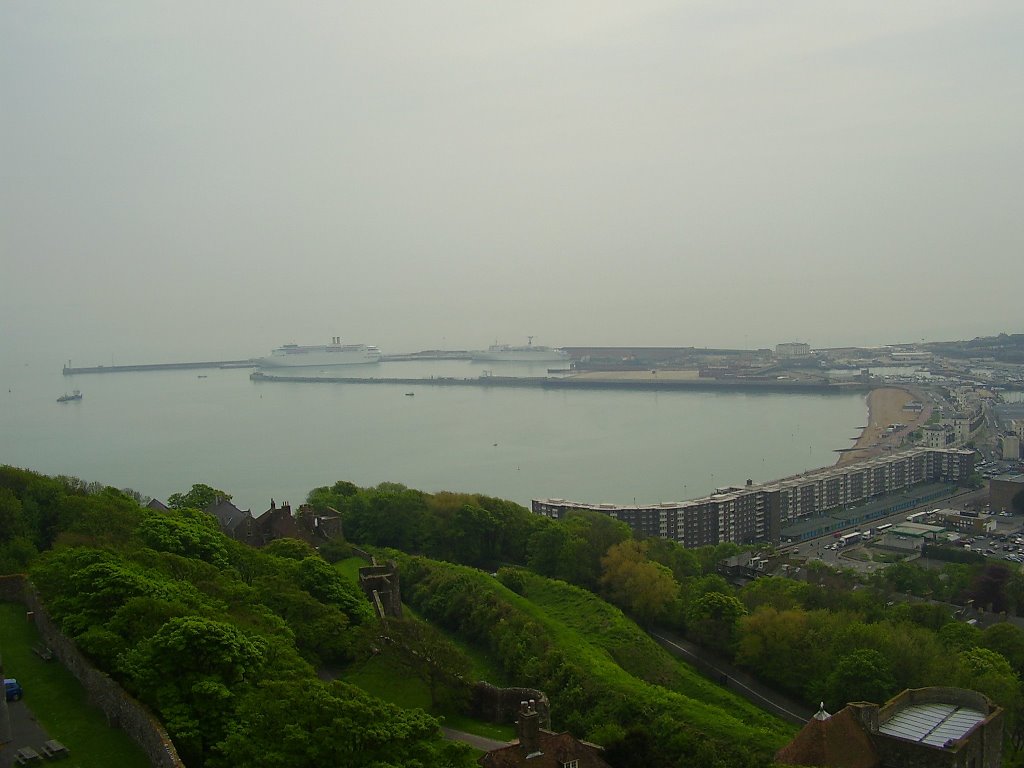
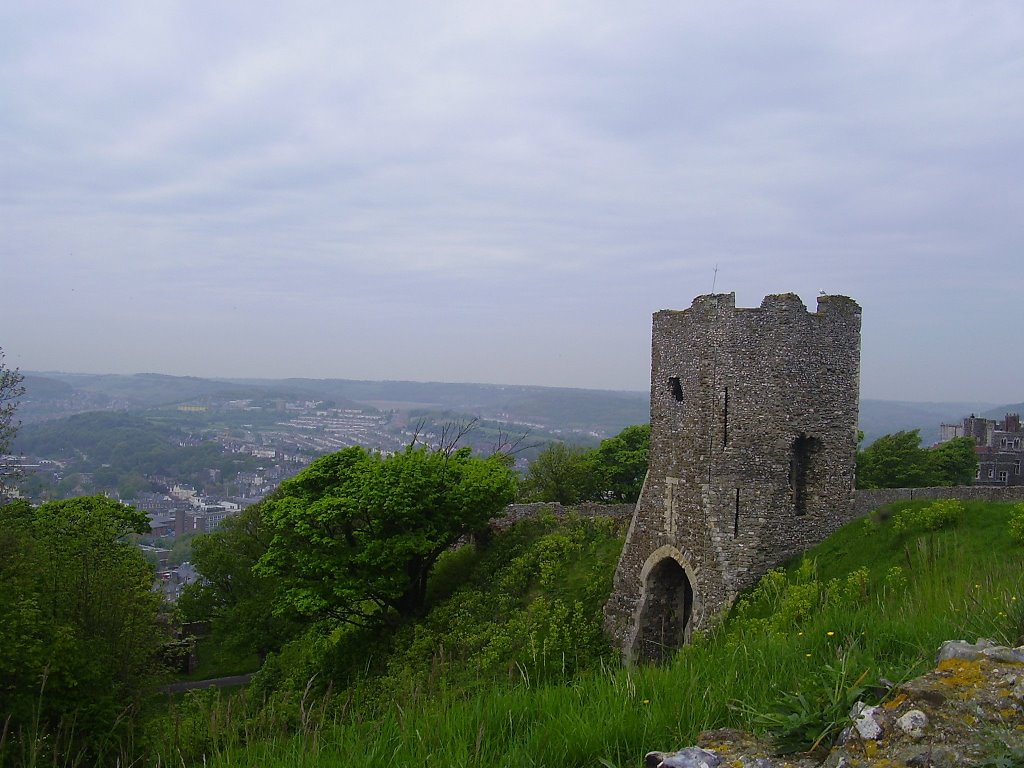
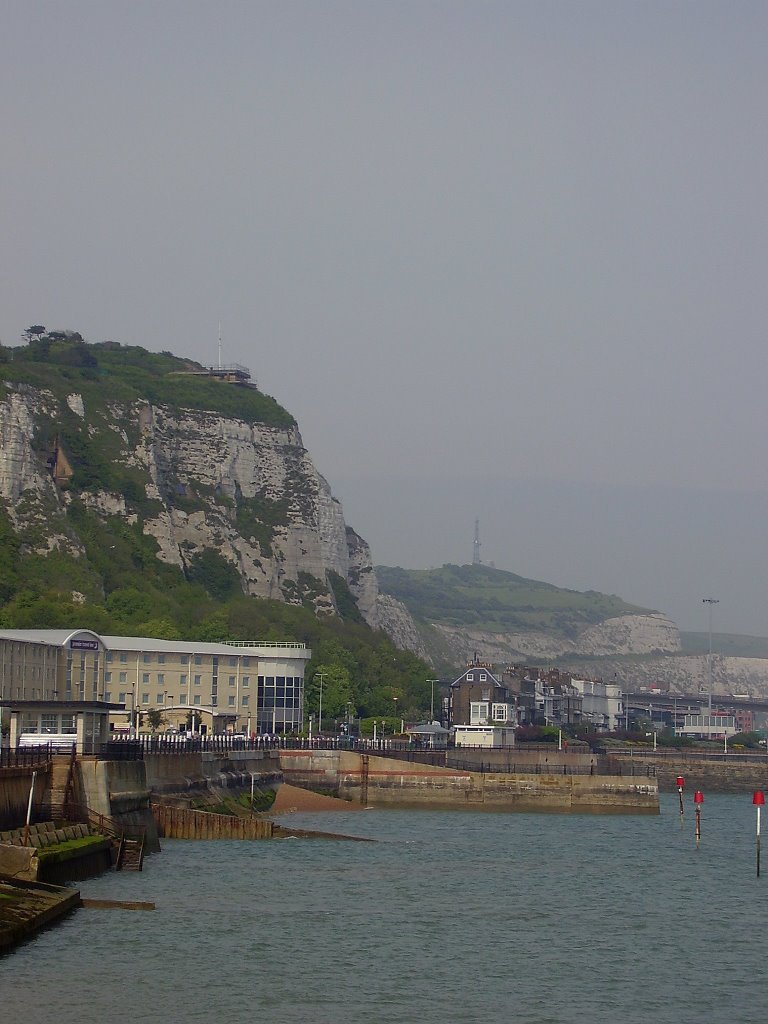
I was again peeling through some old photos and I realized that I never did anything with the pictures I took when I briefly visited Dover in Kent. The city itself wasn't particularly impressive (apologies to any and all Dover residents who read this blog--if there are any, which I doubt), but the castle overlooking the famous white cliffs was a fascinating place, used for literally thousands of years (from the Romans to World War II) and with evidence left by nearly all of its inhabitants. Although harder than one would imagine to get a good view of them, the white cliffs were certainly a memorable sight, as was the countryside that extended out from the city proper, panoramically visible from the Castle complex.

View overlooking the city from Dover Castle

View to the northwest on the wall, one of the Gate Towers

Dover's white cliffs

Sunday, January 28, 2007

Second Tier Photos

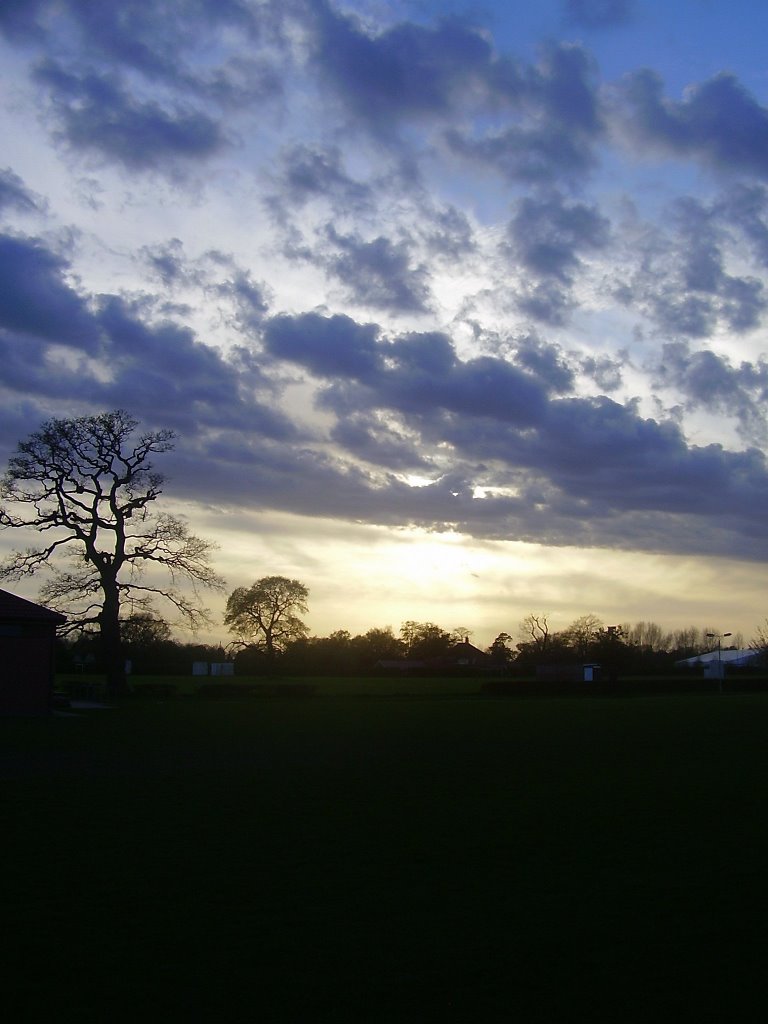
Today, I thought to go through some of my photographs from England. When I took a lot of them, I saved them, and some I labeled, but just like anything else, after their "time" on the memory card in my camera had come and gone, I didn't think on a good number of them again. I am not sure why this is the case, but I was most impressed with the sky in England--it may have been how the clouds were formed or how the sunlight came through them and the surrounding scenery, but every time there was a sunset, it was always impressive. This one was labeled as sometime in April of last year, and it was taken overlooking the soccer field outside of the dorm system I lived in.

Monday, January 22, 2007

Letters Never Sent...

Dear Control-Freak Drivers,

I realize that we live in a world where no one else matters more than yourself. I also know you manifest this manic tendency in multiple ways. First, you may catch a glimpse of me driving along just over the speed limit coming up behind you--and see a younger chick driving my car--and automatically assume that I must be "taught a lesson" about safe driving by you behind the wheel of your overstuffed family vehicle with "Baby on Board" sign proudly displayed on one of your stylistically tinted windows. Your reaction under these circumstances is usually to slow down to three or four miles per hour under the speed limit, ultimately endangering the many bundles of joy that are in your car as my frustration gradually extends into the "road rage" category. Or, on the other hand, you may see me coming and know that you are going to force me to hit the brake rather hard if you pull out from Stop and Shop a spilt second before I pass you by (with no one behind me, I might add). As a result, you, with all of your superior years on the road before the gas shortages of the 1970s, wisely decide to turn onto the road in front of me anyway, and then drive exactly at the thirty-mile-per-hour speed limit all the way down the one-lane road extending between me and where I live. I applaud your efforts to deserve the smug look on your face as I sail by you as soon as a second lane appears in either of these circumstances. It's always nice to feel superior, even for a few brief seconds, and especially in environments where the people you've ticked off can't say anything audible to you when you pull your mean-spirited jaunts. I'd like to inform you that I have contacted the Department of Transportation and formally proposed that all cars be fitted with a radio system whereby I, the offended party, can simply type into the computer your lisence plate number and then immediately be connected to the audio system inside your car to tell you what an incredible ass you really are. I feel that this may be the only way you may think twice before impeding my progress on purpose just to feel that little bit better about yourself you apparently need.


Dear Self-Obsessed-Facebook-Profile-Editor,

I admit, yes, I did ask for it by "friending" you online, so I only have myself to blame for the multiple repeat appearances of your name on my "News Feed" every time I check the website. I also admit that Facebook is only one of a number of websites that force people to share information about themselves in inordinate dosages. However, I hate to inform you that I do not believe anyone on your friend list is that interested in your 50+ "Notes" about yourself and your opinions or the continuous updates of your "Status" which include mundane details such as dish washing. I know that the endless searching you do to find "Groups" that truly fit your personality and interests should be acknowledged by the world as a whole, given the list of them extends at least halfway down the long page you have filled out about yourself. Regardless, I must alert you to a few observations--one, that you must spend too many hours in front of a computer given the amount of time that it takes to produce those multiple gems of personal information on my "News Feed" every day. As a result, you may adulterate such important things as your sight and your relationships with actual breathing people (some of whom are on your friend list and may want to see rather than read all about you). My advice? See if you can go one full twenty-four-hour period without "perfecting" your personal information on Facebook. Yes, I know, baby steps toward the goal of actually combatting this obsession, but progress is progress nonetheless. God forbid you go out into the real world and meet someone who may be more talented or perhaps even more interesting than you are.


Dear Self-Important-Woman-With-Too-Much-Time-And-Too-Little-To-Do,

Yes, society is funny isn't it? Since it became unpopular to employ or even own a servant staff of your own, I know circumstances have compelled you to find other targets for your sense of personal superiority. These mainly come in the form of staffpeople at your more frequented establishments such as Panera or Starbucks. However, I regret to inform you that no matter how many times you make an appearance at one of these local businesses, the people there aren't looking for when you are going to come in that day. In fact, this may actually extend to the staff not setting things up to your liking for when you do ultimately arrive. Because of a long morning rush of caffine-deprived small-time-suit-wearers, the Starbucks staff may not have quite gotten around to refilling the milk dispensers, for example, and perhaps, they may not "learn something" from your lecture about how "it is NEVER like this" whenever "YOU" come in for your non-fat, half-caff latte. Outside of the statements themselves, you may be surprised to find out that few people are going to take a forty-something upperclass socialite who is "supported" by her husband wearing a Prada version of camoflage cargo pants, Chanel sunglasses shaped like a box, and with hair dyed that shade of red that insults real redheads everywhere seriously. In fact, you may be shocked to discover that a simple "please" and "thank you" (don't tell me you didn't watch Sesame Street growing up) may get you all that you need or want and may even earn you a smile from the staff when you do come in again. You're more assured to get that result under that premise because otherwise, when you return and you turn your head away for one split second, you don't want to know what the barista is putting in your drink.


The above are letters to people you always "wished" you could send, but ultimately could not because you probably didn't fall into one of the types of categories that would compel doing anything more than waiting out your aggrivation at the actions of other people. I encourage any and all forms of liberation of such frustration. What's a blog for?

Wednesday, January 03, 2007

Oh, yes, I spent my New Years in the company of---Barry Manilow.
Well, not exactly...
Last summer, Lindsay and I created the "Bagging Barry" plan, which essentially meant that we intended to go and see his show in Las Vegas and spend the New Year in the city as well--the New Years' celebration being entirely secondary to seeing Mr. Manilow, of course.

As you can see, we were successful in this endeavor.


Above we have Barry singing "Mandy" at the piano and below it, Barry singing one of the classic hits from the 1960s off of his newest CD. Yes, Lindsay and I were, by far, the youngest attendees in the audience. We even had to instruct our closest seated neighbors how to get the glow sticks, handed out to all of the audience members before the show, to actually glow. In a phone message left by me after the concert, I described it as having "lots of music, lots of passion..." and Lindsay handily added in "lots of boas..."


We stayed at the Monte Carlo on the Strip, although the sheer size of these places there makes distance seem rather deceiving. It can take about twenty minutes to get from one place to another because you are literally "passing" the places on the way for such a long time.


On New Years, the most interesting elements involved included one fifty year old guy who had taken the time to write "Show your Tits" on a piece of cardboard with a green marker and was showing it to all who passed by, a bunch of "The End is Nigh" Christians holding signs condemning just about everyone and everything (one even had his own wooden cross, life size) holding up foot traffic in the streets, and the simultaneous fireworks let off at a few of the hotels at midnight.

We also saw "Mystere" by Cirque de Soliel at Treasure Island. It really is characteristic of the surrealism associated with the troupe. However, the surprising thing was the audience participation element. An "usher" made occasional appearances from the beginning to the end of the show, generally harassing audience members. Lindsay, at one point, did exhibit extraordinarily good judgement, given an "infant" in the form of one of the performers rolled a large, rubber, orange ball in the direction of our row, which was stopped by a railing in front of us. The "infant" indicated that he wanted the ball returned to him, so Lindsay stood up and pushed it back. Of course, this only prompted him to roll it again, and Lindsay refused to perform the same office a second time. A more compassionate audience member a few seats away obliged, only to become the "infant's" designated "Mama" for the rest of the show. Well done avoiding that fate, Lindsay.

Lest I be accused of putting off my "tag" for yet another post (now only understanding for the first time what the tag actually means), I shall leave off for the present.

"When will our eyes meet...."

Tuesday, December 26, 2006

Part One: Rated Poorly

Here's some "fun with expectations" to be enjoyed in three parts.

Stuff that turned out worse than was expected:
  • "A Christmas Carol" performed by Trinity Reperatory Company in Providence, RI: Every year, my family buys tickets to see this annually produced show, and Trinity Rep. reliably creates a new perspective or interpretation to keep the many-times/many-ways seen show interesting. However, "interesting" this year bordered on the bizarre. My first indication that this would be the case was a commercial I saw on a local TV channel about the show by the director. The director, "so honored to be able to do Trinity's play," in as few words a possible, convinced me that he apparently thought he had come up with THE new, modern, artsy way to do the show. Therefore, I wasn't so much "shocked" as I was disappointed to have been correct. The guy had a thing for puppets--perhaps wishing to shed some much needed employment upon his rarely spotlighted puppeteering friends--but he didn't quite carry through his ideas. There was one of Scrooge himself, which disappeared about mid-way through the play without ceremony and consequently, with a loss as to audience interpretation of the puppet's meaning. The most "striking" was the Ghost of Christmas Future, which rose out from a curtain on the stage in the form of a Phantom of the Opera mask-like face, accompanied by one "pointing" and one "non-pointing" hand. In other news, the set was "minimalist" to a severe degree--cups and tables in scenes weren't even "real", but were instead cardboard cut outs (unconvincing when they had to be "used" by the cast as if they retained that third dimension they were missing). The background sets, wheeled in and out by stage hands (and this was the first production I actually "saw" the stage people "working" on the stage--other times they were strategically well hidden) could have been sketched by, and were perhaps on loan from, a local third grade class attempting a similar production. Even the cast was minimalist--a chorus of girls between about 8 and 12 years old made up for the lack of "company" in song or in bustling, "busy" street scenes.

The Bottom Line: The reason why this production is being judged rather harshly is because first, Trinity has done amazing versions of this story that have wowed and truly affected its audience. If they couldn't do so, families like my own wouldn't make the yearly pilgrimage to see A Christmas Carol. Since it is such a popular play, enough so that they have to have two casts to perform it, you would think they would take that in hand and mind when they choose an "interpretive style" or perhaps even a director in the future.

  • "The Crimson Petal and the White"--a novel by Michael Faber: When this book came out, I was working at Borders, and Mr. Faber was celebrated as "a twenty-first century Charles Dickens." However, simply setting a novel in the 19th-Century Victorian London, including some less-than-reputable characters and throwing in a slum or two to remind the reader of the "hard times" experienced by the masses does not qualify comparison to a literary paragon. The book is over eight hundred pages long but it does not at any point inspire the reader to the "unable to put the book down" level. In fact, the characters are so poorly developed and two-dimensional that the reader rather doesn't care what happens to them "next" as chapter after chapter passes by. In order to "make" his characters interesting, he gives them some peculiar mannerism--one of the main characters is a "fop" with an "innocent, sickly" wife, and another, a captivating whore. Faber is so preoccupied with preserving his mystique and setting the scene (or one can only suppose those are his motives) that he includes long interactions between characters that even he in the omnipresent "author's voice admits are irrelevant to the story the reader ultimately skips through to get back to some significant action. At first, the reader may be fooled into thinking these scenes and interactions are somehow symbolic; however, after perusing through many of them, it becomes abundantly clear that the reader will never be left in a position where he or she will have to backtrack in the novel to pick up that one piece of information or one detail missed in these scenes. Because of his minutea, one actually comes to expect the sex and the murder, etc., which destroys the surprise at these elements so well woven by far more skilled authors.

The Bottom Line: I think invoking Dickens as a comparison to any unproven author is rather strong. I should have taken the hint when I found the book at a local used book store in hardcover form for about five dollars. Then again, I was told once that any book that is five dollars or less is worth getting. I think this is the only case to which that statement does not apply.

Sunday, December 24, 2006

The "Christmas Spirit"

A friend of mine gave me a copy of a book called The Four Agreements for Christmas this year--it was very kind of him to think of me, let alone share with me something that is very much a part of his own philosophy of life. The basic premise of these four agreements is not only to raise personal awareness, but to raise awareness for those around you and what that means. At this time of year, I have to say that I was most struck with the "second agreement," which discusses the reasons why people do certain things.

Simply stated, the author (Don Miguel Ruiz) says:

Nothing other people do is because of you. It is because of themselves. All people live in their own dream, in their own mind; they are in a completely different world from the one we live in. When we take something personally, we make the assumption that they know what is in our world, and we try to impose our world on their world. (page 48)

I think most people can agree that this is an important point. However, I find that agreement may come easily while practice does not.

Say you're sitting in a park on a bench on a nice day by yourself. You're watching the world around you, and you focus in on one or two people in particular that you see either walking by or talking to someone or playing a game, perhaps. For one minute, do you ever wonder what kind of a life that person has had--what brings them from black and white to color or from the two to the three dimensional?

Yes, it's true, we all get wrapped up in our own little worlds at times--especially if something goes wrong or if we are nervous about something potentially going wrong. However, in those moments especially, it is essential to step outside and see the "big picture" to regain perspective.

Case in point--the "Christmas rush."

I hate it, and I'll be the first to admit it. I have to wait in line everywhere. What I want has to be completely out of stock when I get there. The guy in front of me is taking absolutely forever to pay with that credit card. I am in a line of ten cars to park in the garage, and in a line of triple that to get out. No matter where I am walking, there are people I have to walk around to keep my own pace up. I am constantly thinking of the next task I have to accomplish and how I can get that done as painlessly as possible.

And that is completely wrong. Absolutely none of that applies one fleeting thought to anyone else other than myself. I forgot to consider the fact that everyone else who is a part of that "Christmas rush" is on his or her own mission and is subsequently in his or her own world. Since this is the case, the so called "Christmas spirit" may be an extension of the second agreement--not just that we have to buy the "perfect gift" for Uncle Joe and Sister Janet, but that we have to remember that everyone around us is doing the same thing. Instead of tapping the toe of our boot on the linoleum while a thirty extra seconds are taken by the guy at the head of the line to complete his purchase or whizzing by the "slower drivers" who are just "in our way," we should take a deep breath, realize what is going on in the minds of the people around us. Why worry--for countless Christmases past, we were all able to get everything done we wanted to. And, since the point of the season is to think about someone other than ourselves, perhaps the challenge isn't to donate money to the "faceless needy," which most of us do without thinking about why that is important, but it is to see beyond our own little worlds when the tasks on our list seem to close us into our own minds.

So, what ARE they talking about?

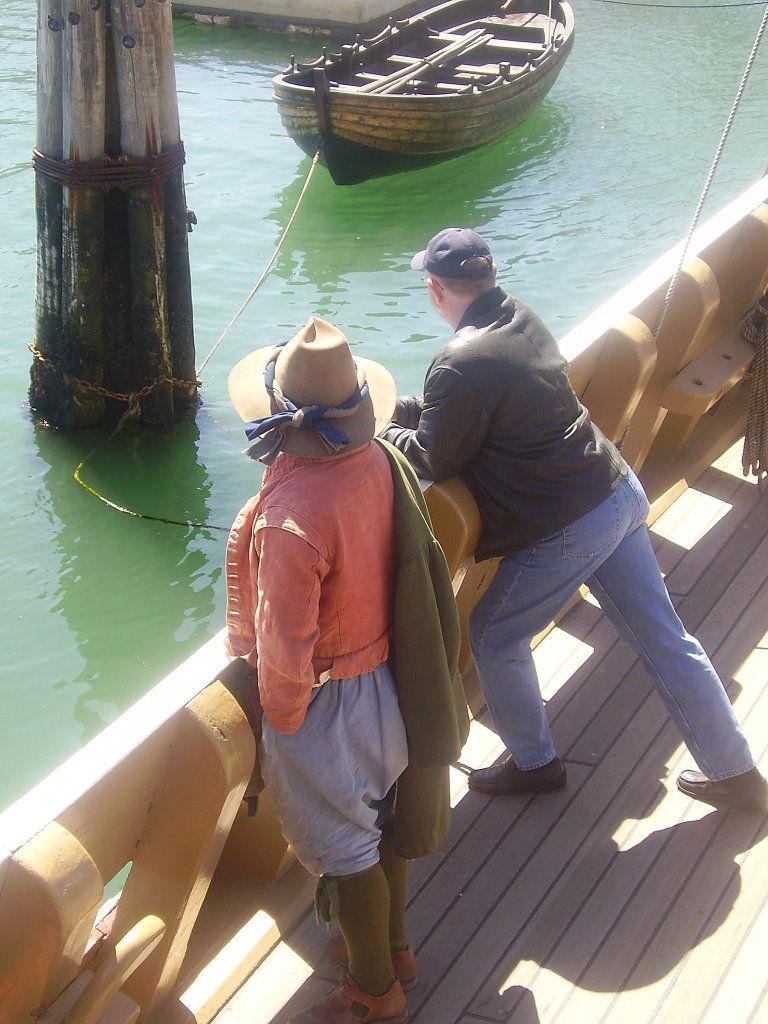
The honest answer to this question is B. I was standing on the half deck at the time, slightly behind and above the subjects, so I have no idea what they were really talking about. I can assume, from prior experience, that A is the most likely choice, given those are the three most popular questions to pose to interpreters of all kinds. The fourth most common question has to do with a piece of equiptment called the capstan. The reason that inquiries about the capstan are so memorable has to do with the "guesses" visitors come up with to explain it.

The capstan, to clear up any confusion, is a large, black, round piece of wood that is right behind the main mast extending from the main deck down through the orlap deck, the deck below. It has metal fittings around it and two square holes bored through the diameter of it on opposite sides. Yes, it does look odd. If we're interpreting on the main deck, we answer "what is that? (point at capstan)" most often. However, we have also had some folks "interpret" what it is for us. These interpretations include anything from "it steers the ship" (at least that somewhat makes sense) to it grinds corn (yes, that was certainly feasible on a moving ship), it is a furnace (a one-time-only-use furnace apparently given it is made of wood) and finally, that it "holds the telescope" somehow.

I very much enjoyed comments made by Captain Picard--always an honor, sir, when you come by, and the Mr. Anonymous who posted this time, whether or not he/she may be the same one who visited before.

Tuesday, December 12, 2006

What is the most likely dialogue between these people?
A) One of these questions are being answered: "How many passengers were there?", "How long was the journey?", or "What did you eat on board?"
B) How would I know? I was taking this picture on the half deck clearly from above them.
C) Costumed guy: "No, I think the one in the yellow tank top has the nicest ass."
D) Visitor: "Is that your dingy over there?" Costumed guy: "No, my pinnace is much bigger than that."

What is Beth doing in this picture?

The answer is: A.

On a rather stormy and miserable day at the Mayflower II, as you can imagine, there isn't much to do. We are allowed to leave the site, given we have no heating and are almost entirely exposed to the weather out there, only if there are no visitors on board. Of course, the result of this plan is that we'll get a couple or a family of four that come on in so well timed a fashion that we'll all have to stay on the ship while they tour the whole thing, and, just as one of these groups finishes, ah, yes, another comes on board. Therefore, you end up spending most of the day dressed head to toe in rain gear (for those not in costume) or in varying degrees of wet wool (for those in costume).

In this picture, Beth, after one of those smaller sets proceeded down to the below-deck area, tied the bits and pieces of a malkin--a mop--together and hung the line off the side, attaching a piece of ship's biscut to the end of it. Unfortunately, this resulted in the biscut getting caught on something close to the waterline, and the line breaking apart, leaving the ship's biscut hanging off of the ship until we finally figured out where it was and could bring it back up. The biscut, hard-tack-like as it is, having been rained on and left exposed for days, was entirely intact, proving by experiementation that even seventeenth century methods of preserving foods are effective.

Monday, December 04, 2006

What is Beth doing in this picture?
A) Fishing off the side of the Mayflower with line from a malkin (mop) attached to a piece of ship's biscut (unseen).
B) Escaping, later to be heard yelling "YO-HO, YO-HO, A pirate's life for me!" from the shallop (boat tied off of the side).
C) Taking the depth of Plymouth Harbor to impress the hot harbormaster motoring by.
D) Rescuing our manager after a run-in with an unsatisfied guest.

Monday, November 27, 2006

Fade to Black

Today was the last time I will have to get up at 6 in the morning and drive myself the hour and a half out from here in southern Rhode Island to Plymouth, Massachusetts in order to complete an eight hour work day as an employee of Plimoth Plantation.

That is not just a statement--that is a resolution.

The "season" just ended--running from March to the last Sunday after Thanksgiving. This year, there was a lot going on that put the Plantation in the public's eye in ways we hadn't experienced in a long time. Nathaniel Philbric, for better or worse, published his book, Mayflower, to a very willing and enthusiastic audience. Our participation in "Desperate Crossing," using even members of our own staff as characters in the film, ensured that visiting the Plantation was a suitable "follow-up" to seeing the documentary on the History Channel. In short, "recognition," whether the Plantation directly participated in producing it or not, had finally started to filter in the direction of our museum.

However, as much as things may seem to be looking up in this case, so very much remains the same. The "all-hands-end-of-the-year" meeting today informed us of very few specifics when it comes to the Plantation's finances and our part in them. The staff is at an all-time low, featuring as few as 9 or 10 "pilgrims" on the Village site on some days of the week, and at the Mayflower, we are holding at the minimum of 5 staff members on most days. There are people who have not received raises in over five years. In my time alone, the "face" of the interpretive staff has changed from fairly diverse in age and gender to mostly out-of-college kids and retired people, heavy on the female side of the line.

I have been given the "things aren't going to change" lecture several times from longer-term staff there. I am certainly not tossing the dice on arguing that point with anyone. However, regardless what the museum does or whether it has done it for a day or twenty years, it doesn't make the situation right. The upper level management shouldn't be able to say that they "haven't been down in the Village all year." When the budget goes bad, they shouldn't slash three interpretive positions when the sacrifice of but one of the all-too-top-heavy administrative level would more than satisfy the deficit. If larger projects or programs come up, they shouldn't be relegated to the already-too-busy staff to do all the work and only to receive none of the credit. And if someone dedicated does things a little differently for whatever reason, and that difference benefits the organization, that person shouldn't be put in an uncomfortable situation and made to feel like an outsider for "not following the unspoken rules."

My issue, however, is more personal. I am not going to trick myself into thinking that my Plantation-pay, which may not outdo the wages earned by a local gas station attendant, is a liveable income. I am also not going to trick myself into thinking that the job is somehow more than it is. For seven and a half of my eight hours a day, I am answering the same questions over and over again, and trying to be as enthusiastic about those answers the eighth and ninth times as I was on the first. In this kind of position, you live for those moments when a visitor starts to put two and two together and ask you things that are a little more in depth and require some problem solving skill or when a visitor actually, gasp, has some background information to go on. However, you can go days without that materializing, and no matter how much you read or what you have a background in, the visitors' lack of interest puts a damper on your ability to share anything other than the basic facts. That's when you become a recording on continuous playback rather than a living, breathing person "from that time."

So, to Plimoth Plantation, I thank you for being my first "real" job out of college. I thank you for allowing me to return right after I finished my Master's degree so that I would have something to do with my time that included human interaction. I thank you for helping me acquire some real in depth knowledge and interest in this time and place. I thank you for giving me access to some fantastic people, a good number of whom I would like to keep in touch with, and subsequently, some very valuable life experience.

However, it is time for me to go, so I take my leave of you in gratitude for the advantages you have imparted on me in the hopes that perhaps someday, your "things will never change" reputation, at least on the part of your treatment of your dedicated staff, will be proven wrong.

Friday, November 17, 2006

And the winner is...

Congrats, Mr. Anonymous, you win. In this so-well-put 17th century scene of touching love and affection in the midst of hardship, there is a stainless steel gangway in the background extending from the "nonexistent" pier to the half deck.

Thanks to you all for playing.

Wednesday, November 15, 2006

I want someone to tell me what's wrong with this picture:

Desperate Crossing II

You'll win my undying respect.

Visual "Desperation"

Last year, right before I left the Plantation to go to England, acting-mania hit the staff, and hit it hard, with the introduction of the Lone Wolf documentary company into the late-season insanity. In order to "make ends meet" (and certainly not to make some extra money with which to pay the staff something approaching a "living" wage), the Plantation got itself involved in a few "side" projects that would allow us some more extensive exposure as a museum. The first of these projects was Colonial House, a PBS series following in the extremely successful footsteps of Frontier House and 1900 House (English Victorian theme) whereby a group of volunteers are whisked away from modern life and into the "times" and "environments" associated with the show's theme. Colonial House, obviously, had a New England, 17th century colony setting. Our staff built their houses, made and gave them their "props," and supplied them with appropriate food stores. In fact, the spring/summer of 2003 was so wet that our wardrobe department was called upon to throw together appropriate coats for the participants. The show aired to moderate success. Instead of being the bastion of representative history that the previous series had been, it instead acquired the reputation of being "Survivor" in the 17th century given the structured conflicts that emerged between the carefully selected "liberally minded" and "conservatively minded" volunteers. After the show appeared on TV, we hosted a number of functions associated with it, inviting cast members to visit for "meet and greets" with the visitors and devoting an entire exhibit to their show. The result was lukewarm at best, but the staff was less than pleased because it pillaged our resources for the sake of the project. We had half as many objects in the Village with which to work, including tools, and the ones that were returned to us weren't in good condition at best and severely damaged at worst. Our artisans, who should have been actively on site repairing the Village, were all called up regularly to assist Colonial House's colonists instead. In the end, those of us most disadvantaged by the whole project were the last ones to be acknowledged for working through it.

The latest Plantation side project, due to air this Sunday, is the new History Channel Documentary, "Desperate Crossing". It's a combination of drama and historical commentary centered on how the "Pilgrims" went from living in England to living in Holland to travelling to America and stops around the time of the first "Thanksgiving." It is certainly up to History Channel standards, although I'll only question the inclusion of some of the varying "experts" on the panel (it seemed as if some of the professors consulted were simply asked because they taught American history at some point in their lives and not because they are 17th century experts). You'll notice some overacting, certainly, but thankfully that sticks out rather than establishes a rule followed by the sum total of the actors, including the interpreters from our staff who got a chance to participate. Among their number are the characters of Captain Miles Standish, Elizabeth Winslow, Stephen Hopkins, Master Christopher Jones, The Billington Family, Elizabeth Hopkins, William White and his wife, a few of the sailors, and a number of the Native Americans, including "Squanto." They all did very well and seemed to have enjoyed the experience very much. Of course, in some cases, the epidemic we call "starstruck" is still raging, which doesn't come as a surprise. Overall, it is worth a view, although I will warn the masses that it is about three TV hours long and will air in its entirety rather than being broken up into "episodes" to air several days running.

At least this production did not ultimately pillage Plantation resources in the way Colonial House did, and the film makers asked our staff to talk about the history they were intending to present, too.

One and a half weeks left...

Sunday, November 12, 2006

A Quiet Evening of TV and...

When I went over to England for the first time over a year ago, my parents and I stayed in a Mariott on the opposite side of York from the University. I remember turning on the TV the night after arrival before literally passing out due to the inevitable jet lag resulting from such a long trip. One channel covered the selection of a new leader for the "oppostion" party, the Tories, by vote; the later result being David Cameron. On another, I saw for the first time bits and pieces of a recently completed series, Elizabeth, about the latter stage of the Tudor queen's life starring Helen Mirren and Jeremy Irons. At first, I compartmentalized it as "wow, these English folks really ARE obsessed with her reign." However, a few months later, I got to see the whole series for the first time from beginning to end when it re-aired. Apart from being well-acted and well-written, and, God forbid, well-researched, at least a portion of the focus struck me.

The first part centers on Elizabeth's relationship with Robert Dudley, and although there isn't much discussion on the matter between characters in such a way as to actively explain it, the acting between Mirren and Irons adds a third dimension that truly allows the viewer a new insight into that relationship in such a way as I have never seen in any other drama. The definition of this partnership ironically is colored by Elizabeth's decision to pursue a marriage with the Duke of Anjou. For perhaps the first time in her reign, she seriously considered the idea of marriage, and therefore, by extension, for the first time, Robert Dudley had to consider the idea of being without her primary affections and attentions. What she could not, because of circumstance, have with Robert Dudley, she realized she could have with the Duke and perhaps it was the first time she actually considered having it rather than continuing on without it entirely, or with it in a different form that wasn't entirely fulfilling for her with Dudley. If the English people had not objected to her marriage to the Duke, I wonder what decision she would have ultimately made for herself.

Gave me some food for thought, although I will leave my personal take on that subject to myself.

Wednesday, November 01, 2006

Off-Site Interactions, or How NOT to Address a "Pilgrim" Who Is NOT on the Clock

Half of my first day at Plimoth Plantation was spent in the company of the "Billington" family, which was comprised of Goodwife Billington, played by Cindy Brewster, and Goodman Billington, played by Rick Currier. Cindy moved away within months of my arrival, and I only wished I could have gotten to know her better. Rick, on the other hand, left only months before I did. He always had a lot of practical wisdom--I remember his one liners very well about how to cope with the job. For example, New England summers can be awfully hot and humid, and once one finally dons the burlap-lined pilgrim suit, it only then comes to light that those clothes will also be worn when it is ninety degrees out as well as at a comfortable fifty. The first thing he ever said to me was "Don't psyche yourself out," and to this day, whenever I am sitting out in the blazing sun covered in five layers of wool while visitors mill around in bathing suit tops, I can hear that line run through my mind.

He also suggested that "getting dressed twice" in the morning was rather impractical. Most of the interpreters come to work, change into costume and then change again before heading home at the end of the day. I was among them for a long time when I thought about what Rick said and considered the practicality of coming to work already in costume, eliminating the need to show up fifteen minutes early just to put it on, then walk all the way on site. It became even more useful for me to make this choice when I started elongating my drive in the morning. When I was living in downtown Plymouth, literally a walk from work, time wasn't much of a problem. However, since I am driving in from home and competing with who-knows-how-many idiot motorists who think tailgating you will make you drive faster no matter how many cars are lined up in front of you, dressing before work seems to be the best option.

This, of course, leads to other inconveniences. When you walk around in the costume, you end up falling into the same category in the minds of onlookers as homeless or handicapped people. The inevitable "what do you do now?" question runs through their heads as you pass by, and you can almost see the text of the inquiry as it makes its way from one ear to the other.

Some look away and "pretend" there is nothing odd about you.

Some smile, then move on in a quickened pace so not to wreck their moment of politeness for the day.

Then, there are the parents with small children who see you pass by, give that overemphasized "gasp" to get the attention of whatever tot they are leading by the hand, and then, bend down to their level, pointing in my direction with a peer-acted, "fascinated" tone of voice, saying "Look at the pilgrim" the same way they said "Look at Mickey Mouse" the last time they visited Disney World.

Some people stop you to ask you to take a picture with their friend or their kid. This is a very normal occurence while we are on-site, but after work or if we are on break, it just serves as a reminder that to the vacationing public, you are still working no matter what the break schedule is on the wall. My reply has always been to say that the Plantation does not allow us to pose for pictures off-site and when we are not fully in costume (and pieces do come off at break time), which is a complete lie, but in a way, it is more polite than to acquiese to their demands and then stand there, on-edge and obviously annoyed while someone snaps the picture.

Some start up a conversation with you. Now, this is a very nice gesture and it is always great to meet new people, especially those who have done or do similar work. However, when the day is over, most of us just want to get into our cars and leave because all we do is talk all day. Some of the conversation starters know this and talk to us for a few minutes before letting us get on our way and they on theirs. However, others expect a run down of all of the "behind the scenes" footage you can give them once they catch you after five o'clock, especially if you had spoken to them in character at some point at the museum before it closed that day.

Then, there are particularly odd moments. On my way out the other day from work, while walking to the car, I called home to inform everyone that I was going to attend a rehearsal instead of drive back right away. About half way to the car, a vehicle passing on the other side of the road actually came to a dead stop over a crosswalk, the passenger-side window came down, and traffic in downtown Plymouth was momentarily brought to a hault because a woman felt the need to yell "Hey! Pilgrims didn't have cell phones" and then laugh at this soundbite of witty hilarity.

On another occasion, I stopped by a local convenience store to pick up a few things before starting the drive home, and as I was standing in line having my items checked out, I felt someone behind me pressing onto the upper pleats of my petticoat. I turned around hastily to find a woman standing there, actually poking away at my skirt, and given my sudden attention to her, having to say "There is NO WAY those can be your hips." I was rather baffled--costume or no, the action was more than a little rude. I replied "Well, yes, you're right, but normally people don't poke me to find that out." She recoiled back, implying that perhaps I had actually been the rude one there when if I had suddenly thought to do that to her, I probably would have been court martialed for physical harrassment.

The best off-site-yet-costumed interaction I ever had involved a police officer who pulled me over for speeding on Route 6 coming off of Cape Cod. I was late for work on a Sunday with literally no other drivers on the road, and I was certainly pushing the envelope a little bit. Before I could pass Exit 5, I saw a cop sitting over a hill, well positioned enough that by the time I saw him, it was too late for me. He pulled out after I passed, and I stopped in the breakdown lane. He came up behind me, stopped his car, got out, and approached my driver's side window. In the minute or so that passed, I thought about what he might say upon finding a pilgrim in the car that was inevitably going to get fined. When he came to the window, he asked for my lisence, told me how fast I had been driving, processed the information, presented me with the ticket, and then, got right back into his car and moved on. I may have earned myself a three hundred dollar speeding fine, but he didn't say a single word about where I worked or what I was wearing.

If only everyone would treat us just like everyone else...