Some recent moments:
It's about 1am in England, and finally, it isn't raining or immediately threatening to do so, so I decide to tackle the ever present and ever increasing pile of laundry in the basket on the far end of my room. The laundry fascilities are actually quite a distance away across a few parking lots, so I hoist the basket over my shoulder and begin the Exodus-like march to the one-story, brick building with the Halifax College coat of arms on the front. As soon as I get there and unload the heavy basket with a huff to the floor, I notice the prices on the washing machines and driers have changed--and of course, this isn't a reduction in price, either. I no longer have enough change on me to wash my clothes, so I have to walk all the way back to my room and count out more from my store of "useable" British coins (which does not include 5, 2 or 1 pence pieces). On my way back out the door, I see a middle-aged guy that I do not recognize on his way around the corner of the path, and apparently, about to enter my portion of the building. I give him an odd, contemplative look, and I let the door shut behind me on purpose. This meets with a gruff "thanks for holding the door" from him as he is forced to bring out his key card and open the door himself.
Another occasion--it's morning. Since I had been up late the previous night putting together a chapter for my dissertation in order to hand it in to my supervisor, it is about 1o am, and I'm still sleeping. Then, an unexpected knock comes on my door. I manage a "hello?" from my lying on the bed. The unknown individual either was not daunted or did not hear me, and proceeded to try and open the door with one of the universal room keys the college loans out to personnel. This prompted an immediate and far more adament response from me, which came in the form of, "WHO is it?!" I finally receive a response, but it isn't an offer of any form of personal identification. Instead, I hear an equally adament reply from a man, "Open the door." Excuse me? I was annoyed to no end. My reply was "WHO are you? I'm not just opening this door." I couldn't believe I had to spell that out to anyone with a functioning brain. Finally, the man insisted that he was simply coming through the hallway to limescale the bathrooms. I get up and open the door myself--no way is he going to barge in on his own time. I look at him, myself covered in a blanket. He seems to have this sudden revelation about why I wasn't thrilled by his address. I open the door and tell him that I will wait in the kitchen until he is done, and then return to my room.
So, what do these random snapshots have in common? It's a simple question of personal safety.
Years ago, I took a course in 18th Century Literature with a woman professor who also taught courses in Feminist Literary Theory. In class one day, she told us about a scenario she put forth to the other class, which had both guy and girl pupils in it. She asked if anyone had ever felt intimidated in any environment they had been in for no apparent reason--like they may have been in the dark, for example, but clearly without anyone around. The guys responded by proposing situations where they had been intimidated, but there was always a reason--the immediate presence of someone nearby who was unknown to them, for example. The girls were different--they described experiences where there were no immediate threats, but they still felt intimidated by what may be lurking behind a corner, for example. The point is that the latter experience is very much a part of a woman's consciousness, and it is something that men do not seem to be able to comprehend--there has to be a reason for them, while for women, a "bad feeling" is enough.
At Holy Cross, since the college was not in a city well-known for its personal safety rating, there were "call boxes" everywhere on campus. You could find one simply by looking for the poles with the blue lights on them. As soon as you picked up the phone, you didn't even have to touch a button--you were immediately transfered to Public Safety on the line. Public safety also did regular rounds through the campus by car and on foot, the officer on duty required to go around the school entirely once an hour. There were similar call boxes on every door to every building on campus. If you wanted to enter the campus through the front gate, you had to stop at a booth and explain your business to an officer there. Of course this system wasn't perfect and there were mishaps on campus like there are on any other in any situation. However, safety was present in an immediate sense.
I cannot give as high a rating to the University of York in this category--in fact, the score isn't even close. Here, there is a "porter's lodge" at every "college" in the university, but they aren't staffed 24 hours a day save one or two. There is no clear extension to call the closest lodge to you posted anywhere, and if you do wish to call them, you have to, not only look up the number online, but you may also have to "dial out" of the college network phone system to reach them given the U of York has so obviously sold out to the Dog N Bone phone service. If I said the term "call box" to the security officers on campus, it would be more than simply a dissent between English and American forms of the spoken language that would produce a questioning look. Given this country is against any forms of "anti-social" behavior, even if it comes in the form of something that may assist me in protecting myself, I cannot carry mace on me, and the solution that has been suggested to me is some kind of loud beacon I can buy, and if I am in trouble, I can set it off (Ok, people, DUMB idea--first, that requires someone come and find the beacon, and as you know from listening to endless car alarms go off with no one in sight reacting to them, that doesn't exactly bring about the correct response. In addition, unless I am deaf, the loud sound meant to distract and incapacitate my attacker would do the same to me, limiting my ability to get away--brilliant plan). So, I am already "on my own" technically before we start.
Although public safety leaves much to be desired here (and the porters are very nice people who do their jobs well, so it isn't their fault the system they work for is deficeint), the biggest problem is the creation of situations that may end up compromising. How do I know that the guy on the other side of the door is really a University employee, or just some random guy who managed to get a hold of a U of York polo shirt and a room key if no one has notified me otherwise? That isn't the first time that scenario has occured, either. Any one of them could have taken advantage of a vulnerable situation. I am usually caught-off guard, and even if I insist otherwise, their keys let them in my room regardless of my protests. It would take one situation one time with one less-than-admirable person for someone to possibly be hurt or compromised.
I have lived on my own fairly often throughout my life, and I have prided myself on identifying and avoiding compromising situations for myself. However, what makes me nervous is the idea that I am being placed in potentially compromising situations that I have no control over. It has actually made me more nervous than before--every morning at about the same time, I almost anticipate that knock on my door that save on three or four occasions, has never come. Regardless, I have to be honest and say that it upsets me that I have spent such a long time doing everything I can to ensure my own safety that it angers me that it hasn't been acknowledged that this could change that in a wrong place, wrong time scenario. All it is going to take is one time, and then this University will be forced to reassess the situation, and God forbid, spend some money to fix it. I just don't want to be that one person who makes the sacrifice to enlighten an establishment that prides itself on enlighening others.
Back to my exciting Friday night programming, and Chapter 2 of this ridiculous dissertation...
Friday, September 08, 2006

Sunday, September 03, 2006
Details as Part of Present Living
I don't have a very exciting life of late. I've been working on my dissertation to complete my MA, so most of my Friday and Saturday--not to mention, say all of the rest of the days of the week--nights have been spent here in my room reading, writing, and editting. I talked to my brother on the phone yesterday, and regardless of the fact that he tripped over his own shoes in his apartment and wacked his ribs on his coffee table on his way to the floor, he still told me that I don't have a life. For me, it was more of a "stating the obvious" moment than my being subjected to a round of insults from a younger sibling.
So, let's discuss some more interesting things.
Last night, I watched a UK "IQ Test" on TV called "Test the Nation." I recall similar, although less technical or useful, shows in the US. It was actually kind of interesting. They broadcasted all 70 questions and a variety of people participated. People at home could access (and can still access) the test online or with their TV systems to play. In the studio, there was a group of English "celebrities" also playing along. In addition, the studio had amassed groups of people who all fell in a number of prescribed categories. For example, there were vegitarians and butchers, state school students and public school students, footballer's wives (who the hell cares about them?) and estate agents. The highest score was attributed to an older woman among the vegetarians. At one point in the show, the host spoke to her. Apparently, the most interesting event that happened to her of late was her having purchased a plant, cared for it painstakingly, only to discover no less than six months later that it was made out of synthetic materials. I have officially lost faith in the superior intelligence of the British nation.
I was dismayed to discover that "The Friday Night Project"--another entertaining show--has left off the airwaves until January. It seemed ad hoc, but that may have been the technique of the presentation of the show. The hosts were good at responding quickly to their guests and providing a good dose of ridiculousness in addition to that in the form of games and sketches. They also chose more laid back, eager to participate guests, which created a different dynamic each show but also contributed to its entertainment value.
"The Friday Night Project" was replaced by the I'm-trying-too-hard version of the same thing in the form of the Charlotte Church show. Yes, a talented young lady for certain--in the singing department, and that only. In the comedic realm, she comes off as very affected and she appears to be a little diva who thinks that she is automatically able to successfully participate in all forms of entertainment. Unfortunately, she is a poor substitute for her predecessors. From her big entrance with the poorly written and sadly dull "This is my theme tune", you just knew that nothing was going to save it. Too bad my boring Friday nights are now officially shot. Time to start renting again.
In the music world, I have recently been trying to amass the better parts of new British artists that I will be missing out on in the US. Ray Lamontagne is on the top of the list--his music is soulful but without pushing that element too far. James Morrison is also good, although the songs that have been "released" are truly the best of the best--the rest of the CD, although very much together as a unit, just doesn't have the same power over the listener. Orson is good fun, but not much more. Korin Baley Rae (and I apologize if that spelling is poor) is rather happy-go-lucky with a simple message and not much feeling behind it. Any suggestions from the masses are more than welcome.
Fortunately, the Indigo Girls will be coming out with a new CD right in time for my return home at the end of September called "Despite Our Differences." Their most recent release came in form of a compellation CD called "Rarities" that featured recordings of some previously released and some unreleased music, and overall, it was a great listen, but something was missing that only comes from a recording that is produced to be a whole. All of the songs on "Rarities" were recorded in different places at different times, so as the songs were good on their own, they did not have the unity that a CD like "All That We Let In" had. I am looking forward to experiencing that again with their newest recording.
Yes, simple things in life, granted. However, these simple things are significant because they are the little details of life as I know it right now. In a very short time, I will be leaving off this life, and the things we tend to forget first are details like that--the shows we watched, the food we ate, the music we heard--what it was like taking a shower in the bathroom in our room or using the furniture and belongings we had. In this case, for me, I can't take much of this life with me. I have to sell or distribute most of my belongings I have here with people who will be staying. If I wish to come back here and see the city again, I will have to book a long, expensive plane ride and stay in a hotel room. The people who know me here will probably remember me for a little while, and the people I see only in passing will forget quickly if they haven't already. It's all part of life, and as this will happen soon, it has happened before and will happen again in the unforseen future.
I'm looking forward to the change again, but that is a difference. In the past, change wasn't so welcome. For example, when I was at Holy Cross and a student, I remember counting down the days between my arrival and becoming comfortable and when the whole experience would abruptly end when we graduated four years later. My anticipation of change in this case has no bearing on how I have perceived my experience here. It is more that I can pick up and be ready for adjustment without lurking fear in the back of my head.
So from what is a present, and about to become a past, self to a future, and about to become a present, self, you know how it will all turn out in the end. You'll read this one day and say "oh, yeah....I remember that..." and it will probably lead to recollection of other details that I didn't bother to write down. Some will certainly be lost as soon as I walk out of the door here for the last time, but I'd like to hope, and perhaps ensure to some degree, that none of those are the important ones.
So, let's discuss some more interesting things.
Last night, I watched a UK "IQ Test" on TV called "Test the Nation." I recall similar, although less technical or useful, shows in the US. It was actually kind of interesting. They broadcasted all 70 questions and a variety of people participated. People at home could access (and can still access) the test online or with their TV systems to play. In the studio, there was a group of English "celebrities" also playing along. In addition, the studio had amassed groups of people who all fell in a number of prescribed categories. For example, there were vegitarians and butchers, state school students and public school students, footballer's wives (who the hell cares about them?) and estate agents. The highest score was attributed to an older woman among the vegetarians. At one point in the show, the host spoke to her. Apparently, the most interesting event that happened to her of late was her having purchased a plant, cared for it painstakingly, only to discover no less than six months later that it was made out of synthetic materials. I have officially lost faith in the superior intelligence of the British nation.
I was dismayed to discover that "The Friday Night Project"--another entertaining show--has left off the airwaves until January. It seemed ad hoc, but that may have been the technique of the presentation of the show. The hosts were good at responding quickly to their guests and providing a good dose of ridiculousness in addition to that in the form of games and sketches. They also chose more laid back, eager to participate guests, which created a different dynamic each show but also contributed to its entertainment value.
"The Friday Night Project" was replaced by the I'm-trying-too-hard version of the same thing in the form of the Charlotte Church show. Yes, a talented young lady for certain--in the singing department, and that only. In the comedic realm, she comes off as very affected and she appears to be a little diva who thinks that she is automatically able to successfully participate in all forms of entertainment. Unfortunately, she is a poor substitute for her predecessors. From her big entrance with the poorly written and sadly dull "This is my theme tune", you just knew that nothing was going to save it. Too bad my boring Friday nights are now officially shot. Time to start renting again.
In the music world, I have recently been trying to amass the better parts of new British artists that I will be missing out on in the US. Ray Lamontagne is on the top of the list--his music is soulful but without pushing that element too far. James Morrison is also good, although the songs that have been "released" are truly the best of the best--the rest of the CD, although very much together as a unit, just doesn't have the same power over the listener. Orson is good fun, but not much more. Korin Baley Rae (and I apologize if that spelling is poor) is rather happy-go-lucky with a simple message and not much feeling behind it. Any suggestions from the masses are more than welcome.
Fortunately, the Indigo Girls will be coming out with a new CD right in time for my return home at the end of September called "Despite Our Differences." Their most recent release came in form of a compellation CD called "Rarities" that featured recordings of some previously released and some unreleased music, and overall, it was a great listen, but something was missing that only comes from a recording that is produced to be a whole. All of the songs on "Rarities" were recorded in different places at different times, so as the songs were good on their own, they did not have the unity that a CD like "All That We Let In" had. I am looking forward to experiencing that again with their newest recording.
Yes, simple things in life, granted. However, these simple things are significant because they are the little details of life as I know it right now. In a very short time, I will be leaving off this life, and the things we tend to forget first are details like that--the shows we watched, the food we ate, the music we heard--what it was like taking a shower in the bathroom in our room or using the furniture and belongings we had. In this case, for me, I can't take much of this life with me. I have to sell or distribute most of my belongings I have here with people who will be staying. If I wish to come back here and see the city again, I will have to book a long, expensive plane ride and stay in a hotel room. The people who know me here will probably remember me for a little while, and the people I see only in passing will forget quickly if they haven't already. It's all part of life, and as this will happen soon, it has happened before and will happen again in the unforseen future.
I'm looking forward to the change again, but that is a difference. In the past, change wasn't so welcome. For example, when I was at Holy Cross and a student, I remember counting down the days between my arrival and becoming comfortable and when the whole experience would abruptly end when we graduated four years later. My anticipation of change in this case has no bearing on how I have perceived my experience here. It is more that I can pick up and be ready for adjustment without lurking fear in the back of my head.
So from what is a present, and about to become a past, self to a future, and about to become a present, self, you know how it will all turn out in the end. You'll read this one day and say "oh, yeah....I remember that..." and it will probably lead to recollection of other details that I didn't bother to write down. Some will certainly be lost as soon as I walk out of the door here for the last time, but I'd like to hope, and perhaps ensure to some degree, that none of those are the important ones.
Wednesday, August 30, 2006
A Thank You to the Poor Role Models
I remember I couldn't stand the woman, but that manifested itself in the mind of an eight year old as abject fear rather than hatred. In fact, after being instilled with the concept of respect for adults since I could remember, I didn't think I had a right to pass judgement upon her like that--to not like her.
Mrs. Haynesworth--I'll never forget her. Because of a cruel twist of fate I would be placed under her supervision as one of her elementary school students twice. The first time was in first grade. I didn't have her as my full-time teacher. At the time, we shifted classes for math and we were organized in classes based on ability. The worst day of the week was Friday, and ironically enough, it was "game day." The class was divided into two teams--the X's and the O's. We would line up on either side of her cleared desk while she sat in the middle. She had a game cylindar in which she placed a pair of die. She'd shake them, then roll, and she would tell the student on either side of her to add or subtract the two numbers that appeared on the face of each dice, and the first student to write the correct sum on the board first would win a point for his or her team. Sounds simple. And yes, it was. However, she was absolutely notorious for berating students if they got the answer wrong or were sluggish to respond. Once, that happened to me. I had been absent during for the lesson that taught us the fact that subtracting a number from itself equals zero (yes, elementary concept, but then again, we were between 7 and 8 at the time). She rolled the die and two sixes came up. The other student rushed to the board to write the answer, and I, not knowing what to do, didn't make a move to respond. She demanded why I didn't know the answer, and before I could explain my having not been present to learn the concept, she hissed the result of the equation and a quick explanation. Then, she stopped and folded her arms over her chest. "Well?!" was the statement. I slowly made my way to the board and drew an '0' on it and then took my place at the end of the line. I remember how long that felt--it felt like ten or fifteen minutes when in reality, I think it didn't last more than two. I received sympathetic looks from my classmates, but that didn't alleviate the utter humiliation.
Luckily, she was subjected to the onset of pregnancy about mid-way through the year and had to disperse on maternity leave. We had a long term substitute in her place in the form of a Miss Boisclair, who was certainly an improvement on the attitude although she insisted upon donning long, parrot-shaped earrings a little too often as part of her set of wardrobe accessories.
Years went on, and I approached 5th grade. A vacancy among the teachers there opened up, and the aforementioned Mrs. Haynesworth took the place given the child she had to leave for was by then, between four and five. I had a one in three shot of getting her, and lo and behold, it happened. Instead of only an hour or so a day, I would have to deal with her in charge of the classroom five days a week all day save an hour when, in that case, there was a reversal of previous fortune and I would be transferred to another group for math in the same fashion as before. At least this time, I had the safety of an ally in the form of my best friend, Lindsay. This time, we saw how she operated in the classroom all day. She certainly had a "favored few" that enjoyed her sugary-sweet smiles and words of encouragement. However, neither Lindsay nor myself were among them--in fact, we were generally ignored. It wasn't until we completed a few projects to the glowing praise of the other two fifth grade teachers that she grudgingly acknowledged our contribution to the class. Given we had allies amongst the other instructors throughout the school by that point, it wasn't as easy for her to dislike us anymore or pull the same kind of thing she did when another "Game Day" came around.
The truth of the matter is that she was a very poor teacher--one among a few that I recall. She was in her early forties and probably not particularly happy. She was a socialite from an upper class, local society that taught people to favor some and snub others based on ludicris standards. This is what I know now, but it is surprising to me to think that way about an "adult" even to this day. I had a right then not to like her and to pass judgement upon her actions if I were treated unfairly, and looking back, I certainly have a right now. But it is always odd to reconsider those people that you "respected" in the past who truly didn't live up to that respect, but yet, as a child or given your position at the time, you had to give it to them. As you get older or your situation changes, it forces to to give some real color to people from your past. If I could go back to that time as I am now, I could have been one of her colleagues, and she wouldn't have out-done me age-wise by too great a margin. If I had seen her act the way she did to her students, I wouldn't have had a great deal of respect for her, and I probably would have thought that she was in the wrong line of work. But those are thoughts that do creep into our heads when we are in a position where that respect must nontheless be given. Many times, we are afraid of those thoughts because they break down all the golden rules of conduct that we were taught.
The good thing about this is the idea that no matter who you have respected in your past, either because you truly throught that person deserved it or simply because that person figured as a superior in your life at one time, you can learn something from them. Unfortunately, it may not be how to become a better person in a direct sense. Instead, if you look back, a person like that can teach you how NOT to be. We all have role models that did something--or maybe a number of somethings--that demonstrated to us how to be better people and what that means. The best lesson that can be learned here is what it means to be worthy of that respect. I am sure that to this day, if she is still around, Mrs. Haynesworth hasn't thought once about whether or not she was worth the respect that we, her young pupils had to give her. It was probably enough to her that we gave her the respect in the first place. To her more thoughtful students, of which I am sure I am not the only one, we can look back and reconsider what she may have done or said that made her unworthy and how we as people can avoid making those mistakes in our own lives.
I want to say thank you Mrs. Haynesworth and others for showing me a true example of what I would never want to become. It's even more valuable in some ways than the good examples in my life. At least you gave me a picture of what I would be if I chose your example to emulate over theirs.
Mrs. Haynesworth--I'll never forget her. Because of a cruel twist of fate I would be placed under her supervision as one of her elementary school students twice. The first time was in first grade. I didn't have her as my full-time teacher. At the time, we shifted classes for math and we were organized in classes based on ability. The worst day of the week was Friday, and ironically enough, it was "game day." The class was divided into two teams--the X's and the O's. We would line up on either side of her cleared desk while she sat in the middle. She had a game cylindar in which she placed a pair of die. She'd shake them, then roll, and she would tell the student on either side of her to add or subtract the two numbers that appeared on the face of each dice, and the first student to write the correct sum on the board first would win a point for his or her team. Sounds simple. And yes, it was. However, she was absolutely notorious for berating students if they got the answer wrong or were sluggish to respond. Once, that happened to me. I had been absent during for the lesson that taught us the fact that subtracting a number from itself equals zero (yes, elementary concept, but then again, we were between 7 and 8 at the time). She rolled the die and two sixes came up. The other student rushed to the board to write the answer, and I, not knowing what to do, didn't make a move to respond. She demanded why I didn't know the answer, and before I could explain my having not been present to learn the concept, she hissed the result of the equation and a quick explanation. Then, she stopped and folded her arms over her chest. "Well?!" was the statement. I slowly made my way to the board and drew an '0' on it and then took my place at the end of the line. I remember how long that felt--it felt like ten or fifteen minutes when in reality, I think it didn't last more than two. I received sympathetic looks from my classmates, but that didn't alleviate the utter humiliation.
Luckily, she was subjected to the onset of pregnancy about mid-way through the year and had to disperse on maternity leave. We had a long term substitute in her place in the form of a Miss Boisclair, who was certainly an improvement on the attitude although she insisted upon donning long, parrot-shaped earrings a little too often as part of her set of wardrobe accessories.
Years went on, and I approached 5th grade. A vacancy among the teachers there opened up, and the aforementioned Mrs. Haynesworth took the place given the child she had to leave for was by then, between four and five. I had a one in three shot of getting her, and lo and behold, it happened. Instead of only an hour or so a day, I would have to deal with her in charge of the classroom five days a week all day save an hour when, in that case, there was a reversal of previous fortune and I would be transferred to another group for math in the same fashion as before. At least this time, I had the safety of an ally in the form of my best friend, Lindsay. This time, we saw how she operated in the classroom all day. She certainly had a "favored few" that enjoyed her sugary-sweet smiles and words of encouragement. However, neither Lindsay nor myself were among them--in fact, we were generally ignored. It wasn't until we completed a few projects to the glowing praise of the other two fifth grade teachers that she grudgingly acknowledged our contribution to the class. Given we had allies amongst the other instructors throughout the school by that point, it wasn't as easy for her to dislike us anymore or pull the same kind of thing she did when another "Game Day" came around.
The truth of the matter is that she was a very poor teacher--one among a few that I recall. She was in her early forties and probably not particularly happy. She was a socialite from an upper class, local society that taught people to favor some and snub others based on ludicris standards. This is what I know now, but it is surprising to me to think that way about an "adult" even to this day. I had a right then not to like her and to pass judgement upon her actions if I were treated unfairly, and looking back, I certainly have a right now. But it is always odd to reconsider those people that you "respected" in the past who truly didn't live up to that respect, but yet, as a child or given your position at the time, you had to give it to them. As you get older or your situation changes, it forces to to give some real color to people from your past. If I could go back to that time as I am now, I could have been one of her colleagues, and she wouldn't have out-done me age-wise by too great a margin. If I had seen her act the way she did to her students, I wouldn't have had a great deal of respect for her, and I probably would have thought that she was in the wrong line of work. But those are thoughts that do creep into our heads when we are in a position where that respect must nontheless be given. Many times, we are afraid of those thoughts because they break down all the golden rules of conduct that we were taught.
The good thing about this is the idea that no matter who you have respected in your past, either because you truly throught that person deserved it or simply because that person figured as a superior in your life at one time, you can learn something from them. Unfortunately, it may not be how to become a better person in a direct sense. Instead, if you look back, a person like that can teach you how NOT to be. We all have role models that did something--or maybe a number of somethings--that demonstrated to us how to be better people and what that means. The best lesson that can be learned here is what it means to be worthy of that respect. I am sure that to this day, if she is still around, Mrs. Haynesworth hasn't thought once about whether or not she was worth the respect that we, her young pupils had to give her. It was probably enough to her that we gave her the respect in the first place. To her more thoughtful students, of which I am sure I am not the only one, we can look back and reconsider what she may have done or said that made her unworthy and how we as people can avoid making those mistakes in our own lives.
I want to say thank you Mrs. Haynesworth and others for showing me a true example of what I would never want to become. It's even more valuable in some ways than the good examples in my life. At least you gave me a picture of what I would be if I chose your example to emulate over theirs.
Friday, August 25, 2006
How to Have a Great Time with Newspapers and Crayons
Years ago, my parents insisted upon going to Block Island for two weeks every summer. This eleven-square-mile island off the coast of Rhode Island is a favorite day trip for Southern New Englanders because of its beaches, its rural roads, and its generally pastoral landscape. However, as you can probably assume, this does translate to absolute boredom for the average teenager with only a few precious weeks of freedom we call "summer vacation" on his or her hands. My first trip over was when I was fifteen, and I made absolutely sure I brought with me all of the books that high school teachers heartlessly impose upon their students for the holiday. The one advantage was that Block Island, especially after the last ferry left, taking the rest of the day trippers with it, was a quiet and safe place, so my parents didn't have a problem allowing myself and my siblings free reign to walk or bike around the island as we liked.
Passing the time was made easier by the visitation of friends from the "mainland." Lindsay joined me for at least a day or two every year, and every year, we came up with a different way to pass the time.
The first year, we were staying in a house on the far side of the island--meaning in a place away from the harbors and therefore, most of the temporary crowds. One night during her visit, we were sitting in the living room on the upper floor with a television that got two channels if we held the antennae at odd angles--and one of them, of course, was public access and had gone off the air promptly at 8pm. What we did have was the reminents of the several-times-read-over newspaper acquired that morning from one of two markets and a set of art supplies that my mother purchased for my little sister and some of her buddies, all of whom were fast asleep in a bedroom down the hall. Given the limitations put upon our options, we started "amending" the newspapers. Our inspiration was a baseball cap Lindsay always wore--the "cool and in" logo at the time was "No Fear", and she, with a little help from a seam ripper, had transformed it into "No Ear." We applied this strategy to the sections of the paper we still had in tact, changing headlines, ads, pictures, and parts of stories to create entirely new versions. Lindsay made the business section more interesting with its lists of stock prices while I created a "Where's Jack Reed?" storyline that extended throughout the local pages (Jack Reed, at the time, being our Congressional Representative).
This, of course, could only be done when all of the adults had enough of the papers. During the day, we had to find other amusements. One of the things it seemed that a lot of the other, similarly trapped kids on the island did was sell lemonade. We saw the occasional stand on the road, and we figured that it couldn't hurt to try the same thing. The only problem was our location--we were a long way from the majority of the tourists, but if we gave it a shot, it couldn't hurt. At one of the local markets, we purchased the necessary lemonade mix and Lindsay thought it may be worth it to try to add a trail mix in. It made our purchase more expensive, which was something my mother noticed right away.
We set ourselves up at the end of the driveway to the house. My brother also joined in, walking a little ways up the road for anticipatory advertisement as our human billboard. Instead of languishing, in fact, the business thrived. Our being outside of the usual realm of business competition put our stop into the "only refreshment for miles" category, and the more hard-core island bikers took that into account when they spotted our table. Within about an hour, my brother was proudly able to present my mother with full reimbursement for our supplies. We even had a bunch of lost New Yorkers stop and buy nearly everything we had on the table, giving us a personal check in return.
Two years later, we were put in a similar environment, but this time at least, in a better house. We were closer to town than before, and therefore, our competition was up. After a day of selling, Lindsay and I were sitting in the living room, again looking over the newspaper. This time, we alighted upon the personals section. As you would expect, we skimmed through column after column of "Looking for Mr. Right", "Daydreamer", and "Could Be For You" titles over run of the mill personal descriptions. Who doesn't like walks on the beach, or nice dinners, or a good conversationalist? Not surprisingly, they mostly all said the same thing, save one. The title was "Ugly, Ugly, Ugly" and was written by a guy who described himself as lazy, boring, unambitious, and "looking for a model type lady." We found this so amusing that we started to come up with personals ad titles ourselves, including "No More Nuns" and "Squirrel Eater." It was very similar to the time we found Lindsay's mother's thank you cards for Christmas gifts. You could have found all of the items she was expressing gratitude for in the local Job Lot--and I'll be willing to bet that 90% of it came from there. Lindsay and I made a list of the gifts and then composed our own, more frank thank you notes for our own personal amusement. We actually transcribed one of them inside a card in reference to a potholder we referred to as "the third prettiest" of the combined lot of already owned potholders and Christmas gifts of the same variety.
It is clear to me that people don't sit down and use their creative abilities much anymore. I mean, what's the point? We have game systems that give us three dimensional worlds to explore, TV shows with near-to-real special effects, and the Internet showing us how many other people had the same idea we did....before we did. If you go to a bookstore, the "best selling authors" save a few, are on the "Da Vinci Code" Level--great thriller stories with one and two syllable words--the description entirely sacrificed for the action and pace of the story. Gone are the days anyone will sit through a two-page paragraph painting the image of the English countryside in your head a la Henry James in "Portrait of a Lady." On the subject of painters--where there was once a time when there were "great masters," the death knell of those days sounded simultaneously with the end of Picasso's life. Music? Heh, try younger and younger looking make-up caked and provocatively dressed children shaking booty for three minutes to a techno beat that could have been entirely produced by a synthesizer. Do I doubt that there are artists out there in all these fields, and more? Absolutely not. What I do doubt is society's ability to appreciate them as they deserve to be appreciated for a long-term contribution made with driven effort.
So go ahead people. Pick up a paint brush, pick up a pencil, put your hands in position on an instrument and see what comes of it. That doesn't mean we can't enjoy those aspects of the media that we like--the exciting TV shows and movies, the fast paced music, or computer generated versions of art. What it does mean is that however enjoyable those things are, we need more in our lives or else we run the risk of becoming as two dimentional as some of those media. And, there hasn't been one memorable person, either in our own lives or in society as a whole, who ever fell into a two-dimensional category. Maybe this is the key to transforming that lack of potential into being memorable.
Passing the time was made easier by the visitation of friends from the "mainland." Lindsay joined me for at least a day or two every year, and every year, we came up with a different way to pass the time.
The first year, we were staying in a house on the far side of the island--meaning in a place away from the harbors and therefore, most of the temporary crowds. One night during her visit, we were sitting in the living room on the upper floor with a television that got two channels if we held the antennae at odd angles--and one of them, of course, was public access and had gone off the air promptly at 8pm. What we did have was the reminents of the several-times-read-over newspaper acquired that morning from one of two markets and a set of art supplies that my mother purchased for my little sister and some of her buddies, all of whom were fast asleep in a bedroom down the hall. Given the limitations put upon our options, we started "amending" the newspapers. Our inspiration was a baseball cap Lindsay always wore--the "cool and in" logo at the time was "No Fear", and she, with a little help from a seam ripper, had transformed it into "No Ear." We applied this strategy to the sections of the paper we still had in tact, changing headlines, ads, pictures, and parts of stories to create entirely new versions. Lindsay made the business section more interesting with its lists of stock prices while I created a "Where's Jack Reed?" storyline that extended throughout the local pages (Jack Reed, at the time, being our Congressional Representative).
This, of course, could only be done when all of the adults had enough of the papers. During the day, we had to find other amusements. One of the things it seemed that a lot of the other, similarly trapped kids on the island did was sell lemonade. We saw the occasional stand on the road, and we figured that it couldn't hurt to try the same thing. The only problem was our location--we were a long way from the majority of the tourists, but if we gave it a shot, it couldn't hurt. At one of the local markets, we purchased the necessary lemonade mix and Lindsay thought it may be worth it to try to add a trail mix in. It made our purchase more expensive, which was something my mother noticed right away.
We set ourselves up at the end of the driveway to the house. My brother also joined in, walking a little ways up the road for anticipatory advertisement as our human billboard. Instead of languishing, in fact, the business thrived. Our being outside of the usual realm of business competition put our stop into the "only refreshment for miles" category, and the more hard-core island bikers took that into account when they spotted our table. Within about an hour, my brother was proudly able to present my mother with full reimbursement for our supplies. We even had a bunch of lost New Yorkers stop and buy nearly everything we had on the table, giving us a personal check in return.
Two years later, we were put in a similar environment, but this time at least, in a better house. We were closer to town than before, and therefore, our competition was up. After a day of selling, Lindsay and I were sitting in the living room, again looking over the newspaper. This time, we alighted upon the personals section. As you would expect, we skimmed through column after column of "Looking for Mr. Right", "Daydreamer", and "Could Be For You" titles over run of the mill personal descriptions. Who doesn't like walks on the beach, or nice dinners, or a good conversationalist? Not surprisingly, they mostly all said the same thing, save one. The title was "Ugly, Ugly, Ugly" and was written by a guy who described himself as lazy, boring, unambitious, and "looking for a model type lady." We found this so amusing that we started to come up with personals ad titles ourselves, including "No More Nuns" and "Squirrel Eater." It was very similar to the time we found Lindsay's mother's thank you cards for Christmas gifts. You could have found all of the items she was expressing gratitude for in the local Job Lot--and I'll be willing to bet that 90% of it came from there. Lindsay and I made a list of the gifts and then composed our own, more frank thank you notes for our own personal amusement. We actually transcribed one of them inside a card in reference to a potholder we referred to as "the third prettiest" of the combined lot of already owned potholders and Christmas gifts of the same variety.
It is clear to me that people don't sit down and use their creative abilities much anymore. I mean, what's the point? We have game systems that give us three dimensional worlds to explore, TV shows with near-to-real special effects, and the Internet showing us how many other people had the same idea we did....before we did. If you go to a bookstore, the "best selling authors" save a few, are on the "Da Vinci Code" Level--great thriller stories with one and two syllable words--the description entirely sacrificed for the action and pace of the story. Gone are the days anyone will sit through a two-page paragraph painting the image of the English countryside in your head a la Henry James in "Portrait of a Lady." On the subject of painters--where there was once a time when there were "great masters," the death knell of those days sounded simultaneously with the end of Picasso's life. Music? Heh, try younger and younger looking make-up caked and provocatively dressed children shaking booty for three minutes to a techno beat that could have been entirely produced by a synthesizer. Do I doubt that there are artists out there in all these fields, and more? Absolutely not. What I do doubt is society's ability to appreciate them as they deserve to be appreciated for a long-term contribution made with driven effort.
So go ahead people. Pick up a paint brush, pick up a pencil, put your hands in position on an instrument and see what comes of it. That doesn't mean we can't enjoy those aspects of the media that we like--the exciting TV shows and movies, the fast paced music, or computer generated versions of art. What it does mean is that however enjoyable those things are, we need more in our lives or else we run the risk of becoming as two dimentional as some of those media. And, there hasn't been one memorable person, either in our own lives or in society as a whole, who ever fell into a two-dimensional category. Maybe this is the key to transforming that lack of potential into being memorable.
Sunday, August 20, 2006
Star Trek and the Lighter Side
I thought I would lighten the mood, and perhaps toss a friendlier pitch to the English folks out there by expounding upon something I am sure the English and the Americans can agree upon.
Star Trek: The Next Generation--an American show, but employing the incredible and undoubted talent of Patrick Stewart--aired between 1987 and 1994 (at least in the US it did; I don't know if those dates correspond in the UK) and was extraordinarily successful--so much so that the creators made the mistake of saturating the then-eager market with some sub-standard shows under the same brand name, including Deep Space Nine (introduced sometime around 1992), Voyager (aired 1994) and then Enterprise (who knows when it aired--did anyone actually watch it?). I know, I know, there are probably some folks out there who really like those other series and think they trump The Next Generation, and in some ways, I am sure they did, but they would have never been conceived without the success of The Next Generation to drive the market.
I'm not going to try and tell you why it was such a great show, but you'll find few out there who truly disliked it even if they favored other Star Trek series. The most interesting thing about it to me is regardless of how far forward we have gone in terms of media technology, I am very surprised at how it doesn't look all that dated. That may be just me, and maybe I'm farther behind than I thought. However, the shows are still enjoyable today; no matter how many times you may have seen a particular episode previously, it comes on TV (as some lately have on Saturdays here in the UK) and you think "yeah, I remember this one" and you still sit back and watch it (minus the hefty dose of commercials you get in America).
I remember a few years ago, I was sitting and watching an older episode on my father's office TV while doing some work on the computer. My brother came in on his way out to see some friends. The show had something to do with there being two Captain Picards (Patrick Stewart's character) due to a time shift and the episode very gradually and using perfect timing slowly revealed to us why that was---and it wasn't until the very end that all of it came together. Between commmercials, my brother came in and out to watch, and at the time, although we recognized the episode, we had no idea what was going to happen. He literally put off his friends, acknowledged that he would be late, and stayed around to see the outcome of the show.
Hats off to you, Next Generation, for making fifty minutes in front of the TV into a combination of an interesting story and not a waste of time. If only more shows that come out every year with the flash of amazing battle scenes in space or the melodrama of teenaged sex, relationships and life had the same longevity and were worth a look.
Star Trek: The Next Generation--an American show, but employing the incredible and undoubted talent of Patrick Stewart--aired between 1987 and 1994 (at least in the US it did; I don't know if those dates correspond in the UK) and was extraordinarily successful--so much so that the creators made the mistake of saturating the then-eager market with some sub-standard shows under the same brand name, including Deep Space Nine (introduced sometime around 1992), Voyager (aired 1994) and then Enterprise (who knows when it aired--did anyone actually watch it?). I know, I know, there are probably some folks out there who really like those other series and think they trump The Next Generation, and in some ways, I am sure they did, but they would have never been conceived without the success of The Next Generation to drive the market.
I'm not going to try and tell you why it was such a great show, but you'll find few out there who truly disliked it even if they favored other Star Trek series. The most interesting thing about it to me is regardless of how far forward we have gone in terms of media technology, I am very surprised at how it doesn't look all that dated. That may be just me, and maybe I'm farther behind than I thought. However, the shows are still enjoyable today; no matter how many times you may have seen a particular episode previously, it comes on TV (as some lately have on Saturdays here in the UK) and you think "yeah, I remember this one" and you still sit back and watch it (minus the hefty dose of commercials you get in America).
I remember a few years ago, I was sitting and watching an older episode on my father's office TV while doing some work on the computer. My brother came in on his way out to see some friends. The show had something to do with there being two Captain Picards (Patrick Stewart's character) due to a time shift and the episode very gradually and using perfect timing slowly revealed to us why that was---and it wasn't until the very end that all of it came together. Between commmercials, my brother came in and out to watch, and at the time, although we recognized the episode, we had no idea what was going to happen. He literally put off his friends, acknowledged that he would be late, and stayed around to see the outcome of the show.
Hats off to you, Next Generation, for making fifty minutes in front of the TV into a combination of an interesting story and not a waste of time. If only more shows that come out every year with the flash of amazing battle scenes in space or the melodrama of teenaged sex, relationships and life had the same longevity and were worth a look.
Friday, August 11, 2006
Why The British Should Complain More Regularly: The Case for Service
The British are famous for a lot of things--Waterloo, rolling fields, tea, the Queen, informative news programming, great cheese. . .a very impressive list of checked boxes in the "accomplishment" category. However, there is one thing that the British are a little lagging on.
That is: Service.
The Brits can poke fun at us Americans for dozens of things, and rightfully so. Yes, our currency is meaningless in comparison to yours--I pull out an American dollar bill and have to realize that it is worth the equivalent of a fifty pence piece. Our country is run by a man ignorant enough to think he's God's representative on earth and resembles an ape. There are lots of fat people in the US. We're, apparently, loud and boorish in comparison (however, we do have activites other than drunkenness to occupy our Friday and Saturday nights). However, in the US, if I need service, I get it with a smile no matter what I do or say to attempt another response from the server. It's very similar to poking around one of those Buckingham Palace guards that aren't supposed to move or speak. No matter what I do or say to an American service employee, I am still going to get fantastic, efficient service with a smile.
Not so here in the UK. Service here is horrible, save in chain stores that are American brands, such as Starbucks or Gap. You line up for absolutely everything. You may be in a line with seven people in front of you and the front-most person in line is having a debate with the counter clerk, but that clerk will not, under any circumstances barring fire or a hold up, call for back up to move the line faster for the customers. If you want to pay for something in the US, that's no problem--you can do anything as long as the money gets into the hands you're aiming for. When I tried to pay my credit card bill over the phone with my debit card--very standard practice in the US--I get a song and dance, a lot of excuses, and really, no explanation why that can't happen from the operator, but apparently, I have to send in payment in the form of check by post. I go to the library on campus--the signs say it closes at 5:15pm. Promptly at 4:55, I am ordered to leave the photocopy room so one of the employees can do the very physically taxing and time consuming task of turning off the machines, then gruffly told by one of the other employees that "We're closed" as I exit the room, regardless of the fact that every clock in immediate view says a range of times between 5:03 and 5:07. One Sunday, I went through hell and high water on the only-sometimes-efficient bus system in the city to get to Tesco. Upon arrival at 3:45pm, I was turned from the door by an employee explaining they were closing at 4pm--well, yes, I knew that, hence why I arrived fifteen minutes before closing. However, I still couldn't go in for the one item I needed, so I said to the guy, "And the reasons your country lost the American Revolution still persist today," while marching off.
In the US, service is key--it's the key to keeping your business going in the face of countless others. In any shopping center, there will be at least three stores all selling the item or type of items you're looking to buy, and the prices are all within about 10 USD of each other. As a result, what gets you to come back is how useful you found the staff, how willing they were to help you and how available they were, and just generally, how they treated you. If you were treated poorly, found no one to help you and waited in a long line at the counter, you may just leave behind what you were thinking of purchasing and then going into the store across the street. Although there are very many downsides to Capitalism, this is one of its best features. It forces a store to find a way to spend the least amount of money it can to operate while serving the customer as well as possible, and if that standard seems deficient, well, you never have to go back there again.
Not so in the UK. The way things are structured, you are FORCED to come back because that is probably the ONLY store for miles that is selling what you need or want. For example, the only sizeable drug store in York is Boots. It doesn't matter if they treat me like crap or as if I am descended from their royal family--I still have to go back there if I need painkillers or shampoo. Therefore, they treat you how ever they fancy. If the clerk at the counter wants to have a ten minute discussion with one of her regular customers, she can and she will because you may not wait in the line now, you may walk out in exhasperation, but you'll be back because you have to be.
My most recent poor service experience involves the bank--Barclay's Bank, to be specific. There are a lot of banks in York, so I cannot complain for want of suitable alternatives. It's more the principle of the thing that makes the difference.
Last month, I had to pay for my last housing installment at the University of York. This was a considerable sum--over 1000 GBP, and I had the money wired into my account from home to cover it. I was going to go back to the US for a short time, so I paid early by personal check at the office on campus, then went home.
While I was at home, I received a very brief e-mail from the bursar's office at the University. Apparently, my check had been refused for the funds, and the explanation had come back to them as "suspected fraud." The bank, of course, had not notified me at all--I was left in another time zone with only this piece of information to go on. I waited until a suitable time, then called the bank. The first issue was figuring out which number applied to my situation the best. I tried three of them, and each time, I had a teller give me a new number to try. By my third or fourth phone call, I finally got someone who had the information to help me and who was with the right department. I explained my situation--just the information I had via the e-mail. I asked why I had not been informed about it, with the reply that it wasn't bank "policy" to inform customers if their accounts were under inspection for fraud. Eventually, he transferred me over to a manager or some such supervisor named Paul. Paul at least had more answers. He had three of my most recently written checks in front of him as I spoke to him--all written between the beginning of June and mid-July. He told me that they expected all three of them of fraud because of how they looked. Why, then, did they allow two of them to clear without complaint and only stopped this one? He had no answers, only that they were "trying to protect and serve me as best as they could." Since there weren't going to be any explanations forthcoming in that capacity, I moved on to what could be done to clear the latest payment. He kept telling me what they looked like, as if that made them suddenly become invalid and fraudulent in the face of all I was saying to him to the contrary. Finally, he "relented" and agreed to redraft the refused check, and in addition, to stop this from happening again, he issued me a new checkbook.
Problem solved, right? Absolutely not.
I returned to York about a week later. As I deplaned in Manchester Airport, I noticed there was a message on my UK cell phone. While standing in the nearly endless immigration line at the equivalent, for me, of about 4am, I listened to it. It was from the bank. A woman who didn't audibly identify herself well said that she was from Barclay's Bank and wanted to talk about something having to do with the account, leaving me a number to call which I swiftly wrote down. The line, with at least seventy-five people ahead of me in it, had not moved up more than a foot or so in the meantime, so I was in no danger of being called to the podium in the near future. Instead, I called the number she left me--I even double checked the number several times on the message. The number, according to the operator's recorded voice, did not exist.
A few hours after returning to my room at the University, I called again, this time, the number that had finally been resolved upon when I first called the bank after I found out about the fraud charge. At first, although the teller could bring up my account on the screen, no one had any idea why I had been called, and I was put on hold for about ten minutes. Finally, someone apparently found something out because I was picked back up and then assured that I would speak again to the same Paul as before. When I finally got on the phone with him, he told me that they tried to redraft the check and could not, no explanation given. I asked him how he expected me to pay the department with an invalidated check book on my hands. Paul assured me that if I did write a check by this same means, he would clear it. Given the number of concrete answers I had received from Paul to that point to rather weighty matters, I decided not to risk it and paid the bill with my debit card instead.
Things got even more interesting when I went to the bank. Since the buses on my line only allow for payment in correct change, I regularly go to the bank to get one pound coins. That day, I used the end of my remaining English coinage to get to town, then went to the bank as usual to replenish my supply. As soon as I got to a teller and had my card swiped, there was a problem. A lot of numbers and letters on the teller's screen alerted her to a hold put on my account, stating that no transactions could occur on it. She checked with a manager, I explained what happened, and the transaction passed. I thought that I had seen the end of it.
I was very, very wrong.
The next day, I thought to do the same thing in order to ensure I had enough to do laundry. Right before I went into the bank, to make the transaction more simple, I took 100 GBP out of the cash machine on the side of the bank building. Then, I went inside, stood in the line, presented my card to the available teller. The same problem came up on my account again. This time, when a new manager looked at it, she wouldn't allow the transaction to follow no matter what I said, and proceeded to take me to the next available personal accountant. The manager stood there while two women looked at my account. I sat in a chair and listened to them talk in such a way to ensure that I said or asked as little as possible. No, there was nothing wrong with the account--it looked just fine--the whole issue was explained having to do with the check book. So, why was it affecting my card if it was check book oriented? It had to do with the whole account, so a block had been put on all transactions. So, why could I take money out of the machine? No real answer to that one. How come I was not notified when the check was suspected to be fraudulent? Because I may be committing fraud on my own account. With my own funds? What is the statistic of that happening? Sometimes it happens--it isn't bank policy to notify you. So, if you suspected fraud, why did your bank allow two checks that were believed to be fraudulent to pass through only stopping the third? My reply to this one was a quick change of subject that someone with a lower IQ would probably have still noticed. The "speaker" of the two female accountants was rather tiring of my questions, probably because she didn't have suitable answers to them, and thought that I would be satisfied if I were allowed my transaction to pass and sent on my way.
Well, the conflict of interests here was more than clear. I wanted to know the whys they didn't have answers to because I wanted the problem to be solved so I could go to a teller in peace. They thought that as long as I got what I came in for that day, that my temporary quick-fix satisfaction would be enough to carry me through the situation.
At home, I called the bank again. I spoke to another teller, who explained to me that the computer revealed a claim on the account that my personal banking information had been removed from my room. I asked the teller when this claim had been made and she said the date was the 20th of July--the same date I had called up the bank the first time right after receiving the e-mail from the bursar's office. I insisted that I had never said anything about that at all--and now, I was starting to get, very simply, a bit pissed off. First, the bank charges my account with fraud that wasn't the case, even suspected my account of it two checks before stopping the one that they did without doing anything about it and still insisting they were trying to "serve me as best as they could." Now, "Paul" had made the mistake of restricting my card transactions as well with a completely different problem that yet again, did not exist. The teller I was speaking to on the phone said to me that "my complaint was noted, but there was nothing he could immediately do about the problem." Surprise, surprise.
About twenty minutes later, the phone rang. It was another associate at the bank to which my complaint had been passed. She told me the same thing the teller had less than half an hour before, then explained it would be cleared up by Monday. I was even called on Monday morning by the same woman who said to me that "everything had been cleared up" and asked me whether or not I wanted that in writing. My reply? "Hell yes, send that right away."
To test this new assertion, I proceeded again to the bank. This time, I got a teller who recognized me and knew the circumstances. She put through my transaction only to find the same problem come up on her computer again. Since she knew me, I could get my money, but she suggested that I see one of the accountants on my way out and mention it, along with my recent phone call. I went to the podium, amply supplied with a large, blue sign that said "I'd Be Happy To Help" by the door. A young man was standing there. As soon as I got up to him, I handed him the card, saying to him "Your day and my day isn't going to get much better unless this gets cleared up." He told me, "My computer isn't working well, so I may not be able to see what is going on. My reply to him was "Well, then, you'll be finding another way to solve this problem." He swiped my card on the computer--nothing was showing as wrong. I took him to the teller myself, and she showed him what it said when she tried to put a transaction through on it. Basically, he had no idea what was going on. He stuttered that perhaps it took a day or two for the computer system to completely register any changes made to the account. I left, with the full intention of coming back the next day.
And, the next day came around, and I took my now daily stroll to the bank. I got to the same teller again. Not surprisingly, the same problem occured, and she told me to go to see the accountants. So, I did.
Finally, I got someone I had been through this song and dance with before at the "I'd Be Happy To Help" stand. It was one of the two women I had spoken to earlier, but this one wasn't the one who insisted upon talking to me then and refusing to answer my questions satisfactorally. I handed her the card, explained the situation, and she remembered me. Instead of asking me questions about why the problem continued, or what she could do about it, or showing me any sign of her being "Happy To Help," she insisted that all had been explained to me before and tried to hand me back my card to close the conversation.
That was it. I HAD it.
I looked at her straight in the eyes and said to her: "Look, I don't know how many times I have to come in and be a pain in the ass, here, for this to be resolved."
I stood still in front of her podium, making it clear through eye contact and body language that I was NOT going to be put off and I was NOT going to continue to deal with this.
She sighed, almost huff-like, and went behind the counter to find out exactly what the computer was saying. She returned with my card and a piece of paper with some writing on it. She explained that she would be just a minute, she had to call the bank branch in London. I heard her go behind the counters through a side entrance and say something in an exhasperated tone to whoever was there to listen to her. I know it had to have been something none-too-complimentary about myself, but I didn't care. She was actually doing something about the problem. Eventually, she came out again and gave a few pieces of paper over to another accountant who was sitting in front of a computer and brought up my information. The other accountant, another, more pleasant woman, picked up the phone to make a call, then, beckoned for me to join her while the previous, less "Happy To Help" accountant pointed me in her direction and resumed her place behind the ironically labeled podium.
The other woman spoke to someone at the London branch and explained the whole thing. Suddenly, within a few words, the problem was solved. She told me that if I had any more problems, to come to her directly on Monday and she would sort them out in person with me.
So, what's the moral of the story here? First, the irony of the line "We're trying to serve you as best as we can." NO ONE save the last woman and the very understanding, but limited in action tellers, served me as "best as they can." The accountant who was with me twice--she is the one I have the biggest beef with, but not only because she was so dissatisfied to help me. It was because she was there, steps and steps ago in this process, and she obviously knew how to take care of the problem. She didn't, for the sake of convenience for only herself, do anything for me until I stood there and literally made a scene. Only then was she forced to take action, but I don't think she realized that never would have happened had she done that in the first place.
Well, my British friends, on so many fronts, you one-up your American counterparts, but I'll tell you, this circus never would have happened in the US. Perhaps if the British learned how to complain, which never seems to happen, then something may be done.
At least if you make a scene, you'll have a good story to tell about it.
That is: Service.
The Brits can poke fun at us Americans for dozens of things, and rightfully so. Yes, our currency is meaningless in comparison to yours--I pull out an American dollar bill and have to realize that it is worth the equivalent of a fifty pence piece. Our country is run by a man ignorant enough to think he's God's representative on earth and resembles an ape. There are lots of fat people in the US. We're, apparently, loud and boorish in comparison (however, we do have activites other than drunkenness to occupy our Friday and Saturday nights). However, in the US, if I need service, I get it with a smile no matter what I do or say to attempt another response from the server. It's very similar to poking around one of those Buckingham Palace guards that aren't supposed to move or speak. No matter what I do or say to an American service employee, I am still going to get fantastic, efficient service with a smile.
Not so here in the UK. Service here is horrible, save in chain stores that are American brands, such as Starbucks or Gap. You line up for absolutely everything. You may be in a line with seven people in front of you and the front-most person in line is having a debate with the counter clerk, but that clerk will not, under any circumstances barring fire or a hold up, call for back up to move the line faster for the customers. If you want to pay for something in the US, that's no problem--you can do anything as long as the money gets into the hands you're aiming for. When I tried to pay my credit card bill over the phone with my debit card--very standard practice in the US--I get a song and dance, a lot of excuses, and really, no explanation why that can't happen from the operator, but apparently, I have to send in payment in the form of check by post. I go to the library on campus--the signs say it closes at 5:15pm. Promptly at 4:55, I am ordered to leave the photocopy room so one of the employees can do the very physically taxing and time consuming task of turning off the machines, then gruffly told by one of the other employees that "We're closed" as I exit the room, regardless of the fact that every clock in immediate view says a range of times between 5:03 and 5:07. One Sunday, I went through hell and high water on the only-sometimes-efficient bus system in the city to get to Tesco. Upon arrival at 3:45pm, I was turned from the door by an employee explaining they were closing at 4pm--well, yes, I knew that, hence why I arrived fifteen minutes before closing. However, I still couldn't go in for the one item I needed, so I said to the guy, "And the reasons your country lost the American Revolution still persist today," while marching off.
In the US, service is key--it's the key to keeping your business going in the face of countless others. In any shopping center, there will be at least three stores all selling the item or type of items you're looking to buy, and the prices are all within about 10 USD of each other. As a result, what gets you to come back is how useful you found the staff, how willing they were to help you and how available they were, and just generally, how they treated you. If you were treated poorly, found no one to help you and waited in a long line at the counter, you may just leave behind what you were thinking of purchasing and then going into the store across the street. Although there are very many downsides to Capitalism, this is one of its best features. It forces a store to find a way to spend the least amount of money it can to operate while serving the customer as well as possible, and if that standard seems deficient, well, you never have to go back there again.
Not so in the UK. The way things are structured, you are FORCED to come back because that is probably the ONLY store for miles that is selling what you need or want. For example, the only sizeable drug store in York is Boots. It doesn't matter if they treat me like crap or as if I am descended from their royal family--I still have to go back there if I need painkillers or shampoo. Therefore, they treat you how ever they fancy. If the clerk at the counter wants to have a ten minute discussion with one of her regular customers, she can and she will because you may not wait in the line now, you may walk out in exhasperation, but you'll be back because you have to be.
My most recent poor service experience involves the bank--Barclay's Bank, to be specific. There are a lot of banks in York, so I cannot complain for want of suitable alternatives. It's more the principle of the thing that makes the difference.
Last month, I had to pay for my last housing installment at the University of York. This was a considerable sum--over 1000 GBP, and I had the money wired into my account from home to cover it. I was going to go back to the US for a short time, so I paid early by personal check at the office on campus, then went home.
While I was at home, I received a very brief e-mail from the bursar's office at the University. Apparently, my check had been refused for the funds, and the explanation had come back to them as "suspected fraud." The bank, of course, had not notified me at all--I was left in another time zone with only this piece of information to go on. I waited until a suitable time, then called the bank. The first issue was figuring out which number applied to my situation the best. I tried three of them, and each time, I had a teller give me a new number to try. By my third or fourth phone call, I finally got someone who had the information to help me and who was with the right department. I explained my situation--just the information I had via the e-mail. I asked why I had not been informed about it, with the reply that it wasn't bank "policy" to inform customers if their accounts were under inspection for fraud. Eventually, he transferred me over to a manager or some such supervisor named Paul. Paul at least had more answers. He had three of my most recently written checks in front of him as I spoke to him--all written between the beginning of June and mid-July. He told me that they expected all three of them of fraud because of how they looked. Why, then, did they allow two of them to clear without complaint and only stopped this one? He had no answers, only that they were "trying to protect and serve me as best as they could." Since there weren't going to be any explanations forthcoming in that capacity, I moved on to what could be done to clear the latest payment. He kept telling me what they looked like, as if that made them suddenly become invalid and fraudulent in the face of all I was saying to him to the contrary. Finally, he "relented" and agreed to redraft the refused check, and in addition, to stop this from happening again, he issued me a new checkbook.
Problem solved, right? Absolutely not.
I returned to York about a week later. As I deplaned in Manchester Airport, I noticed there was a message on my UK cell phone. While standing in the nearly endless immigration line at the equivalent, for me, of about 4am, I listened to it. It was from the bank. A woman who didn't audibly identify herself well said that she was from Barclay's Bank and wanted to talk about something having to do with the account, leaving me a number to call which I swiftly wrote down. The line, with at least seventy-five people ahead of me in it, had not moved up more than a foot or so in the meantime, so I was in no danger of being called to the podium in the near future. Instead, I called the number she left me--I even double checked the number several times on the message. The number, according to the operator's recorded voice, did not exist.
A few hours after returning to my room at the University, I called again, this time, the number that had finally been resolved upon when I first called the bank after I found out about the fraud charge. At first, although the teller could bring up my account on the screen, no one had any idea why I had been called, and I was put on hold for about ten minutes. Finally, someone apparently found something out because I was picked back up and then assured that I would speak again to the same Paul as before. When I finally got on the phone with him, he told me that they tried to redraft the check and could not, no explanation given. I asked him how he expected me to pay the department with an invalidated check book on my hands. Paul assured me that if I did write a check by this same means, he would clear it. Given the number of concrete answers I had received from Paul to that point to rather weighty matters, I decided not to risk it and paid the bill with my debit card instead.
Things got even more interesting when I went to the bank. Since the buses on my line only allow for payment in correct change, I regularly go to the bank to get one pound coins. That day, I used the end of my remaining English coinage to get to town, then went to the bank as usual to replenish my supply. As soon as I got to a teller and had my card swiped, there was a problem. A lot of numbers and letters on the teller's screen alerted her to a hold put on my account, stating that no transactions could occur on it. She checked with a manager, I explained what happened, and the transaction passed. I thought that I had seen the end of it.
I was very, very wrong.
The next day, I thought to do the same thing in order to ensure I had enough to do laundry. Right before I went into the bank, to make the transaction more simple, I took 100 GBP out of the cash machine on the side of the bank building. Then, I went inside, stood in the line, presented my card to the available teller. The same problem came up on my account again. This time, when a new manager looked at it, she wouldn't allow the transaction to follow no matter what I said, and proceeded to take me to the next available personal accountant. The manager stood there while two women looked at my account. I sat in a chair and listened to them talk in such a way to ensure that I said or asked as little as possible. No, there was nothing wrong with the account--it looked just fine--the whole issue was explained having to do with the check book. So, why was it affecting my card if it was check book oriented? It had to do with the whole account, so a block had been put on all transactions. So, why could I take money out of the machine? No real answer to that one. How come I was not notified when the check was suspected to be fraudulent? Because I may be committing fraud on my own account. With my own funds? What is the statistic of that happening? Sometimes it happens--it isn't bank policy to notify you. So, if you suspected fraud, why did your bank allow two checks that were believed to be fraudulent to pass through only stopping the third? My reply to this one was a quick change of subject that someone with a lower IQ would probably have still noticed. The "speaker" of the two female accountants was rather tiring of my questions, probably because she didn't have suitable answers to them, and thought that I would be satisfied if I were allowed my transaction to pass and sent on my way.
Well, the conflict of interests here was more than clear. I wanted to know the whys they didn't have answers to because I wanted the problem to be solved so I could go to a teller in peace. They thought that as long as I got what I came in for that day, that my temporary quick-fix satisfaction would be enough to carry me through the situation.
At home, I called the bank again. I spoke to another teller, who explained to me that the computer revealed a claim on the account that my personal banking information had been removed from my room. I asked the teller when this claim had been made and she said the date was the 20th of July--the same date I had called up the bank the first time right after receiving the e-mail from the bursar's office. I insisted that I had never said anything about that at all--and now, I was starting to get, very simply, a bit pissed off. First, the bank charges my account with fraud that wasn't the case, even suspected my account of it two checks before stopping the one that they did without doing anything about it and still insisting they were trying to "serve me as best as they could." Now, "Paul" had made the mistake of restricting my card transactions as well with a completely different problem that yet again, did not exist. The teller I was speaking to on the phone said to me that "my complaint was noted, but there was nothing he could immediately do about the problem." Surprise, surprise.
About twenty minutes later, the phone rang. It was another associate at the bank to which my complaint had been passed. She told me the same thing the teller had less than half an hour before, then explained it would be cleared up by Monday. I was even called on Monday morning by the same woman who said to me that "everything had been cleared up" and asked me whether or not I wanted that in writing. My reply? "Hell yes, send that right away."
To test this new assertion, I proceeded again to the bank. This time, I got a teller who recognized me and knew the circumstances. She put through my transaction only to find the same problem come up on her computer again. Since she knew me, I could get my money, but she suggested that I see one of the accountants on my way out and mention it, along with my recent phone call. I went to the podium, amply supplied with a large, blue sign that said "I'd Be Happy To Help" by the door. A young man was standing there. As soon as I got up to him, I handed him the card, saying to him "Your day and my day isn't going to get much better unless this gets cleared up." He told me, "My computer isn't working well, so I may not be able to see what is going on. My reply to him was "Well, then, you'll be finding another way to solve this problem." He swiped my card on the computer--nothing was showing as wrong. I took him to the teller myself, and she showed him what it said when she tried to put a transaction through on it. Basically, he had no idea what was going on. He stuttered that perhaps it took a day or two for the computer system to completely register any changes made to the account. I left, with the full intention of coming back the next day.
And, the next day came around, and I took my now daily stroll to the bank. I got to the same teller again. Not surprisingly, the same problem occured, and she told me to go to see the accountants. So, I did.
Finally, I got someone I had been through this song and dance with before at the "I'd Be Happy To Help" stand. It was one of the two women I had spoken to earlier, but this one wasn't the one who insisted upon talking to me then and refusing to answer my questions satisfactorally. I handed her the card, explained the situation, and she remembered me. Instead of asking me questions about why the problem continued, or what she could do about it, or showing me any sign of her being "Happy To Help," she insisted that all had been explained to me before and tried to hand me back my card to close the conversation.
That was it. I HAD it.
I looked at her straight in the eyes and said to her: "Look, I don't know how many times I have to come in and be a pain in the ass, here, for this to be resolved."
I stood still in front of her podium, making it clear through eye contact and body language that I was NOT going to be put off and I was NOT going to continue to deal with this.
She sighed, almost huff-like, and went behind the counter to find out exactly what the computer was saying. She returned with my card and a piece of paper with some writing on it. She explained that she would be just a minute, she had to call the bank branch in London. I heard her go behind the counters through a side entrance and say something in an exhasperated tone to whoever was there to listen to her. I know it had to have been something none-too-complimentary about myself, but I didn't care. She was actually doing something about the problem. Eventually, she came out again and gave a few pieces of paper over to another accountant who was sitting in front of a computer and brought up my information. The other accountant, another, more pleasant woman, picked up the phone to make a call, then, beckoned for me to join her while the previous, less "Happy To Help" accountant pointed me in her direction and resumed her place behind the ironically labeled podium.
The other woman spoke to someone at the London branch and explained the whole thing. Suddenly, within a few words, the problem was solved. She told me that if I had any more problems, to come to her directly on Monday and she would sort them out in person with me.
So, what's the moral of the story here? First, the irony of the line "We're trying to serve you as best as we can." NO ONE save the last woman and the very understanding, but limited in action tellers, served me as "best as they can." The accountant who was with me twice--she is the one I have the biggest beef with, but not only because she was so dissatisfied to help me. It was because she was there, steps and steps ago in this process, and she obviously knew how to take care of the problem. She didn't, for the sake of convenience for only herself, do anything for me until I stood there and literally made a scene. Only then was she forced to take action, but I don't think she realized that never would have happened had she done that in the first place.
Well, my British friends, on so many fronts, you one-up your American counterparts, but I'll tell you, this circus never would have happened in the US. Perhaps if the British learned how to complain, which never seems to happen, then something may be done.
At least if you make a scene, you'll have a good story to tell about it.
Saturday, July 29, 2006
Reflections on the Then and Now
I have just returned from a rather short trip home, and like many of my travel excursions, either back to the US or elsewhere, it made me think.
I must admit that I am surprised to no end that this year, my year as an MA student at the University of York, is nearly over.
So, what was going on in my life one year ago now?
I was working at Plimoth Plantation, as I had been for two and a half years. It was hot, like all summers in New England are, with the added bonus of humidity to make the air all the more close and uncomfortable. I would drive into work every morning from my apartment in Bridgewater, Massachusetts in costume--to save myself to the trouble of dressing when I arrived--and I would pull into the closest free space available to begin my walk to the Mayflower II, sitting in its usual place at the Plymouth waterfront. I would literally work from break to break, deal with the little problems between staff and staff or staff and visitors. I would have one or two great conversations with informed visitors and three dozen slow-moving, elementary ones. By this point, I would usually be suffering health problems from the heat, regardless of how much water I managed to consume.
I lived in a two floor duplex with my landlord occupying the other half. It was rather bare by this time because I had originally moved into it with my boyfriend, Matt, with whom, our relationship did not work out. He had been living on the Cape in his parents' house for about two to three months by this point. I was fully stocked with bedroom and study furniture, but the dining room was left completely unused, save my own bookcase, and the living room had only the couch he left behind at my behest and the television unit. I was never lonely because I had the company of my four cats, and I was always excited to come home to them. I opened the side door to find all four of them waiting on the other side of it in the kitchen. Even though Matt was no longer a part of my life as he had been, his lack of participation when it came to housecleaning had fully prepared me to take on the responsibilities in his absence. I used to spend my evenings after work cleaning up any mess immediately visible, talking to good friends online, and then I would end the night before going to bed with either a cool beer or a chilled glass of wine, cat company also included.
Earlier in the month a year ago, I had lost an old friendship through imprudence and the desire to find something I wanted in a place that I shouldn't have been looking. To this day, it is lost, and to me, fully so. I do not mourn for it, regardless of how hurt I was, as much as I am disappointed in my own actions. I think that if it were me today, I would not have been foolish. I was fortunate in the end, though, to gain a very close relationship--closer than to any other person--with someone who has taught me more about myself, about the person I wish I could be, than any other in my life. I hope that in some way, I have lived up to his high opinion and expectations of and for me. I hope he knows how hard I have tried and continue to try, and if he is able to see any positive change in me if he were to look back on the person I was and the person I am now, then I am more blessed than I can imagine.
How did I see going off to England? I didn't like to think about it. It was an experience I knew I had to embark on--I knew that I would only lose certain fears and insecurities if I came here and pursued this. It's been difficult trying to balance a personal growth experience with focus on academic obligations, but I think I have balanced that out fairly well, but not without a hitch now and again. By this time, I was counting the days, hoping that a month and a half was a longer space of time than it seemed to be before I would have to leave everyone and everything I knew and enjoyed to come to a place I had never seen before with people I had never met. As much as I liked to joke at work about how much I looked forward to leaving, I was still hopelessly nervous about it and I was afraid that I wasn't up to the task at hand.
Although I have been home on and off since coming here, so far, this has been successful in a number of ways. Nothing has been perfect, but I have gained a great deal and will be happy to see the experience right to the end. What the future holds, well, that's not as much of a concern anymore. I'm sure in another year, I'll be looking back again and seeing myself as I was "then" and reflecting somewhat differently on what that means. Until then, well, at least to make sure "then" comes along, I'll take the rest of it one step at a time.
I must admit that I am surprised to no end that this year, my year as an MA student at the University of York, is nearly over.
So, what was going on in my life one year ago now?
I was working at Plimoth Plantation, as I had been for two and a half years. It was hot, like all summers in New England are, with the added bonus of humidity to make the air all the more close and uncomfortable. I would drive into work every morning from my apartment in Bridgewater, Massachusetts in costume--to save myself to the trouble of dressing when I arrived--and I would pull into the closest free space available to begin my walk to the Mayflower II, sitting in its usual place at the Plymouth waterfront. I would literally work from break to break, deal with the little problems between staff and staff or staff and visitors. I would have one or two great conversations with informed visitors and three dozen slow-moving, elementary ones. By this point, I would usually be suffering health problems from the heat, regardless of how much water I managed to consume.
I lived in a two floor duplex with my landlord occupying the other half. It was rather bare by this time because I had originally moved into it with my boyfriend, Matt, with whom, our relationship did not work out. He had been living on the Cape in his parents' house for about two to three months by this point. I was fully stocked with bedroom and study furniture, but the dining room was left completely unused, save my own bookcase, and the living room had only the couch he left behind at my behest and the television unit. I was never lonely because I had the company of my four cats, and I was always excited to come home to them. I opened the side door to find all four of them waiting on the other side of it in the kitchen. Even though Matt was no longer a part of my life as he had been, his lack of participation when it came to housecleaning had fully prepared me to take on the responsibilities in his absence. I used to spend my evenings after work cleaning up any mess immediately visible, talking to good friends online, and then I would end the night before going to bed with either a cool beer or a chilled glass of wine, cat company also included.
Earlier in the month a year ago, I had lost an old friendship through imprudence and the desire to find something I wanted in a place that I shouldn't have been looking. To this day, it is lost, and to me, fully so. I do not mourn for it, regardless of how hurt I was, as much as I am disappointed in my own actions. I think that if it were me today, I would not have been foolish. I was fortunate in the end, though, to gain a very close relationship--closer than to any other person--with someone who has taught me more about myself, about the person I wish I could be, than any other in my life. I hope that in some way, I have lived up to his high opinion and expectations of and for me. I hope he knows how hard I have tried and continue to try, and if he is able to see any positive change in me if he were to look back on the person I was and the person I am now, then I am more blessed than I can imagine.
How did I see going off to England? I didn't like to think about it. It was an experience I knew I had to embark on--I knew that I would only lose certain fears and insecurities if I came here and pursued this. It's been difficult trying to balance a personal growth experience with focus on academic obligations, but I think I have balanced that out fairly well, but not without a hitch now and again. By this time, I was counting the days, hoping that a month and a half was a longer space of time than it seemed to be before I would have to leave everyone and everything I knew and enjoyed to come to a place I had never seen before with people I had never met. As much as I liked to joke at work about how much I looked forward to leaving, I was still hopelessly nervous about it and I was afraid that I wasn't up to the task at hand.
Although I have been home on and off since coming here, so far, this has been successful in a number of ways. Nothing has been perfect, but I have gained a great deal and will be happy to see the experience right to the end. What the future holds, well, that's not as much of a concern anymore. I'm sure in another year, I'll be looking back again and seeing myself as I was "then" and reflecting somewhat differently on what that means. Until then, well, at least to make sure "then" comes along, I'll take the rest of it one step at a time.
Saturday, July 01, 2006
A Self-Indulgent Moment
So, what have I been doing?
I know, I should have some amazing story to tell about flying around to Spain or ending world poverty or writing the novel that will eventually win me a Pulitzer Prize and make me more wealthy than the author of Harry Potter.
Unfortunately I do not.
How's the foot? I thank you all for your kind inquiries. It is getting better. I am no longer in pain, which is very convenient for walking around but it is still rather swollen. I can feel it sometimes, especially when it gets damp--which is always here in England. However, the good news is that I am not hobbling around like Tiny Tim without the added bonus of infantile cuteness and a page-boy cap.
Essentially, I have been working on my dissertation--God help me. My supervisor requested a "chapter" to be completed by this week, which it was. I passed it in and am now awaiting commentary. I have been putting my efforts into creating "mobile research", which, for those of us who were taught how to record quotes from books by notecard as opposed to database, means a lot of peeling through books page by page, picking out a good quote that illustrates a point I think I will try and make, writing that quote down and then giving it a bibliographic reference. Yes, very dull. That is why I am very proud of myself--I have gone through all of my old research--42 separate sources--in two days creating a huge catalogue of cards for the next chapter, and am only in need of a few more sources to finish the whole thing off.
Why create the mobile research lab? Well, for travelling purposes of course. Given my very dull life of late, I am pleased to announce that will soon change. I am going on a rather ambitious trip to Bath and Cardiff starting on Monday that will take me to a lot of the neighboring sites within the vicitinities of those cities. I am very excited. It will certainly break the monotony of being here, in my room, surrounded by papers, photocopies, index cards, pens that leak all over my desk chair (thankfully, I have another chair I can use....). After that, I will travel back the US for a week or two.
I'll have a whole new lot of travel experiences to share soon, which will far outdo this next-to-pointless and self-indulgent blog post.
And I get to see my KITTIES!!! I miss their company---including Miss Harriet, who has fully recovered without a trace of the illness we thought was going to end her life only months ago, and Phoebe, who apparently, with no training at all and no encouragement (and no belief, on our part, that she could accomplish this), can now use the toilet.
Well, back to the boredom, with promises of something more interesting soon.
I know, I should have some amazing story to tell about flying around to Spain or ending world poverty or writing the novel that will eventually win me a Pulitzer Prize and make me more wealthy than the author of Harry Potter.
Unfortunately I do not.
How's the foot? I thank you all for your kind inquiries. It is getting better. I am no longer in pain, which is very convenient for walking around but it is still rather swollen. I can feel it sometimes, especially when it gets damp--which is always here in England. However, the good news is that I am not hobbling around like Tiny Tim without the added bonus of infantile cuteness and a page-boy cap.
Essentially, I have been working on my dissertation--God help me. My supervisor requested a "chapter" to be completed by this week, which it was. I passed it in and am now awaiting commentary. I have been putting my efforts into creating "mobile research", which, for those of us who were taught how to record quotes from books by notecard as opposed to database, means a lot of peeling through books page by page, picking out a good quote that illustrates a point I think I will try and make, writing that quote down and then giving it a bibliographic reference. Yes, very dull. That is why I am very proud of myself--I have gone through all of my old research--42 separate sources--in two days creating a huge catalogue of cards for the next chapter, and am only in need of a few more sources to finish the whole thing off.
Why create the mobile research lab? Well, for travelling purposes of course. Given my very dull life of late, I am pleased to announce that will soon change. I am going on a rather ambitious trip to Bath and Cardiff starting on Monday that will take me to a lot of the neighboring sites within the vicitinities of those cities. I am very excited. It will certainly break the monotony of being here, in my room, surrounded by papers, photocopies, index cards, pens that leak all over my desk chair (thankfully, I have another chair I can use....). After that, I will travel back the US for a week or two.
I'll have a whole new lot of travel experiences to share soon, which will far outdo this next-to-pointless and self-indulgent blog post.
And I get to see my KITTIES!!! I miss their company---including Miss Harriet, who has fully recovered without a trace of the illness we thought was going to end her life only months ago, and Phoebe, who apparently, with no training at all and no encouragement (and no belief, on our part, that she could accomplish this), can now use the toilet.
Well, back to the boredom, with promises of something more interesting soon.
Saturday, June 17, 2006
And now for something....
...completely different.
I would like to dedicate this to my friend, Lindsay, who is the only other person I know with the capacity to understand the hilarity behind the lines:
"BURMA!"
"What did you just say Burma for?"
"I panicked."
Early work by both John Cleese and Grahmn Chapman of Monty Python's Flying Circus. The "chartered accountant" figure would make countless appearances in the Flying Circus, if only to highlight the extraordinary caliber of his extremely dull job. This is from 1967's At Last the 1948 Show.
I would like to dedicate this to my friend, Lindsay, who is the only other person I know with the capacity to understand the hilarity behind the lines:
"BURMA!"
"What did you just say Burma for?"
"I panicked."
Early work by both John Cleese and Grahmn Chapman of Monty Python's Flying Circus. The "chartered accountant" figure would make countless appearances in the Flying Circus, if only to highlight the extraordinary caliber of his extremely dull job. This is from 1967's At Last the 1948 Show.
Friday, June 16, 2006
"So, Where's Summer?" and other questions relating to England
 It's June, finally. Starting in May, I stopped having to expect at least one low-lying cloud-originating rain storm to sneak up on me every day. My umbrellas (and yes, that word is pluralized) have been hung on my coat rack, but certainly not retired. Why, well, this picture tells the whole story. No, that's not a swamp, that is outside my second-story window. This problem was so widespread that first, I had to break out the ENTIRE rain gear collection my father, ever weather ready as he is, sent to me, which includes a pair of boots and a matching water resistent overpants and jacket. After this monsoon finally resided, I made my way to the nearest bus stop, and this walk involves a trip down a dirt path covered in packed wood chips. I took one step "onto" this path, and my boot (thankfully my boot, that is) sunk into what I can only term a "river" where the path once had been.
One thing that never goes away is wind. It is always windy, or at least breezy, out here. That tends to bring the temperature down a bit, and we aren't even close to the water--well, not by English standards anyway.
So, we have a succession of nice days, sun, warm, people in shorts lying on lawns, and then, the cloud cover, never to be thwarted and rarely abated, creeps over the delightful cheeriness that is clear blue sky and now, we're back to the usual "Englishness" that is overcast, just not threatening to dump two inches of water on you at any minute.
Right now, I am sorry to report that I am suffering from THE WORST possible ailment one could be stricken with here in York.
And that is....a foot injury, complete with swelling.
Ok, so that's no big deal. I'm sure you were all thinking cancer or a heart attack. Why is THAT so bad?
York is what I would call your walking city in England. The entire city center has been designated a pedestrian zone for most of the hours of the day. If I want to get anywhere for anything useful, I have to walk about half a mile for a bus, take the bus to the city, get off OUTSIDE of the city center (no matter what the FTR calls their Clifford Street stop), walk into the pedestrian zone, then walk back to the bus, and walk from the stop I get off back to my room. All in all, this has got to come close to nearly two miles of walking, and just for necessities. My other options are to pay Tesco or Sainsbury's to deliver food to me, for example, but I have to order about two days in advance, or to hobble over to the CostCutter here at Halifax College, which usually stocks milk, Asian delicacies, and the occasional bag of prawn-flavored crisps.
There have been many times when I have felt like I was in a live Monty Python sketch here in the UK. It goes back to my father's now-famous quote within days of my arrival here. I was waking up in my hotel room, next to that of my parents, and I heard between blow-dryer motors and shower uses, "I don't want to leave my oldest daughter in the middle of Monty Pythonland. That wasn't a comedy show; it was reality TV."
My most recent experience along these lines occurred when I called the Health Center on campus for an appointment when my foot injury really started to become bothersome. I knew that I needed to stay off of it, but that is next to impossible here in York and vicinity. After explaining my reason for needing the appointment, I asked about the acquisition of crutches.
Me: Well, there probably isn't much you can do about it. I really need to stay off of it, so I could really use some crutches to borrow in the meantime.
Health Center Secretary: Oh, we don't have crutches down here.
Me: So, you can take a look at it, and if I say, needed crutches, you couldn't give them to me.
Health Center Secretary: Yes, we can look at it for you, but we do not have any crutches.
Me: So, where can I get crutches if the nurse I see there tells me I need them?
Health Center Secretary: At the hospital in town you should be able to get them.
Me: How do I get there?
Health Center Secretary: You'll have to walk.
Yet another example of the brilliant British service you can expect here in England. Who says Monty Python isn't a reality TV show? Perhaps this is why I cannot get the series on DVD for Region 2 unless I buy an Asian knock-off on Ebay.
Oh, and another burning question. Why is Richard still with Judy (ref: Richard and Judy)? She has transformed into a bleached-blond hobbit, officially. Watch for press releases on this one when they restart at 5 pm on Channel 4. Maybe I'm just bitter about losing The Paul O'Grady Show.
Saturday, June 10, 2006
Canterbury
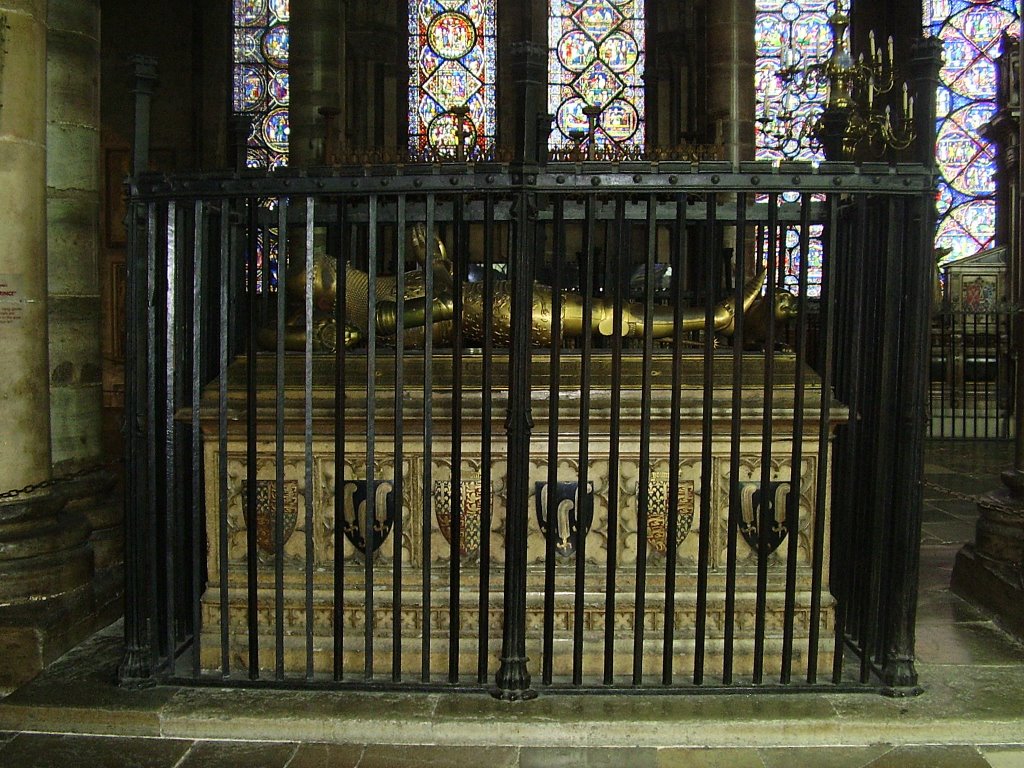 Canterbury Cathedral was one of those "must visit" places for me when I knew I was coming to the UK study. When I was in college at Holy Cross, I had the good fortune to take a number of excellent Medieval History classes with two professors in particular who had seen literally everything Medieval in western Europe and beyond (or at least it seemed they had). They both used a whole host of slides to show the places they were describing, and both of them covered Canterbury Cathedral at different times in different courses. It was hard for me to get a picture in my head of how it was placed or what it really looked like inside, but all of that was easily straightened out by my own visit there.
All Cathedrals have their assortment of famous dead people in them. You never quite know who you are going to find until you get there, and then when you see the tombs, your first thought is always "oh, yeah, I remember that guy...". The most impressive collection of dead folks must be in Westminster Cathedral, where, of course, you can't take any pictures. In Canterbury, I came across the tomb of Edward III's son, the Black Prince. Apparently, he was either a rather humble guy or he just didn't want hundreds of people to gawk at him after he died, so he requested to be buried in the crypt underneath the cathedral building. The monks thought this was improper for a man of his status and reputation, so they put him here, on the north side towards the back, and next to the shrine of Thomas Becket. His colored shirt of armor, his gloves, and his sword were never stolen (unlike other grave goods, especially in the Reformation), and they are on display on the wall nearby while reproductions of the originals are hanging above the tomb. Even Oliver Cromwell, Puritan extraordinaire, respected the Black Prince enough to carry his sword in battle against the Royalists.
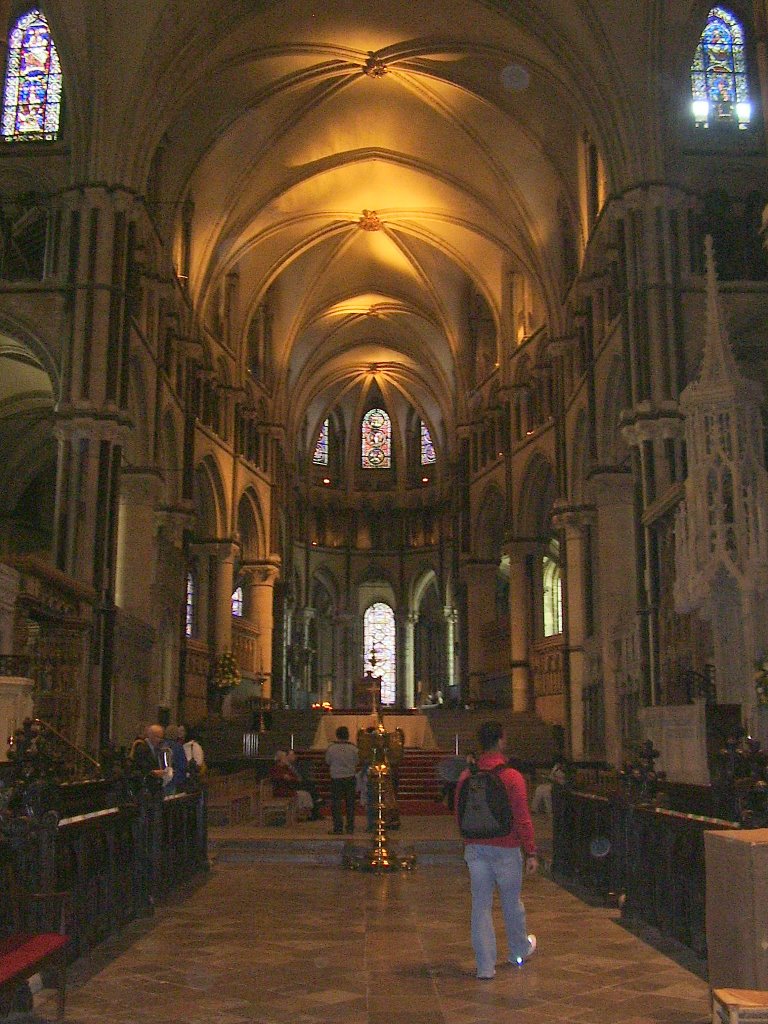 The inside of the cathedral is rather impressive, as are all of them. Lots of arches, columns, and windows. This Cathedral can get a little dark inside, especially behind the altar here where the choir stalls are. A lot of the columns here, instead of the huge Norman versions in Durham and Norwich, are lighter, sometimes trefoiled, and in many cases, made of smooth marble. This interior space is behind a very large, carved stone screen, which served to separate the laity from the activities of the monks and priests.
The outside of the cathedral was a little difficult to get a full look at because it was obscured by a set of buildings right in front of it (unlike York, whick exists almost on its own in the middle of a square, and the front is viewable for several blocks). Like Norwich, the cathedral is behind a set of gates and is very much like part of a complex. The towers are very ornately done and unlike York, the statues by the doors at the front and sides under the towers are still there today (in York, they have been removed and some are in the museum) but they have certainly been repaired or replaced in one form or another. However, it is pretty impressive to walk around. Like Norwich, there is a cloister attached to it, but there is additional evidence of different monastic buildings that have been left to ruin. The limits of the complex were bordered by walls, which may have also been the case at one time in Norwich, too, but they no longer exist there.
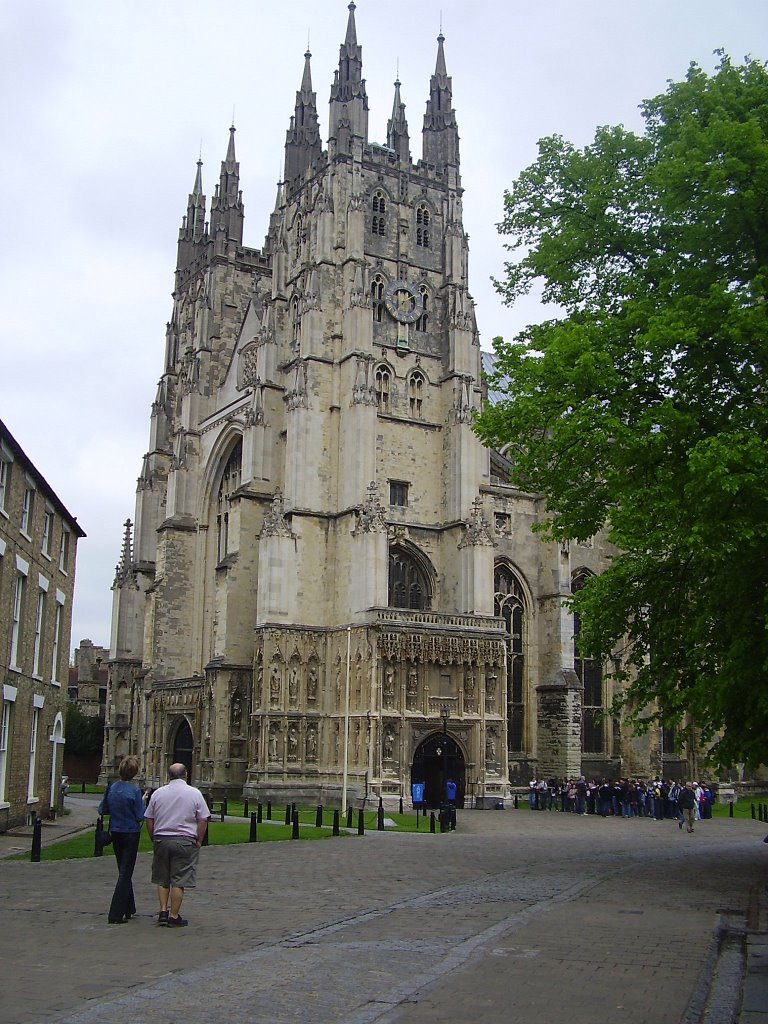
The biggest point of interest at Canterbury is, of course, the shrine of Thomas Becket. Becket had apparently been rather close to Henry II before being appointed, through this friendship, Archbishop of Canterbury. The biggest point of disagreement between them had to do with the prosecution of churchmen. Prior to this time (the mid 12th century), there was a separate law for offending churchmen that was notoriously lax in punishing offenders. Becket sought to preserve this right and tradition while Henry wanted members of the clergy to be prosecuted according to secular law. Henry presented his demands in the Constitutions of Clarendon, which Becket refused to sign. Becket, regardless of his friendship with the king, did not back down on the issue, which led to all sorts of complications for Henry. At one point, Becket was exiled (or willingly exiled himself), and he had a host of well known and well schooled supporters amongst the English and others, such as John of Salisbury, his student and aid.
Unfortunately for Becket, regardless of his return to England, his vigilance to his cause was the author of his end. Famously, Henry was said to have exclaimed in frustration "Will no one rid me of this meddlesome priest?!" which prompted four of his knights to launch an assasination attempt on Becket. They killed him in the entrance to the quire in the Cathedral at the celebration of vespers on December 29, 1170, apparently giving him a blow to the head to finish the act (this is the best source for the description of his murder). He was cannonized quickly, in 1173.
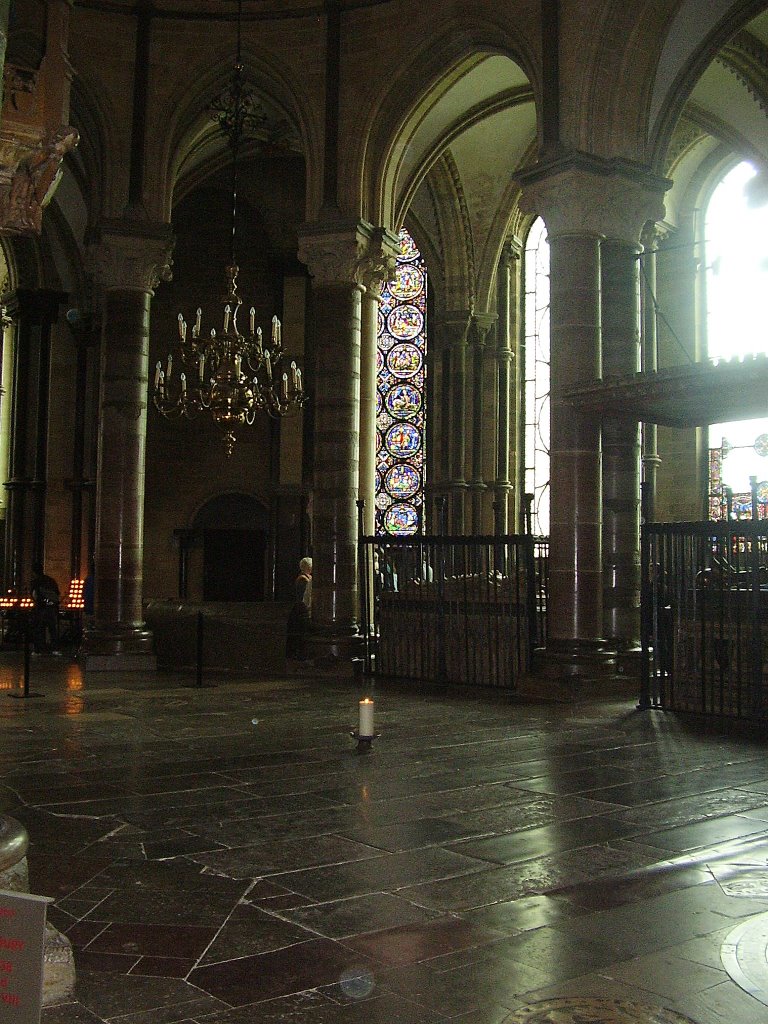 There isn't anything left of his shrine or relics today. Henry VIII took everything, along with the treasures associated with them, during the dissolution of the monasteries in the 16th century. Today, as you can see, there is a single lit candle where the shrine once stood on the marble floor panels at the back of the cathedral. The simplicity is actually surprisingly impressive--maybe even more so than the ornate elements that no longer exist. It's quiet and completely blocked off from immediate access. Even the floor is amazing--the smooth marble tiles are all colored and inlaid. The light from the windows also adds to the effect. The back of the cathedral arches around in a semi-circle, with more accessible windows--meaning windows at the level of the viewers--than anywhere else in the cathedral.
The stained glass windows themselves are also a very unique element in Canterbury Cathedral. My own photograph does not do it justice, but the picture you see here of the window is what is called the "Donor's Window" or the window illustrating those guilds that donated either labor or money to the creation of different parts of the Cathedral. Each circle shows a different trade-in-motion. In fact, in the picture of the Becket shrine above, you can see the "Donor's Window" straight ahead, immediately behind the candle at the back. To see a layout of some of the cathedral windows and what they depict, this is a good resource, but unfortunately pictureless. For some other details, but without an in depth description, try this, these pilgrims, and this miracle.

Unlike in other Cathedrals, or churches for that matter, there is a lot of original stained glass at Canterbury. It's one of the few places that retains it after the zealous English turnover to Protestantism. It isn't all in tact, however. There are a few places here and there where the panes are all clear or partially clear--notably parts of some of the larger windows in the trancepts, for example--in fact one of the trancepts has mostly new windows with the other has bands of 14th and 15th century windows with clear panes between them. Again, it is at the back where Becket's shrine is where you can really get up close to the original stained glass. Most of the windows have themes. There are two that tell the story of Becket's life and martyrdom and another window dedicated to the miracles associated with his influence after his death. As I mentioned above, the donors are also featured in their own window. Some of it has been restored, naturally, but without adulterating the original form or figures. In some of the other pictures above, you can see peeks of the other stained glass windows, and it really gives you a feel for what the other cathedrals in England would have looked like in their hayday. Today, most of them are clear, which makes the cathedrals brighter, but it is deceiving to the historical eye.
I wasn't in Canterbury for long--it was a stop on the train on the way to Dover where I was staying overnight. However, when I did see it, I was very disappointed that I hadn't planned to stay there. It is very much like York in how it is mainly a walking city dominated by a large Cathedral, but smaller than Norwich. I did also get to see the city walls, many of which are still in tact on the south side of the city, and St. Augustine's which is outside of the city, and apparently, the first church in England. St. Augustine's, which is a ruin today, would have been a smaller version of Canterbury Cathedral, but it has a history that goes back much farther, which makes it disappointing to see the state it is in. St. Augustine himself was buried there at one time, but his, like Becket's, relics were removed by Henry VIII. However, other figures mentioned in Bede, notably the bishops that followed Augustine, are all buried there in a section that has maintained it's Anglo-Saxon feel. There are also four of the kings of Kent also buried there, and many other figures that were significant to the history of the abbey. The audio tour there is absolutely fantastic and very informative.
I would certainly like to return to Canterbury for a longer stay. It is hard for me to rate it first, because my stay was so short, and second, because it was your typical cloudy, rainy (maybe the adjective "English" is best here....) day there. I will give it a 7 and 1/2 with the potential for an upgrade if I make it back there and if the weather is cooperating.
Saturday, May 20, 2006
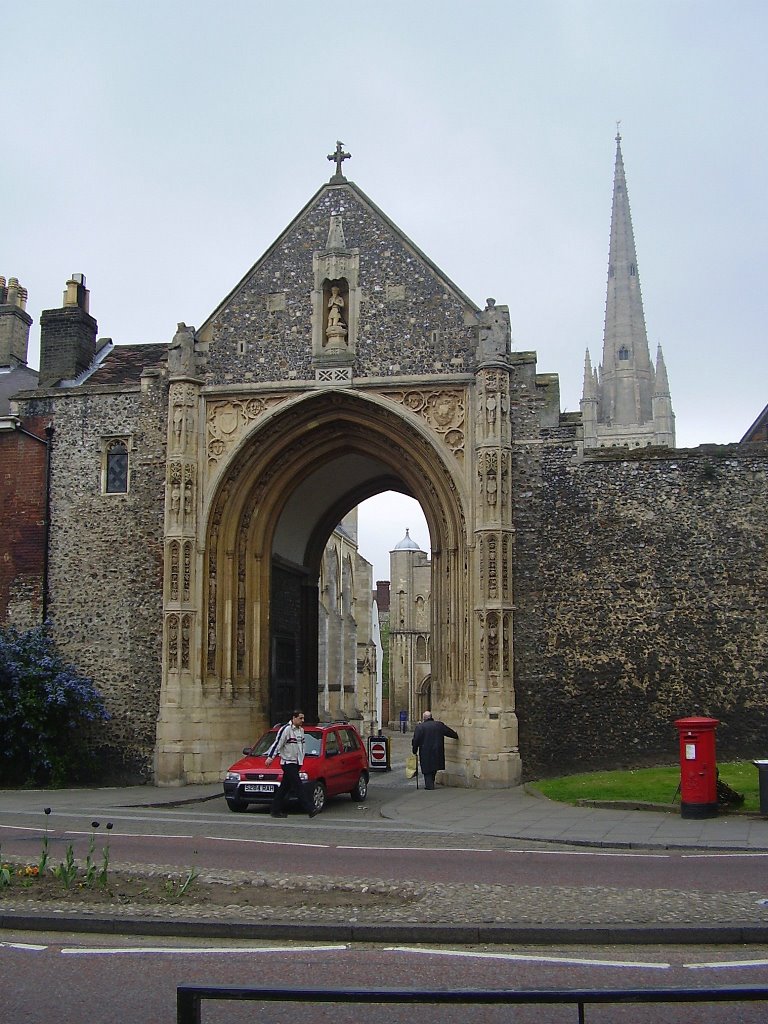 My second destination on my little travel excursion was the city of Norwich. I always wanted to see it, and I was not disappointed in my stay there. I got to see the coastline, which was a good thing, but I was rather tired of Great Yarmouth quickly, and I made my way to the train station (on a really bad side of town--worse than the rest of it) to try and catch an earlier train. Fortunately, there is consistant service from Norwich to Great Yarmouth and back all day long.
At first, I thought I was going to be disappointed by Norwich, too. The train station is outside of the city (in fact, it wasn't even on my town plan, which freaked me out at the beginning), and subsequently, not in the best of areas. When I arrived, it was just after school had ended and apparently a lot of students come from neighboring towns on the same line I was riding, which meant quite a hastle and the need to pull out my 'footballer'-like skills just to exit the train.
The hotel wasn't too far away, thankfully, and in a 'central' location--it isn't in the center of town, per say, but it is right by the Cathedral. The gateway with the tower behind it was right outside my hotel. Of course, those people had to park illegally in their Fawlty-Towers-style car before I took the picture, but so be it. The Cathedral was more of a complex--parts of the area within the gates had been updated, but you could distinguish between the buildings that were contemporary to it and those that had been added later or rebuilt. The area is called Tombland, apparently, and is one of the nicer, more historical, sides of town.

In addition to the Cathedral, there are 32 existing "parish" churches in Norwich. In their hayday, there used to be 61. Most of them are built in the usual "gravel" method, using smaller stones framed in something more substancial. All of them have some kind of bell tower on them. The tower you see here belongs to St. Andrew's which was nearby where I was staying in town. The reason I sought out this one in particular actually had to do with my previous job. The "congregation" of "pilgrims"--or the more religious sorts among them--were all minstered by one John Robinson. Robinson, before being ousted due to his "reformist" beliefs in the early 17th century, was a minister of the Church of England in Norwich, and this was his parish. The whole time I stayed in Norwich, this church was closed (hence the bright yellow sign on the doors). I returned several times there to no avail. However, I did explore the interiors of a number of other, similar parish churches nearby to get an idea of what it may look like inside. Behind it is the Bridewell museum, which is a smaller establishment that focuses on the manufacturing history of Norwich. It is very much like looking at the Lowell mills in Massachusetts, but with several types of exployments rather than just one. Regardless of some failed manufacturing trades, the city, unlike American cities on the east coast, is not dotted with large, hollow, empty brick mill buildings (New England could certainly take a hint).

One of the first things I did when I got to Norwich, regardless of my being exhausted having treked all around Great Yarmouth with my luggage before arriving, was take a walk around the city. There is a huge, mostly outdoor, shopping center there that is in the same place the markets were hundreds of years previously. In the middle of the market, going up a hill, is St. Peter Mancroft church--the outdoor archway is photographed here. According to information in the Bridewell Museum, the cattle market existed just outside of here at one point. In front of it is one of the BBC buildings and off to the right is the main courthouse. It really borders on the upper end of the center of town. Again, I was unable to go inside and take a look--this time due to a late afternoon arrival and the Sunday service on the following day. The original building was Norman, but it was rebuilt and reconsecrated in the 15th century, so that is the style you see here. It really is the largest of the "parish" churches in Norwich--built in the same syle, but approaching more "cathedral-like" architecture.
I saved my trip inside the Cathedral until last given it was on the way to the train station (at that point, I was hoping it was, and I turned out to be right--no thanks to the stupid map I was carrying. It is another Norman foundation--very Romanesque in style but moving in the Gothic direction.
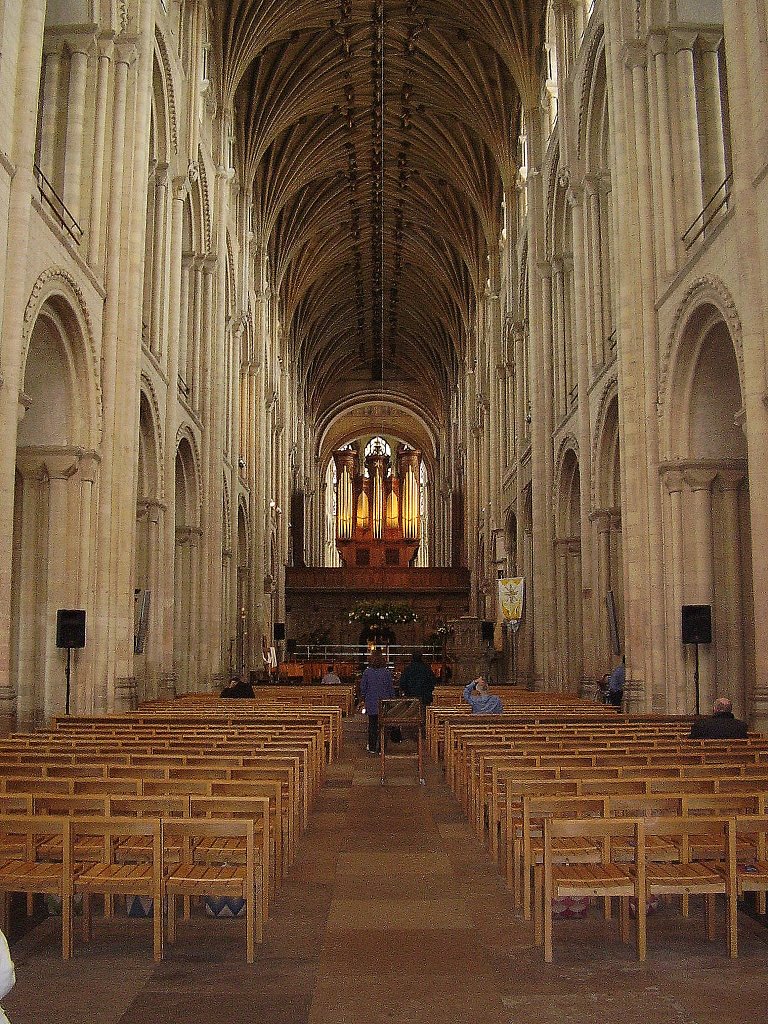
You can see the inside of it here. I got there right when they were about to begin Evensong services, so I didn't get to go around as much as I would have liked. It certainly looks Norman--round, decorated arches and heavy pillars, but you can see the more complicated ribbing on the ceiling, which is more Gothic in style. It is also much lighter--unlike Durham, which is Romanesque through and through, Norwich, with its incorporation of Gothic techniques, takes on a slightly lighter feel. At the back is the organ, which obscures the view all the way down the nave. There is a cloister attached, too, and a few ruins of other parts of the monastery as well as a hospital. The tower is rather distinctive at Norwich, which is probably an identification point for more experienced cathedral-goers than myself.
One thing that I was impressed by was how the Castle dominated the landscape. It is on top of a hill across from the market, so would have been right in the center of town. The Castle was my first stop when I did tour the museums, and I wasn't disappointed. It is an art/archaeologial museum as well as a historical building in its own right. The Castle on the hill gave a great view of the city. I was fortunate enough to choose to take a tour of the prison vaults, which are inside the hill more or less, and had a fabulous tour guide who knew a lot about the city as well as the Castle. She showed me the vaults, explained their use over time, she knew the practices and what the Castle represented in the city itself over time. I was
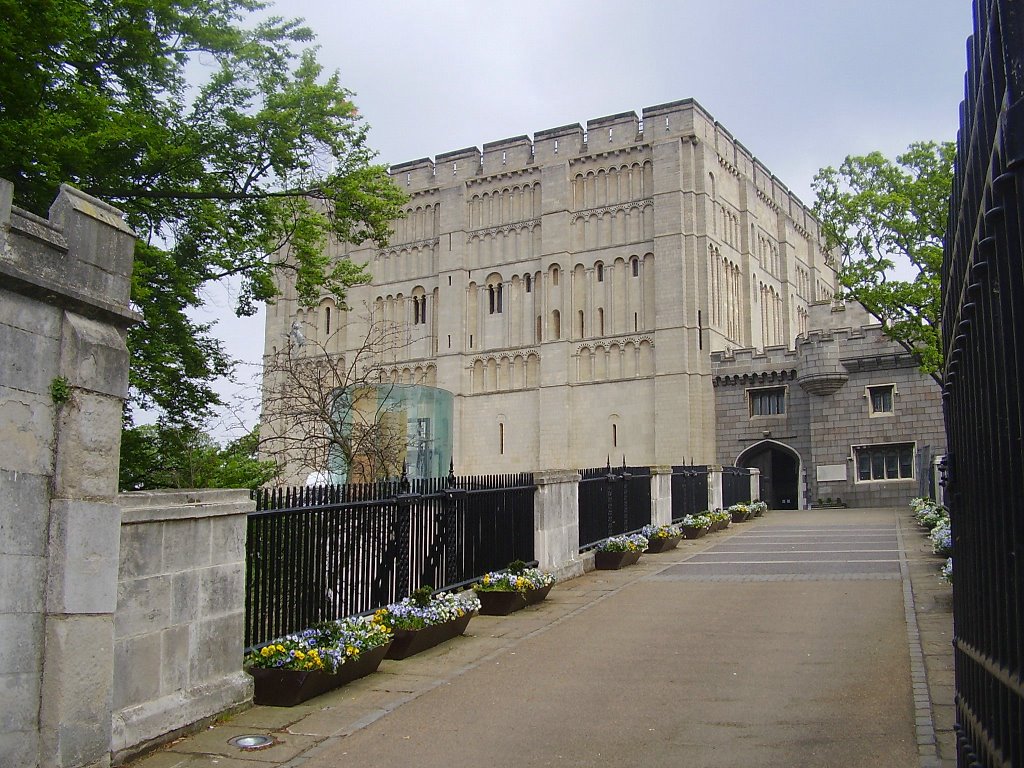
more than impressed, and was fortunate enough to be the only person on the tour with her. The inside of the building you see pictured was used to house the "common criminal"--debtors, thieves, and the like--and they had a sort of "community" inside the walls there. Before that, it had been a Norman palace, but over time, the Castle was turned over to the city and upon that change of hands, it became a prison. This view is from the bridge crossing over to the Castle, and apparently in the Early Modern period, on Saturdays at noon, there would be an execution--or more than one execution--there. Those that were executed didn't stay in the prison "community," but were instead relegated to the vaults underneath the Castle. Later on, the Castle's prisoners became the subjects of phrenologers who made their death masks and explored the bumps on their head to try and determine if any signalled they would become criminals. In the nineteenth century, it became a museum, as it is today.
Accomodations here very much outclassed those in Great Yarmouth. I stayed in the Maids Head Hotel, which is a 13th century establishment added to and built upon over time. It was a great place--very clean, very nice rooms, and fairly affordable. It was right by the gateway to the Cathedral and the market wasn't a long walk away. I greatly enjoyed my stay there.
So, Norwich earns itself an 8 and 1/2, putting it in the lead over Durham, York, and Great Yarmouth at present. Let's see if it maintains that lead...
Tuesday, May 16, 2006
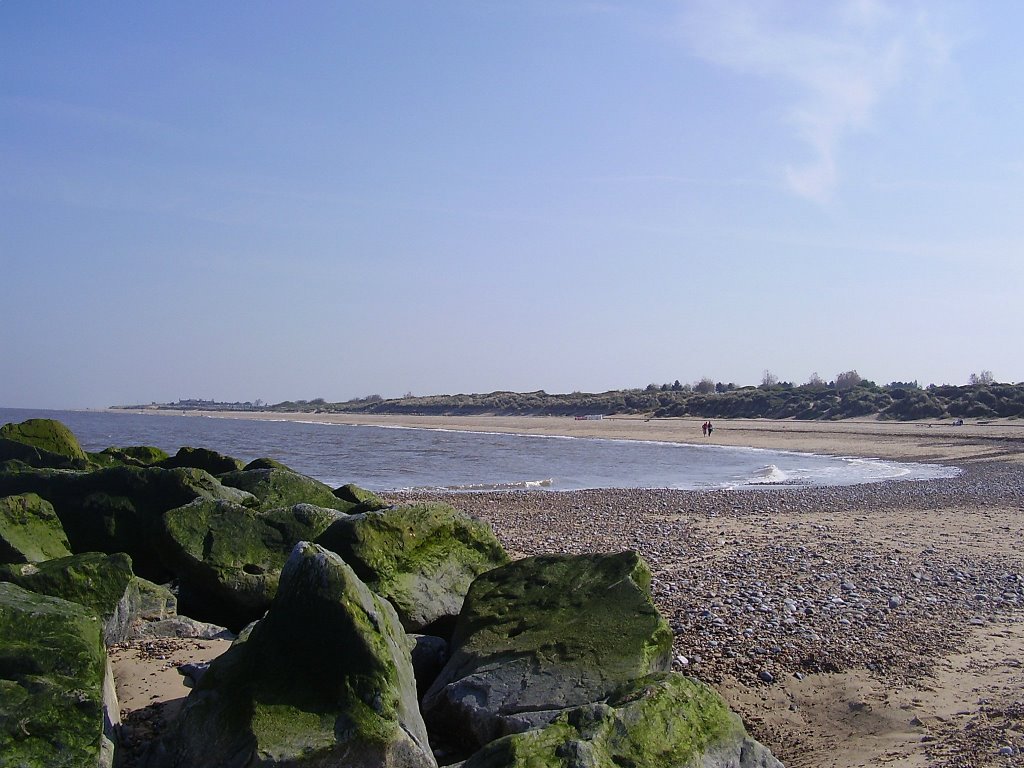 I'm home again after a trip across southeast England. I started in Great Yarmouth.
Great Yarmouth certainly defies its adjective--lacking in "Greatness" in any capacity. It's not much of a place for history-oriented people, but even though the history isn't readily apparent, that doesn't mean that there isn't any at all.
The shore itself is nice. Once you get past the tacky fun-parks and gambling establishments, you can walk for miles down the beach. I found that in comparison to New England beaches, the sand was far more glassy and there were an abundance of rocks smoothed over by the tide. It surprised me just how quiet the walk was--only a few other people, residents I suspect, were taking advantage of the nice weather and the beautiful scenery. Something I didn't know before arriving was the existence of a wind farm on the water. There is a controversy on Cape Cod over the installation of a similar wind farm off the coast in the Nantucket direction--apparently this will "wreck the view out there." Frankly, the wind farm was quiet and graceful--certainly the only power-generating system I have ever seen that is easy on the eyes.
 On my second day, I took a walk around the town to get a look around. I came across the local parish church, St. Nicholas. It's kind of a Victorian "re-do" of the Norman Church. When you go inside, the arches are original, but the walls have clearly been rebuilt around them. It also "said something" that the nicest place in the whole town was the cemetery that spread out from the "nucleus" that is the churchyard. It was very quiet and well kept given that a huge town effort is focused on the maintenance of it. At least if you keel over while playing at a slot machine, you first, won't have far to go, and second, you'll be on a quality piece of real estate.
I was walking around on the "Quay"--and I have no idea what that means even though I am from a coastal area originally myself. I actually had stayed on the Quay, which is by the River Yare (on the other side of the town from the coast), but I didn't actually stroll down the street until after I made my seaside stop.
 When I did, I came across a ruin of a Greyfriar's Abbey. It wasn't visible from the road at all. I turned down a side alley and literally walked into it while I was inevitably getting myself lost. Anyway, it would have been outside of the city proper in its time--about fourteenth century or so. The picture of the brick structure with what looks like a chimney protruding out of it is the ruin. On the other side you can see the arches a little better. It isn't very big, but you can still get a sense of the turns and almost tunnel-like network of rooms that would have existed there when it was a whole building.
It may sound odd, but one of the most interesting features of the town was the remains of the town wall. There isn't much of it around, but every now and then, you'll look at a row of houses and spot the tell-tale arches or tower remains. Apparently most of it came down in the 1840s, but there are still sections around. There is a whole section still existing in the graveyard with a very cool tower at the end of it. I was walking down a street, desperate for the Sainsbury's nearby, when I turned and saw the tower you see in the picture sticking out from a bunch of commercial buildings across the street. The curious thing about it was the direction it faced in--it was facing to the water. Today, the majority of the town is apparently outside of where the original town would have been encompassed by the old wall.
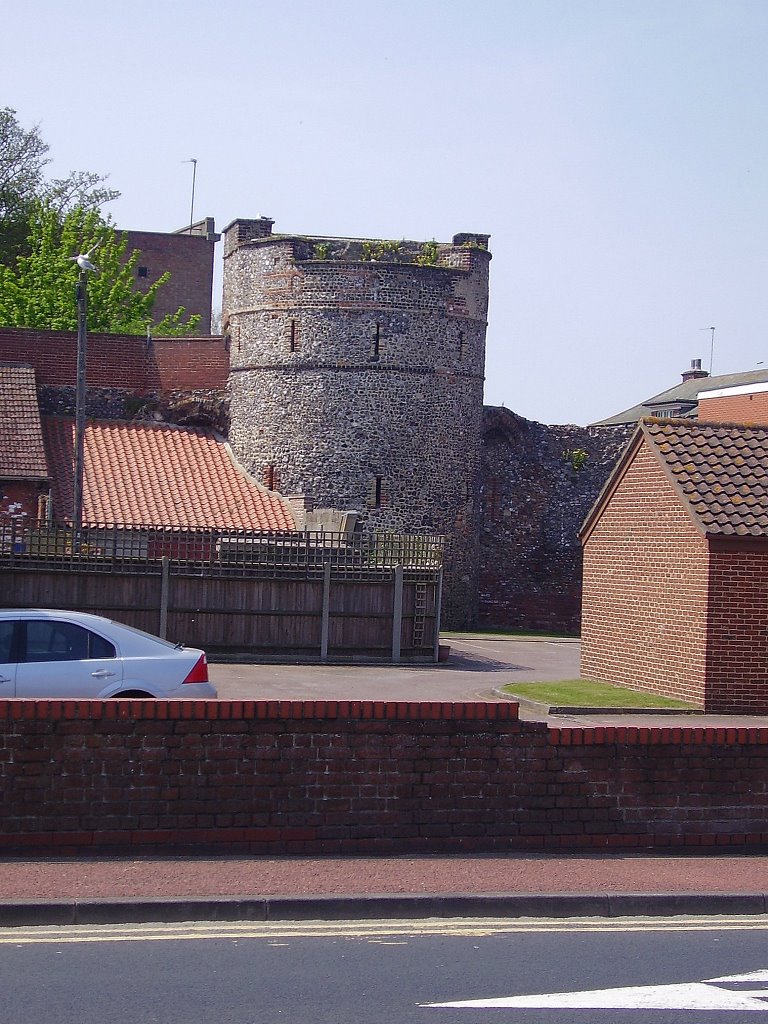
Well, the trip was worth stopping there for a day, but I certainly wouldn't recommend actually travelling there for a prolonged period of time. The few things I managed to capture is the city's history--and that's all there is. The rest of the waterfront looks like a British version of Atlantic City that is even more tacky. I visited in the "off-season" so I can only imagine what it is like down there during the summer. It is windy down there--putting the wind farm to good use, of course, but that makes it hard to sit for a long time by the water. I noticed a lot of the "in the know" folks had these odd reems of tarp that they posted in the ground around where they intended to sit in the direction of the wind to block it.
One final note--I stayed in a place called the Star Hotel. It wasn't that far from the train station, which was an advantage for me. However, I was reminded of the "Royal Imperial Windsor Arms" from the movie "National Lampoon's European Vacation." If you don't know what I am talking about, the movie is well worth watching. At any rate, for those of you who do, I got two TV channels, one of which was a 24 hour run of news (the "Cheese Show"), I got no hot water from the shower head, but I got as much of it as I wanted to take a bath (sans whistling robed stranger), to make the toilet flush, I had to hold down the weight inside of the back of the bowl (that has no specific equivalent, but is just typical), and the bed, a "double" was actually two single beds put together.
 Thus far, Durham will get 7 points out of ten, York gets 5, and Great Yarmouth will get 3 and a half.
On to the next location...
Sunday, May 07, 2006
Letter to my Former Self
Dear "Former" Self:
The unfortunate thing about this letter is that you won't get a chance to read it. However, that does not defeat the purpose of this, my "Present" Self, composing it.
I know school is a pain in the ass. All subjects like Math and math-related Sciences seem to do is bring your overall grade down. And I know you look at your friends who can perform just as well in those subjects as the liberal arts and ask why you can't do that, too. Well, I don't have an answer to that question, but I can tell you that your seeming "deficiency" in those subjects didn't hold you back in the long run. Even when you got older, you still wished you could work out an equation with some reasonable assurance that it was somewhat right, but other than the GRE exam, you won't need to see those odd symbols, parabolas, sines and cosines again. Your staying up late nights doing all of your homework, reading and studying for those AP exams will pay off--in the long run you will be able to do what you can only imagine "in theory" right now: you will be able to go to the school that you choose as the best option for you, if not quite for what you expect at first.
There will never be a time when your parents aren't looking over your shoulder. What you will learn is that it is better to make it easier for them to do that. They'll never admit to you that they were more strict with you than with your siblings, no matter what you do, so just keep that knowledge to yourself. It won't get better, either--you'll see what your siblings will be able to get away with, things you would have been grounded for ages for, and you'll immediately feel the injustice of that. You'll hide that well, though. The only thing I can say is that as you get older, you realize that your parents are human, too. They made mistakes and they had to learn how to be "parents" just like you learn how to do anything else in this life. You will have to admit, though, that their strict upbringing impressed upon you the ability to choose well between right and wrong. Had they been more lax, well, you probably wouldn't have turned out as well.
Your parents will never like any of the guys you bring home--you may as well know that right now. It's true, some of your choices won't be very good, but it is impossible not to throw into the mix the fact that you are the oldest and that it is harder for them to part with you in some ways, especially your father. However, on the other hand, they will always be accepting of your friends, no matter who they are. You are going to realize that you tend to stay in relationships too long, especially when you feel like you don't have any other dating options waiting for you if you were to end what you are a part of. As you move from place to place, school to school, and job to job, your experiences will impress upon you that there are two classifications of things in life: things that are meant to stay with you and things that aren't meant to last. Once you learn this, you will be more and more able to distinguish between them. You will go through a process where you will have to do what you know inside of you that you need to do--you need to go it alone to be able to learn what "you" is. When that happens, it won't matter if you're on your own or not anymore. And, it won't be as scarey as you think. In the end, you will be content with your own company and more comfortable with yourself. Both of these results will help you build better, longer-standing and more stable relationships of all kinds in the future.
Secrets you'll have to admit to yourself:
You're a romantic. Just live with it.
You can throw a ball as well as any guy--don't let them tell you otherwise.
You'll always be a "big sister" no matter where you are or how old your siblings get.
The Indigo Girls will save your life more than once.
Relationships aren't always what you think they are, and love is going to defy conventions for you.
You'll always want to do dozens of things with your life. Narrowing that down is not necessarily a good thing.
Above all, relax. When you do that, you will invite more people to you. You're going to have to learn openness, and thankfully you will, but not without a lot of help. That means not shutting anyone out who has something to offer--and that means everyone.
Until your "Future" self comes along,
Your "Present" Self
The unfortunate thing about this letter is that you won't get a chance to read it. However, that does not defeat the purpose of this, my "Present" Self, composing it.
I know school is a pain in the ass. All subjects like Math and math-related Sciences seem to do is bring your overall grade down. And I know you look at your friends who can perform just as well in those subjects as the liberal arts and ask why you can't do that, too. Well, I don't have an answer to that question, but I can tell you that your seeming "deficiency" in those subjects didn't hold you back in the long run. Even when you got older, you still wished you could work out an equation with some reasonable assurance that it was somewhat right, but other than the GRE exam, you won't need to see those odd symbols, parabolas, sines and cosines again. Your staying up late nights doing all of your homework, reading and studying for those AP exams will pay off--in the long run you will be able to do what you can only imagine "in theory" right now: you will be able to go to the school that you choose as the best option for you, if not quite for what you expect at first.
There will never be a time when your parents aren't looking over your shoulder. What you will learn is that it is better to make it easier for them to do that. They'll never admit to you that they were more strict with you than with your siblings, no matter what you do, so just keep that knowledge to yourself. It won't get better, either--you'll see what your siblings will be able to get away with, things you would have been grounded for ages for, and you'll immediately feel the injustice of that. You'll hide that well, though. The only thing I can say is that as you get older, you realize that your parents are human, too. They made mistakes and they had to learn how to be "parents" just like you learn how to do anything else in this life. You will have to admit, though, that their strict upbringing impressed upon you the ability to choose well between right and wrong. Had they been more lax, well, you probably wouldn't have turned out as well.
Your parents will never like any of the guys you bring home--you may as well know that right now. It's true, some of your choices won't be very good, but it is impossible not to throw into the mix the fact that you are the oldest and that it is harder for them to part with you in some ways, especially your father. However, on the other hand, they will always be accepting of your friends, no matter who they are. You are going to realize that you tend to stay in relationships too long, especially when you feel like you don't have any other dating options waiting for you if you were to end what you are a part of. As you move from place to place, school to school, and job to job, your experiences will impress upon you that there are two classifications of things in life: things that are meant to stay with you and things that aren't meant to last. Once you learn this, you will be more and more able to distinguish between them. You will go through a process where you will have to do what you know inside of you that you need to do--you need to go it alone to be able to learn what "you" is. When that happens, it won't matter if you're on your own or not anymore. And, it won't be as scarey as you think. In the end, you will be content with your own company and more comfortable with yourself. Both of these results will help you build better, longer-standing and more stable relationships of all kinds in the future.
Secrets you'll have to admit to yourself:
You're a romantic. Just live with it.
You can throw a ball as well as any guy--don't let them tell you otherwise.
You'll always be a "big sister" no matter where you are or how old your siblings get.
The Indigo Girls will save your life more than once.
Relationships aren't always what you think they are, and love is going to defy conventions for you.
You'll always want to do dozens of things with your life. Narrowing that down is not necessarily a good thing.
Above all, relax. When you do that, you will invite more people to you. You're going to have to learn openness, and thankfully you will, but not without a lot of help. That means not shutting anyone out who has something to offer--and that means everyone.
Until your "Future" self comes along,
Your "Present" Self
Wednesday, May 03, 2006
Visit to Durham
 At the beginning of this week, I went to Durham. This is the first time I have ever been out there, regardless of having been accepted to the University there. I considered that offer first, actually, before I ended up at York. Therefore, I was all the more curious to see the place.
The "city" is built on a hill overlooking the River Wear, but unlike York and the Ouse, the surroundings have maintained a certain natural beauty, probably because of the high embankments as opposed to the low, flat lands that surround the river in York.
The first picture here is a view of the countryside from the top of Durham Cathedral. Lots and lots of narrow steps, twisting around in a circle, but once you get up there, as you can see for yourself it is certainly worth it. I liked this side because of the green fields you can see on the hill.
 Here is the Castle, which is right next to the Cathedral on the top of the hill. Today, it is actually a part of the University, and there are students who get to live in the keep here. I went on a tour guided by a history student, and the University seems to be a lot more formal than the University of York--it's been around longer, so kind of maintains some old traditions, like formal meals and surprisingly to me, a lot of student religious services. The best part, which you can't see here, was this incredible old Normal Chapel that was walled up about fifty years into the life of the first castle, and then rediscovered in the 19th century as completely in tact as time would allow. It was made of sandstone, so the interor was brownish in color, almost marble-like. It was also very dark, and you could see just how thick the walls really were--about six feet. We didn't get to see the inside of the keep here because of the student accomodations, unfortunately. The main buildings of the castles are actually off to the left beyond a Victorian reconstruction of a medieval gate system.
This is a view of the Cathedral, but you can only see this side if you stand on the other side of the river, which puts you at a rather low angle. It is Romanesque, which makes its architecture rather large and clunky, but certainly Norman in style. The columns on the inside are huge and the archways are rounded. There are a lot of windows in the towers that you can see here, but not so many along the sides of the building--not like the large, spacious Gothic style windows that make Gothic cathedrals feel so much lighter. The key features of the Cathedral, however, are the tombs of St. Cuthbert and Bede. Bede gets a box to himself on this side of the building inside a chapel. Apparently, his bones were stolen from Jarrow by the monks at Durham in the 11th century. Go figure. Anyway, St. Cuthbert was also "moved" here, but his tomb is more like a shrine on the other side of the cathedral. He is buried on an upper "level" beneath the floor there. There is also an exhibit that they called "The Treasures of St. Cuthbert," which was rather misleading because I thought it meant that there was more from his burial that was going to be on display. Instead, most of it, although impressive, was just comprised of some of the Cathedral's artifacts, like seals, manuscripts, and vestments. However, there were a few things that were specifically Cuthbert-oriented, such as a cross with a garnet inlaid in the middle--found on his body even though the majority of his treasures had been pillaged years before. There were also fragments of some kind of Byzantine cloth that covered his remains and a once silver covered portable altar. Most impressive was his coffin, wooden, original, and carved by the Anglo-Saxons with pictures of the apostles. It was in fragments, but the museum had put it back together so you could see it as it would have looked in box-form. It was a great visit, and a very impressive place (and very tiring given the 250 stairs to the tower).

This is a view from one of the bridges over the River Wear. In the distance is another bridge--a footbridge--that allows you access to the level the Cathedral and Castle are on. It was the usual cloudy British day, but regardless, you really can see how beautiful it is there with all the trees--in fact, I think this is the largest concentration of trees I had seen to date in England. I took a walk on the right side of the river along a footpath there, and it was fantastic. I followed it past that bridge to another one around that corner of trees you see back there.
Although Durham is small--smaller than York, I really liked the city. If I had been a more efficient planner, I would have stopped in Newcastle first--only another 25 minutes up the road by train, and then stopped by Durham on the way home to York so I could have seen both places, but it gives me an excuse to hop off the train again and see this place under perhaps some more sunny skies. It was definitely worth seeing.
Well, thank you, Cuthbert and Bede, for showing me your final resting place. It may not have been your first, but hey, you could definitely find a worse one for your last.
Monday, May 01, 2006
Number Two: Emily
This is Emily.

Emily is Anne's sister, and my sweetest baby. She is smaller than her sisters--they are both longer, especially their necks, while Emily is a rather compact little thing. She is also oddly colored, as you can see. My father refers to her as having "calico ends" in the fur on her head, tail and paws, but nowhere else.
At first, she got into everything. I think she believed her name was "No!" when she was little. However, she had such a way about her that under almost any circumstances, she was able to "make friends" (this discounts Phoebe). She did this first with my roommate's cat--a huge Maine Coon named Geronimo who had the brain of a rugby player. As soon as she saw him, she nuzzled right into the bib of long fur under his chin, and he was hooked.
Her favorite friend, however, is Harriet. Harriet, who is notoriously difficult to get along with, has taken to Emily, and tolerates her company in ways she does with no one else, feline or otherwise. Harriet suffered from a glucose crash a few years ago, and she couldn't see or move for about a week while she recovered. We kept her in a laundry basket, lying on a blanket, and always put that basket where there was plenty of human and cat company. One night, Harriet was sitting there, sprawled out, at least partially blind, and Emily, perked up with a tiny mew, jumped right into the basket and sat with her. This action met with mutual purrs from both of them.
Emily expresses joy by rolling all over the floor when you pass by her. She'll purr whenever she meets up with anyone who may offer her some attention, and she was the only of my cats to like my last boyfriend, Matt.
Perhaps her sisters could take a lesson from her kindness....
Perhaps we all could.
Emily is Anne's sister, and my sweetest baby. She is smaller than her sisters--they are both longer, especially their necks, while Emily is a rather compact little thing. She is also oddly colored, as you can see. My father refers to her as having "calico ends" in the fur on her head, tail and paws, but nowhere else.
At first, she got into everything. I think she believed her name was "No!" when she was little. However, she had such a way about her that under almost any circumstances, she was able to "make friends" (this discounts Phoebe). She did this first with my roommate's cat--a huge Maine Coon named Geronimo who had the brain of a rugby player. As soon as she saw him, she nuzzled right into the bib of long fur under his chin, and he was hooked.
Her favorite friend, however, is Harriet. Harriet, who is notoriously difficult to get along with, has taken to Emily, and tolerates her company in ways she does with no one else, feline or otherwise. Harriet suffered from a glucose crash a few years ago, and she couldn't see or move for about a week while she recovered. We kept her in a laundry basket, lying on a blanket, and always put that basket where there was plenty of human and cat company. One night, Harriet was sitting there, sprawled out, at least partially blind, and Emily, perked up with a tiny mew, jumped right into the basket and sat with her. This action met with mutual purrs from both of them.
Emily expresses joy by rolling all over the floor when you pass by her. She'll purr whenever she meets up with anyone who may offer her some attention, and she was the only of my cats to like my last boyfriend, Matt.
Perhaps her sisters could take a lesson from her kindness....
Perhaps we all could.

Subscribe to:
Posts (Atom)
